
Peru’s Presidential Runoff Could Swing the Country to the Right: What to Know
Peruvians will vote on Sunday in a presidential runoff after a chaotic first round that took weeks to resolve because of logistical failures and unproven fraud accusations that triggered widespread outrage.
The two ideologically opposed finalists won less than 30 percent of the initial vote combined, and recent polling showed them deadlocked as they compete for a significant middle ground of undecided voters.
The race comes as an anti-incumbent wave shifts Latin America toward right-wing, law-and-order governments, a trend that has already transformed the leadership in Argentina, Bolivia and Ecuador. With upcoming elections in Brazil and Colombia — where a tough-on-crime conservative outsider recently won the first round — Sunday’s vote will determine whether Peru becomes the next nation to swing to the right.
Who are the top candidates?
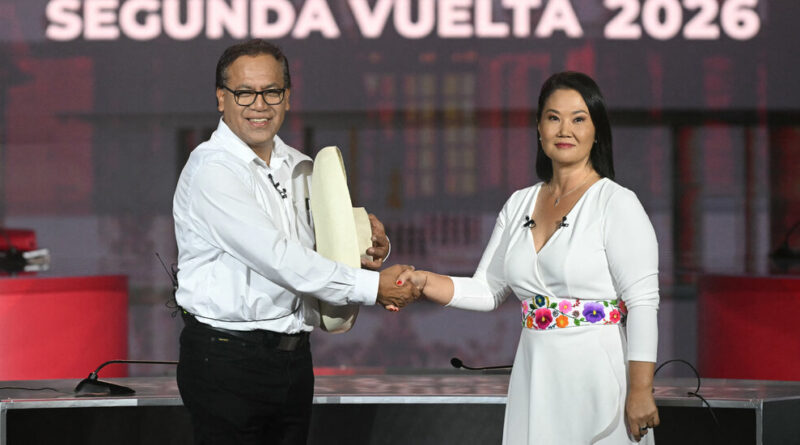
The race pits Keiko Fujimori, a conservative, against Roberto Sánchez, a leftist lawmaker and political heir to the jailed former President Pedro Castillo. Ms. Fujimori’s father was Peru’s authoritarian president Alberto Fujimori, who was credited with dismantling brutal leftist rebel groups, but at the cost of unraveling the country’s democracy.
Mr. Sánchez spent the campaign’s final weeks pivoting toward the center as he sought to court undecided moderates. Backed by a new team of center-left technical advisers, he has promised to maintain fiscally responsible policies, protect private property and preserve the central bank’s autonomy.
Ms. Fujimori, by contrast, has been catering to her right-wing base as a tough-on-crime candidate and framing Mr. Sánchez as a communist would-be authoritarian who will torpedo private investment. Analysts say she is betting that worries over the economy will naturally win over moderates, while a hard-line stance ensures that her base turns out.
If Mr. Sánchez wins, he will face a hostile, right-wing-dominated Congress without the votes needed to block an impeachment, possibly dooming his presidency to the cycle of gridlock and turnover seen in recent years, said Mauricio Zavaleta, a political scientist at the University of Pittsburgh.
A victory by Ms. Fujimori, analysts say, would allow her to quickly consolidate power because her political coalition has already taken control of the legislature.
In recent years, Ms. Fujimori’s legislative bloc has appointed allies to the high court and state watchdogs, altered laws to favor Congress in legal battles, and used the constant threat of impeachment to keep the executive branch weak.
Backed by corporate elites, mainstream media and a projected one-third of the legislature, Ms. Fujimori would command the leverage to block any impeachment attempts. Critics say her presidency could lead to the erosion of democratic checks and balances and open the door to authoritarianism.
What are voters focused on?
The primary concerns driving Peruvian voters are a surge in violent crime and extortion, deep-seated anger over rampant government corruption, and a profound distrust of the country’s unstable political institutions.
Ms. Fujimori has made security the centerpiece of her campaign, leaning heavily on her father’s iron-fisted legacy and calling for military deployment to borders and prisons, as well as the expulsion of undocumented Venezuelan migrants who have surged into the country in recent years.
While Mr. Sánchez also favors deploying the military to help the police, his primary focus is raising the minimum wage, expanding welfare and pensions, subsidizing loans for informal workers, and cutting corporate tax exemptions. Though Mr. Sánchez has campaigned on a traditional left-wing promise to scrap the 1993 Constitution written during Mr. Fujimori’s tenure, analysts say he lacks the political capital to push such a change through.
Many people in Latin America have expressed support for the heavy-handed security tactics popularized by El Salvador’s president, Nayib Bukele, though critics contend that they have resulted in widespread human rights violations.
In Peru, the most hard-line candidates did poorly in the first round of voting. After years of ineffective states of emergency, voters are skeptical that harsh crackdowns will dismantle entrenched extortion networks, said Eduardo Dargent, a political analyst.
“It doesn’t become a highly effective campaign issue,” Mr. Dargent said. “It’s hard to believe that there will be huge changes quickly.”
In various Latin American nations, a tilt to the right has been driven in part by voters punishing leftist incumbents. But identifying an incumbent is more complicated given Peru’s revolving presidential door.
Ms. Fujimori has blamed the chaos of recent years on leftists like Mr. Sánchez because of his association with Mr. Castillo, who was imprisoned three years ago. But experts say many voters view the deeply unpopular, conservative-led Congress as the true incumbent. Because Ms. Fujimori’s party dominates the legislature, she represents the status quo, allowing Mr. Sánchez to position himself as the outsider by attacking Congress as a “mafia pact.”
“Both accuse each other of being the incumbent,” said Alberto Vergara, a Peruvian political analyst.
When are results expected?
Polls are open from 7 a.m. to 5 p.m. Results could be clear by Sunday night if one candidate pulls ahead with a large margin in preliminary counts. But a tighter race would most likely take weeks to settle.
Mithra That contributed reporting from Lima, Peru.
