Marco on Yoga, Meditation and Buddhism: “We Are Already Whole” – The Writing Yogini
Yoga, meditation, Buddhism and mindfulness have been part of Marco’s life for many years. His spiritual journey began at an unusual age: As a child, he spent several years living in a Tibetan Buddhist monastery in the Eifel region of Germany, where he was introduced to Buddhist teachings and met renowned spiritual teachers. He later studied Buddhism in the United States and eventually found another important expression of his spirituality through yoga.
I had the opportunity to experience Marco myself at a “Vipassana meets Vinyasa” seminar. I was deeply moved by his yoga flows accompanied by mantra chanting, which showed me just how powerful the connection between yoga, meditation and music can be. Today, Marco brings these elements together with Buddhist mindfulness, compassion and devotion. In this interview, he shares his personal journey, reflects on the role of spirituality and explains why yoga and meditation are not about performance for him, but about finding our way back to ourselves.
How did you first get into yoga, meditation, and Buddhism—was there a defining moment?
From 1983 to 1986, I lived for three years in a Tibetan monastery in the Eifel region. This allowed me to come into contact with spiritual energy and Buddhist teachings very early on. At the time, that was just “normal” for me, of course; it wasn’t until later that I realized how special that time actually was. I grew up as a German-American and also lived in the U.S. In Boulder, Colorado, I studied Buddhism at Naropa University—that was also a very formative period for me. Yoga didn’t become a more intense part of my life until later, but meditation and spirituality have actually always been part of my life.
You spent part of your childhood in a Tibetan Buddhist monastery—how did that experience influence your view of spirituality and life?
It wasn’t until later that I realized what blessings I was able to experience there. My mother ran the shop at the monastery back then, and it was almost like a big hippie commune—very open, warm, and communal. I was able to meet great spiritual teachers there at a young age, such as the Dalai Lama, Thich Nhat Hanh, and Ayya Khema. That naturally had a profound impact on me, even though there was a lot I couldn’t fully grasp at the time. Funnily enough, as a child, I found the vegetarian
food there—I’d rather have had chicken nuggets. Today, of course, I see things very differently.

What does mindfulness mean to you personally in everyday life, beyond courses or retreats?
For me, mindfulness means above all honesty and compassion toward myself. Not having to be perfect, but rather noticing what’s happening right now. One of my teachers, Pema Chödrön, says, “You are the sky, and everything else is just the weather.” That still resonates deeply with me today.
At the same time, I also see the challenges of our time. For me personally, cell phones and the internet are often the biggest challenge. If even we adults can barely resist this addiction at times—how is that supposed to work for children? As the father of a seven-year-old daughter, this is something that really concerns me.
How would you describe to someone who’s never done yoga or meditation what to expect from your classes?
Above all, a safe space. Without pressure to perform, without having to put on a show. I think it’s important to always approach yourself with a great deal of compassion and loving-kindness. For me, yoga and meditation aren’t a performance, but a way to reconnect with yourself.

Your training programs combine Buddhist teachings with contemporary mindfulness—how do you best bridge that gap?
By preserving the essence but finding a language that resonates with people today. For me, yoga, Buddhism, and modern mindfulness naturally belong together. It’s always about awareness, compassion, and how we treat ourselves and others.
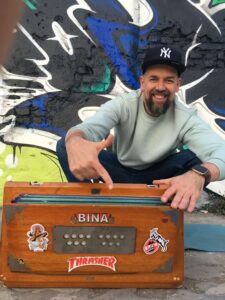
You accompany many practices as a mantra musician and teach the harmonium—how does music influence the meditation experience?
I love the harmonium and really enjoy combining music with meditation and yoga. Through Bhakti, I’ve also come to understand many connections between yoga and Buddhism—especially when it comes to the heart, devotion, and compassion. There are an incredible number of overlaps.
Music often opens up a space that words alone cannot reach. It makes it much easier for people to move from their heads to their hearts.
Is there a particular mantra or musical experience that has deeply moved you?
I love practicing with Green Tara—especially the mantra “Om Tare Tuttare Ture Soha.” Tara has been with me for many years and is still part of my daily practice today. At the same time, I also love powerful Shiva mantras. And actually, last summer I was also deeply moved by a completely different
musical experience moved me deeply: a Cypress Hill concert. It really resonated with me. Music can open something within us in so many different ways.
Many of your events have names like “Bhakti Vinyasa” or “Metta & Dharma”—which values or qualities do you most strongly associate with them?
For me, Bhakti means above all devotion and compassion—similar to Buddhism. Vinyasa means flow, being in motion, staying connected. We also teach formats like “Bhakti Yin Love,” which is more of a gentle, heart-opening variation. Ultimately, all these formats are
is about feeling more connected to yourself and others again.
How do you personally find balance between your personal practice, teaching, traveling, and leading a community?
Actually, that’s exactly what gives me so much strength. Traveling, meeting people, and teaching what I truly stand for and what I love—that fulfills me deeply. Of course, I need to consciously take breaks and retreat from time to time, but at the same time, my work is also a big part of my own practice.

You co-founded the yoga teacher community in Cologne—what is your greatest wish for this community?
I founded this community over ten years ago with the idea that we’d come together more, support one another, and have less of a “dog-eat-dog” mentality in the yoga scene. Back then, it worked very well, and it was a wonderful time of genuine connection. Today, many things have changed—social media, Instagram, and platforms like Urban Sports are, of course, also transforming the world of yoga. That’s why we might need new ways to foster community today.
What projects, workshops, or ideas would you like to bring to life in the coming years?
I’d like to teach more in the Westerwald again because the nature there inspires me deeply. At the same time, I also see many international projects on the horizon—retreats abroad, Vipassana programs, harmonium seminars, and festivals. I’m also very interested in working in ashrams.
In closing: What is the most important message you want to share with the world through your classes, your music, and your work?
That we are, at our core, already whole. Yoga, meditation, and music simply remind us of that. And that compassion—for ourselves and for one another—is perhaps the most important thing we can cultivate.
Check out Marco’s website to learn more about Marco and Bhakti Vinyasa Yoga.