Kevin Warsh Was Confirmed as Fed Chair in the Most Divisive Vote in Federal Reserve History, 54-45. Here's Why That Split Still Matters Now That He's Raised Rates for the First Time Since 2023. | The Motley Fool
Kevin Warsh’s confirmation vote in the Senate in May 2026 was the most divisive ever for a Federal Reserve chair, according to CNBC. The 45 senators who voted against his confirmation likely feared that the new Fed chair would end up trying to bend the Federal Reserve’s policies to the preferences of the White House, even at the expense of the national economy, as well as the prestige and credibility of the central bank. Every Republican voted yes, as did one Democrat, Sen. John Fetterman.
But at its mid-September meeting, the Fed raised rates. The S&P 500 (^GSPC +0.73%) took it in stride, climbing very slightly in the following weeks. So, what does that hike prove about the independence that 45 no votes doubted?
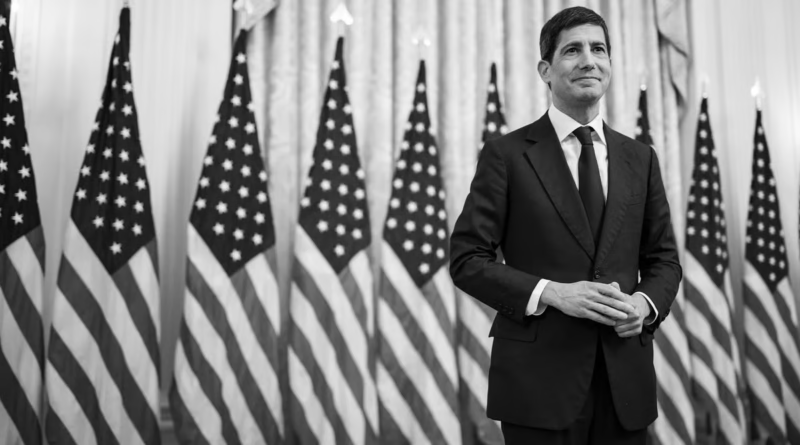
Image source: The White House.
This could be the first hike of a few
Warsh faces a credibility issue that he has just started to address, and it isn’t just the Democrats that he’s trying to build a reputation with.
Before Warsh’s confirmation, the Justice Department opened a probe of his predecessor, Jerome Powell.
Today’s Change
(0.73%) +56.27
Index Level
7,722.72
Key Data Points
Day’s Range
7,700.51 – 7,754.67
52wk Range
6,316.91 – 7,816.70
A judge later ruled that the probe was a pretext, and it was dropped in April. The investigation began after President Donald Trump took issue with Powell’s oversight of renovations to the Federal Reserve headquarters. He also publicly castigated Powell for failing to cut interest rates.
The president had demanded rates of “1% or less” and has generally called for rates to be among the lowest in the world — an approach that would likely be foolhardy at the moment, given that Consumer Price Index (CPI) inflation ran at 3.4% in August 2026, per Bureau of Labor Statistics (BLS) data.
Why should investors care?
Warsh raised rates over Trump’s public objections, but Trump says he told Warsh to vote with the board anyway, so the hike might not prove much. The real test of Warsh’s mettle will come if he judges that high inflation justifies another hike.
For investors, Warsh’s independence matters because inflation expectations determine interest rates, which in turn affect the valuations of stocks and other assets. If people believe that the Fed will cut rates on command, bond investors will demand higher yields to compensate for the risk. Higher yields reduce the present value of future corporate profits, which hits growth stocks hardest.
The next test for Warsh will be at the Fed’s Oct. 27-28 meeting.
If inflation remains on the hot side and the Fed continues to hold out against White House pressure for lower rates, the 45 no votes on the confirmation will look misplaced. On the other hand, if Trump can make enough noise to force the Fed’s hand, investors will need to buckle up and prepare for a world in which the central bank is uninterested in maintaining the purchasing power of its currency when it’s politically inconvenient to do so.
And most likely, that would be incredibly bad for the market as a whole, though inflation-resistant assets would probably perform quite well.