
The US Navy needs more ships. The workers building them are winning bigger paychecks.
The US Navy needs more from the American shipbuilding industry, which depends on skilled workers.
Recent contract wins by shipbuilding unions in California and Maine are delivering better pay, better benefits, and more structured approaches to the introduction of new technologies into shipyards. Shipbuilders and union leaders told Business Insider the improvements would help attract and retain skilled workers as the Navy and industry race to rebuild and revive America’s shipbuilding capacity.
“I think overall, it’ll bring the industry back to where it needs to be,” International Association of Machinists and Aerospace Workers Eastern Territory Coordinator George Edwards said, adding that the new contracts between the workers’ unions and shipbuilding companies have “set the trend for where you’re going to see things going in the next couple years in shipbuilding.”
Last week, IAM union members at General Dynamics NASSCO in San Diego, which specializes in building auxiliary vessels for the Navy, ratified a three-year agreement that delivers wage increases, improvements to retirement benefits, floating time off, and worker protections. Over 800 workers will receive a 10% wage increase in the first year, followed by 5% in the second and 4% in the third.
More money helps workers grappling with the rising cost of living in San Diego, which is nearly 50% higher than the national average.
“It’s also helping the company minimize the turnover,” IAM Western Territory General Vice President Robert Martinez explained, by reducing “losses of skilled workers to other shipyards because they weren’t paying as competitively.”
The successful negotiation came on the heels of a similar contract win in Bath, Maine, last month. Over 4,500 workers at Bath Iron Works ratified a contract giving them a 17% wage increase in the first year and a 4% bump in the following four years, as well as stronger retirement benefits.
Hiring and keeping skilled workers
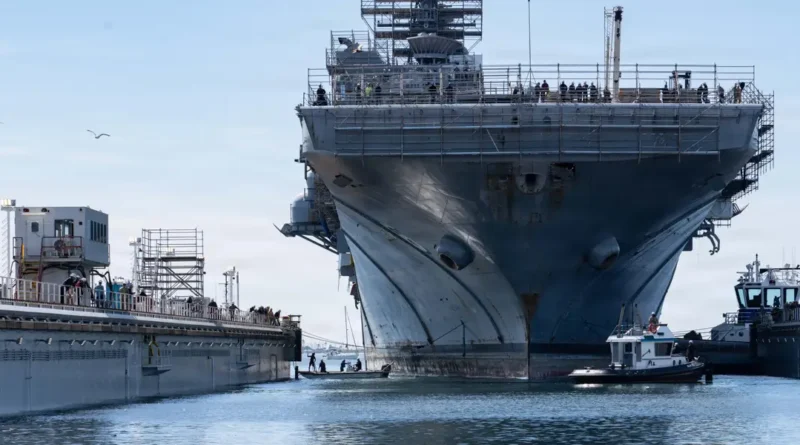
Staff photo by Brianna Soukup/Portland Press Herald via Getty Images
Across the US, shipyards have lost employees due to pay and working conditions. The attrition rates have been especially high among workers early in their careers, as shipbuilders lose talent to competitors — both inside and outside the industry — that offer better pay or benefits or a less demanding environment.
Senior Navy leaders have argued that shipbuilding wages need to be competitive with other sectors of the economy, quality-of-life improvements are essential to recruiting and retaining workers, and the workforce must be preserved.
“I think this is really an issue of wages, to be honest,” John Phelan, the Navy secretary until late April, said last year. He said that if a welder makes the same money they might earn at a Buc-ee’s convenience store or at Amazon, but instead spends most of their day working inside tight, uncomfortable spaces, “it’s hard to get that person to want to do that job.”
Hung Cao, the acting secretary of the Navy, said during a May congressional hearing that “we need to get this industrial base going,” adding that “we need to build ships, and we need to do it yesterday, so we will make sure that we protect our workers.”
Union members told Business Insider that to retain skilled talent, shipyards have to not only pay well but also demonstrate that the job can be a long-term career with applicable benefits, healthcare, flexibility, and retirement.
Keeping those workers raises the overall experience level inside shipyards, which has declined significantly since the end of the Cold War as the industry has been hollowed out.
Huntington Ingalls Industries, America’s largest shipbuilder, said last fall that it had invested more heavily in wages and, in turn, seen “an increase in experienced hires.” In March, the union-represented workers at HII’s Ingalls Shipbuilding division negotiated an immediate base-wage increase of 18% or more, with total wage growth of 35% to 47% through 2031.
Across the US shipbuilding industry, the average worker’s experience level is a fraction of what it was in decades past. Within HII’s shipbuilding division, the average electrical supervisor in the mid-1990s had more than 20 years on the job. As of February last year, that had dropped to about four and a half years.
“That’s a lot of lost experience,” Tom Moore, HII’s senior vice president of government relations, said at the time.
At Bath Iron Works, “maybe three-quarters of the shipyard has got about six years or less of experience,” IAM District 4 Assistant Directing Business Representative Chris Wiers told Business Insider. In a few years, with retention, they’ll have greater seniority and be able to raise the baseline expertise of the workforce.
In a statement, President of General Dynamics Bath Iron Works Charles F. Krugh said that the contract “demonstrates our commitment to retaining our experienced workforce and to our mission of building the highest-quality surface combatants that protect our country and our families.”
During contract negotiations, the union at NASSCO saw membership jump from 21% to 67% as more workers voiced concerns.
“There has been a change of culture in the shop. It’s becoming more of a union shop, and I think you feel the solidarity,” IAM Western Territory Special Representative Luis Silvas said. “There’s a certain youth and passion that comes from believing in themselves, understanding that they’re skilled workers.”
The push to revitalize US shipbuilding
DoD photo by US Air Force Staff Sgt. Jack Sanders
Higher pay is only one part of a much broader effort to rebuild and strengthen the nation’s shipbuilding workforce. Other actions include investments in infrastructure, targeted hiring campaigns, expanded training pipelines, and transportation solutions like gas and public transport cards.
Transportation has been make-or-break for some workers, who may not live near the yards where they work.
IAM Western Territory Coordinator Richard Suarez said that “50% of our membership at NASSCO crosses the border every single day,” coming in from Mexico. To get to the shipyards by 6 a.m., these migrant workers might leave their house as early as 2 a.m. to account for the long wait at the border.
The Navy is also embracing new technologies, such as artificial intelligence and robotics, to help automate labor-intensive tasks for increased shipyard capacity and capability. Beyond pay, workers are pursuing a greater say in the integration process.
In Maine, for instance, the new union contract establishes formal processes for introducing new technologies into the shipyard that bring workers in earlier.
IAM Local S6 President Tim Suiter said that employees were previously brought in toward the end of the process, at times creating confusion and raising concerns about how that automation might reshape work across departments.
Now, workers will be at “the forefront of the process,” he said, helping shape how new technologies are introduced so they support workers instead of sidelining them.
The industry’s success depends on its ability to recruit and retain enough skilled workers to build the Navy’s future fleet. Silvas said the recent contract wins demonstrated how the workers in these jobs “can make long-lasting careers because people can invest in themselves. They can invest in their families. They can invest in their communities.”