Hitler’s Birthplace in Austria Is Now a Police Station
The building where Adolf Hitler was born in Austria more than 137 years ago opened as a police station on Wednesday morning, the country’s interior ministry announcedconcluding a yearslong effort to prevent any attempts from making the location an attraction for Nazi sympathizers.
The refurbishing and repurposing of the building has reignited a debate about what to do with sites associated with the Nazis in a country that is still grappling with how to acknowledge its role in the Holocaust.
“You could make the point that now is a watershed moment,” said Stefan Benedik, the deputy director of the House of Austrian History, a museum in Vienna. But, he added, when it comes to grappling with the past, “such processes are never over.”
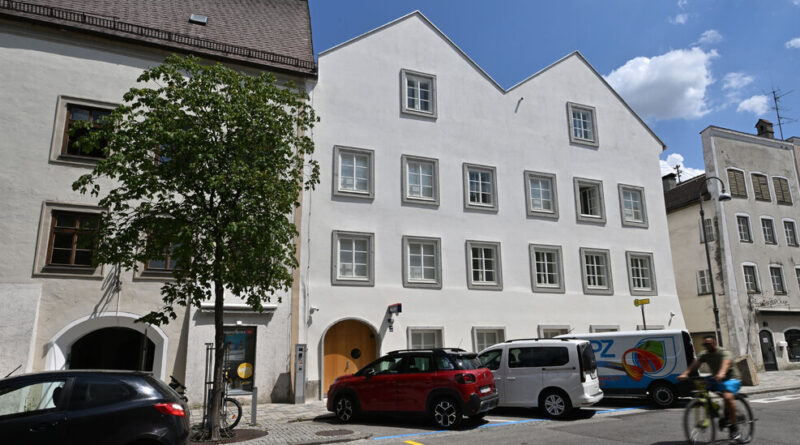
The 17th-century building where Hitler was born — at Salzburger Vorstadt 15 in the center of the small, medieval town of Braunau am Inn, along the German border — has been undergoing renovations for about three years. Now, the exterior is a crisp white. The windows are new. No remnants of Nazi influence remain.
“The future use of the house by the police should send an unmistakable signal that the role of this building as a memorial to the Nazis been permanently revoked,” Wolfgang Peschorn, the interior minister of Austria, said in a statement.
The building had been a thorn in the side of Austrian authorities for decades. Before the recent work, it had been a makeshift museum, a school and a library over the years. Especially after World War II, the building saw regular visitors, especially on Hitler’s birthday, though the frequency of visits dwindled in recent decades.
To gain a final say in how the building was used, the Austrian Interior Ministry began paying about $57,000 per year in rent to the family that owned it.
Then, in 1984, the government tried to acquire the building itself from Gerlinde Pommer, a descendant of the original owners. She long refused to sell, arguing that it was possible to prevent the building from becoming a memorial or pilgrimage site without selling to the government.
In 2017, the government took ownership of the property by expropriating it. A court at the time said that “the only way to make sure that there is no symbolic misuse is to seize it.”
The authorities announced in 2019 that it would become a police center, in an effort to further discourage anybody from visiting the place to venerate Hitler.
“The new police center in Braunau is a place of security and the rule of law,” Thomas Stelzer, the region’s governor, said in a statement. “It is precisely here that we show that we do not merely preserve responsibility from history, but actively live it.”
Some locals said the installation of the police station sent the wrong message. “In a dictatorship, the police is an instrument,” said Annette Pommer, 34, who was born and raised in Braunau and who is a distant relative of the former owner of the building. “When you are in a dictatorship, the police is not for democracy.”
Mr. Benedik, the museum director, acknowledged that preventing the veneration of the site would be an ongoing struggle. “The significance of the place is not going to change because there has been a reconstruction of the building,” he said. A commemorative stone, placed in the late 1980s, remains in front of the structure, bearing a message about the dangers of fascism, without specifying any perpetrators or victims.
The building was renovated to resemble what it looked like in the early 19th century, before Hitler was born. Part of the hope is that the changed facade will make it less appealing for neo-Nazis to visit. The many police cameras now on the property could also help, said Florian Kotanko, a local historian and a Braunau native.
“Nobody will dare to go close to the house or the other side of the street to lift his right arm,” Mr. Kotanko said, referring to the Nazi salute. He added that it was important to separate today’s police in Austria from the Nazi-era police.
“It’s an appropriate use for the building,” he said. But, he said, “We have to deal with this past.”
Both locals and experts agreed that the new look and function of the building alone would not completely wipe away its association as the birthplace of Hitler.
“It’s a big dilemma,” said Barbara Warnock, the co-director of the Wiener Holocaust Library in London. In general, she said, historical places need the appropriate context in the form of information boards or plaques.
But the building in Braunau is tricky, she said, asking the question that the Austrian authorities hoped to at least partly put to bed on Wednesday: “What is the significance of where someone like Hitler is born?”
Helena Smolak contributed reporting from Munich, Germany.