For Israeli settlers, return to Sa-Nur is a dream realised
Seated at a table draped in a floral plastic cover inside his prefabricated home, Meir Goldmintz says he is finally fulfilling a dream he has carried for two decades: “returning to Sa-Nur”.
The tiny settlement, perched above Palestinian villages in the northern Israeli-occupied West Bank, was dismantled in 2005 along with three other Jewish settlements in the area, as well as all the settlements in the Gaza Strip during Israel’s withdrawal from the territory.
Now, its re-establishment — greenlit as part of major settlement expansions undertaken by Israel’s current right-wing government — is freighted with symbolic significance.
For critics of the expansion, it represents another major step backward, pushing further away the prospect of a Palestinian state.
But for Goldmintz and his neighbours in their rows of white bungalows, it is, as far‑right Finance Minister Bezalel Smotrich said during an official reopening ceremony, a “historic correction”.
“His brother lives next door,” said Goldmintz, whose neighbours also include influential settler leader Yossi Dagan, head of the northern West Bank Settlements Council and one of those evacuated from Sa-Nur 20 years ago.
Newly established Jewish settlements — considered illegal under international law, like all settlements in the West Bank occupied by Israel since 1967 — are generally wary of foreign media, which residents see as hostile to their cause.
But AFP was granted rare access last week to Sa-Nur, reached by a dirt road controlled by an Israeli army checkpoint.
– Bicycles and bulldozers –
Only Goldmintz agreed to speak to AFP, though he insisted the focus shouldn’t be on him.
“I don’t want people to think I’m special,” Goldmintz said.
“My personal story doesn’t matter. The story is the return of the Jewish people.”
He had never lived in Sa-Nur before 2005, yet he marched alongside the most hardline settlers demanding its re-establishment as part of their vision of a Greater Israel in which Palestinians have neither place nor name.
Goldmintz, a heavily bearded yeshiva teacher in a black kippa and pale shirt, refers to Palestinians simply as “Arabs”.
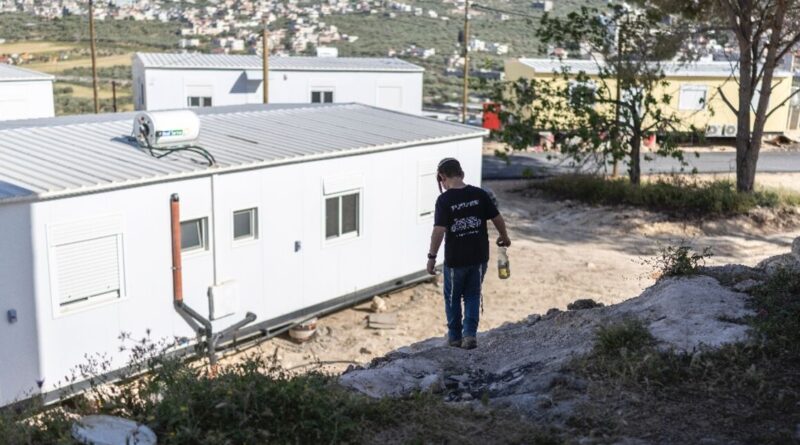
The new settlement is still taking shape, with workers repairing electricity poles while bulldozers carve into the earth.
A paved road runs alongside around 10 white bungalows.
Outside their front doors lie children’s bicycles, drying laundry, a hammock, a barbecue and a trampoline.
The interiors are basic.
“Ninety square metres, standard size,” said Goldmintz, admitting it is far smaller and less comfortable than his previous home in another settlement.
He lives with his wife and seven of their eight children — his eldest daughter being married — whose portraits decorate the two refrigerators in the living area.
There is nothing on the walls, only bookshelves packed with religious texts, a piano covered with a plastic sheet and a sofa.
From the window, the view stretches across beige houses and olive groves on the surrounding hills.
“They are all Arab villages,” he said.
“I don’t know why they are here. This is Jewish land.”
The Palestinian response is spray-painted in Arabic on the walls of an abandoned building: “The resistance will return.”
– Unearthing the dead –
Gradually eaten away on all sides, the West Bank is now home to more than 500,000 Israelis living among three million Palestinians in a territory that Palestinians claim as the core of their future state.
Settlements, outposts and bypass roads have carved the West Bank into a patchwork of zones under varying degrees of Israeli control — further eroding the viability of a negotiated two-state solution to the Israel-Palestinian conflict.
In recent years, approvals for new settlements have surged under the current government of Prime Minister Benjamin Netanyahu, considered one of the most right-wing in the country’s history.
From just three between 2013 and 2022, the figure rose to 54 in 2025, and already stands at 34 in 2026, according to Israeli NGO Peace Now.
“We are burying the idea of a Palestinian state,” Smotrich said during the reopening of Sa-Nur last month.
However, Goldmintz insists nobody in the area is hostile towards them.
The other day, he says, he was stuck in traffic outside the settlement and young Palestinians helped him get through.
But a video filmed by Palestinians the day after AFP’s visit tells a different story.
Below the settlement, in the cemetery of the village of Al-Asaasa, men can be seen carrying a shrouded body toward the exit.
Behind them stand settlers, assault rifles slung over their shoulders, alongside Israeli soldiers.
The body was that of an elderly man who had died that day.
“While we were burying him, the settlers started provoking us from up there, but we ignored them,” the dead man’s son, Mohammad Asaasa, told AFP.
He had left once the burial was over, but fellow villagers called him back to say the settlers were still there.
When he returned to the gravesite, Mohammad Asaasa found they had dug into the earth “trying to exhume the body”, he said.
In a statement, the Israeli army said the funeral had been coordinated in advance with the security forces.
It said it had never given orders to remove the body, adding it had confiscated the settlers’ tools.
The military condemned “any attempt to act in a manner that harms public order, the rule of law, and the dignity of the living and the deceased”.
Asaasa reburied his father in a nearby village.