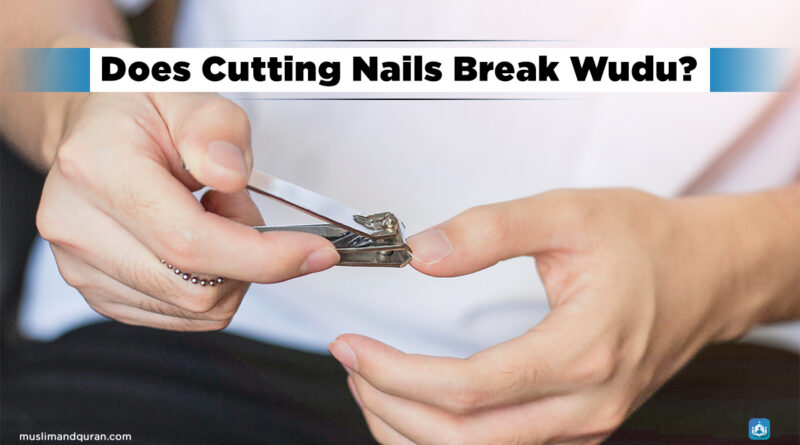
Does Cutting Nails Break Wudu?

Islam gives the highest priority to purity. Purity, in Islam, refers to two types: spiritual and physical purity. Spiritual purity in Islamic teachings is the purification of the heart and soul. It also refers to the purification of intentions and getting rid of spiritual diseases, such as arrogance, greed, and jealousy. Physical purity, on the other hand, is physical cleanliness of one’s body from all types of physical impurities, referred to as “najasah” in Islamic terminology.
Physical purity of an individual is highly important, not only when intending to worship but also as a matter of practice in routine life. The Prophet Muhammad صَلَّى ٱللَّٰهُ عَلَيْهِۦ وَسَلَّمَ emphasized the importance of maintaining cleanliness (physical purity) as part of one’s faith. Hadith 223 of Sahih Muslim mentions it as follows:
Translation of relevant part
Cleanliness is half of faith
Accordingly, it is important for every Muslim to ensure that they remain in a state of physical purity at all times in their daily life. However, it becomes even more important, rather obligatory, in the context of performing an act of worship, such as standing for prayer (salah) or recitation of the Quran. The Islamic way of attaining the required level of physical purity before performance of an act of worship is ablution, better known as “wudu” in Islamic terminology.
Since ablution (wudu) holds a special status in Islam, especially in the context of worship, Muslims are quite sensitive about knowing what makes wudu invalid. A very common question in this regard is “Does cutting nails break wudu?” In this blog, we will explore the correct answer to this important question, in light of the Quran and Hadith, and the general ruling of Islamic scholars about it.
Wudu (Ablution) In Islam
Before exploring the correct ruling on the question “Does cutting nails break wudu?”, it is important to understand what wudu (ablution) refers to in the Islamic teachings. Wudu is also known as “Ritual Purification” in Islam, which is mandatory for every Muslim man and woman before preparing for worship, such as standing for prayer. It comprises a set of actions aimed at attaining purity, as elaborated in the 6th verse of Surah Al-Ma'ida.
Translation of relevant part
O believers, when you stand up for the service of prayer, wash your faces and hands up to elbows, and also wipe your heads, and wash your feet up to the ankles.
So, the basic thing to do while making wudu is to wash hands, face, forearms, and feet, and wipe the head. If any of these actions are skipped, wudu will not be considered valid. Moreover, if any of these body parts are covered with some waterproof substances that prevent water from touching the skin, wudu will be incomplete and invalid.
Occurrences And Actions Making Wudu Invalid
The next important issue in understanding the correct answer to the question “does cutting nails break wudu?” is to understand what happenings, occurrences, and actions break wudu. The main occurrence or event that breaks wudu “is Hadath” (It happened)which is mentioned in many Hadiths. Hadith 214 of Sahih Al-Bukhari narrates it as follows:
Translation – Narrated `Amr bin `Amir:
Anas said, “The Prophet (ﷺ) used to perform ablution for every prayer.” I asked Anas, “What did you use to do?’ Anas replied, “We used to pray with the same ablution until we broke it with Hadath.”
The subject is also mentioned in Hadith 649i of Sahih Muslimwhere the occurrence of Hadath is further explained as “breaking of the wind”.
Translation of relevant part
Abu Huraira reported Allah’s Messenger (ﷺ) as saying ………. The angels invoke (blessings upon him in these words): O Allah! pardon him. O Allah! show mercy to him, (and they continue to do so) till he returns (from the mosque having completed the prayer) or his ablution breaks. I said: How is the ablution broken? He said: By breaking of the wind noiselessly or with noise.
Hadith, as explained by scholars, is a condition of ritual impurity, which is further bifurcated into two categories, minor Hadath and major Hadath.
- Minor Hadath – It includes the evacuation of urine, stool, or gas. If a person has experienced any of such occurrences, his wudu is no longer valid and needs to be redone.
- Major Hadath – Major Hadath is caused by accidental sexual discharge, sexual intercourse, menstruation, and post-delivery bleeding. In the event of any of these happening, wudu will be broken. In this case, ritual purity can only be attained through ghusl (ritual bathing).
In addition to Hadath, Wudu also breaks under the following circumstances:
- If an individual goes into deep sleep.
- If anyone loses consciousness.
- If someone touches his/her own private parts.
- If someone is affected by physical impurity, such as a najas material (impure substance or filth), that touches any part of the human body.
- If any part of the organs, which are included in wudu, is covered by a waterproof material, wudu remains invalid until such time the waterproof material is removed, and wudu is done after that. A glaring example of this condition is the application of nail polish by women.
Cutting Nails While in Wudu
From an in-depth review of the process of making wudu and the circumstances that break wudu, the answer to this important question becomes quite clear, i.e, cutting nails does not break wudu. The logical reason is that cutting nails does not fall under any category of Hadath or other occurrences that break wudu. Additionally, there is no direct or indirect narration in the Quran or authentic Hadith collections, which declare the wudu invalid if someone trims nails while in the state of wudu.
Hence, it is a consensus across all major Islamic Jurisdictions that “Cutting nails does not break wudu”. However, trimming of nails is also an obligatory action to maintain physical purity. Trimming of nails is made obligatory for Muslims, within a fixed time frame, which is mentioned in many Hadiths, as forty days/nights. Cutting nails within this time limit is considered part of ritual purification, as mentioned in Hadith 258 of Sahih Muslim.
Translation
Anas reported: A time limit has been prescribed for us for clipping the moustache, cutting the nails, plucking hair under the armpits, shaving the pubes, so that it should not be neglected for more than forty nights.
The importance of cutting nails is also mentioned as one of the five practices, which are included in the characteristics of fitra (natural hygiene), in Hadith 5891 of Sahih Al-Bukhari.
Translation
Five practices are characteristics of the Fitra: circumcision, shaving the pubic hair, cutting the moustaches short, clipping the nails, and depilating the hair of the armpits
It implies that if someone has not trimmed nails for more than forty days, they may not be in a state of physical or ritual purity; hence, their wudu may not be perfect. So, under this situation, it is necessary for such persons to cut their nails before making wudu.
To summarize:
- Cutting nails does not fall under any actions that break wudu; hence, if someone cuts nails after making wudu, his/her wudu does not break.
- Cutting or trimming of nails, within the time limit of forty days, is necessary to maintain ritual purity. Hence, if this limit expires, the concerned person must trim their nails before performing wudu.
- If a woman applies nail polish, she must remove it before performing wudu; her wudu will not be valid.
- Cutting nails does not break wudu, but it is related to personal and natural hygiene and cleanliness. Hence, it is important to trim nails at regular intervals, not exceeding 40 days. The preferred practice is to trim nails weekly.
Important
- Although trimming nails does not break wudu, it is highly recommended to wash hands after cutting nails, whether one is in the state of wudu or not.
- If excessive bleeding occurs while clipping nails, it may invalidate wudu. Hence, it is important to be careful when cutting nails. Some scholars opine that wudu remains valid even if the event of bleeding, whereas others are of the view that, in this case, one must renew wudu to be on the safe side.
- As a matter of practice, one should make it a habit to cut nails once a week.
FAQs
Does cutting nails require redoing wudu?
No, cutting nails does not break wudu. Hence, there is no requirement to renew wudu after cutting nails.
Can you pray immediately after trimming nails?
Yes, there is nothing wrong with praying immediately after cutting a nail if you have performed wudu beforehand.
Will my wudu break if it bleeds while cutting nails?
If bleeding is nominal, it is a consensus among scholars that it does not break wudu. However, if the bleeding is excessive, it breaks wudu, according to the majority of scholars. As a precaution, it is better to renew wudu if the bleeding is excessive.
Is it a Sunnah practice to cut nails regularly?
Yes, the Prophet Muhammad, may God bless him and grant him peace, emphasized regularly cutting nails, as a part of the five things that are included in fitra (natural hygiene).
How often should I cut my nails?
As a Sunnah practice, cutting nails at least once a week is recommended, whereas the maximum time limit to do so is within forty days.
Is it allowed to cut nails while having wudu?
Yes, there is nothing wrong with cutting nails while having wudu. However, the best practice is to trim nails before performing wudu, although trimming nails does not affect the validity of wudu.
Is it necessary to wash hands after cutting nails?
Washing hands after cutting nails is not required to maintain wudu, but it is a best practice for personal hygiene.
Conclusion
Wudu is an obligation before performing any worship, such as standing for Salah, reciting the Quran, and circumambulating the Ka’aba. Wudu remains valid unless the occurrence of any such thing, which breaks it, such as the excretion of urine, stool, or wind from the human body. Even going into deep sleep breaks wudu. So, the acts or events that break wudu are quite elaborately mentioned in Islamic teaching, and Muslims are quite particular about it. In this context, it is very clear that cutting nails does not break wudu, as it does not fall under any category of events, occurrences, and happenings that break wudu, as defined in the Islamic Jurisprudence. It is a consensus across all major Jurisprudences, Hanafi, Maliki, Shafi’i, and Hanbali, that cutting nails does not break wudu.