China Exports Surveillance
When I first read about how China tracks its citizens with surveillance cameras and also ranks them according to a set of political and social criteria set by the Communist Party, it was impossible not to think of “1984” and Big Brother.
Since then, China has become the world’s superpower of surveillance, much of it augmented by artificial intelligence. It’s Mao-era policing on steroids. And as my colleagues David Pierson and Berry Wang write, that model of policing is now being exported to authoritarian states and weak democracies across the world.
China is exporting its surveillance state
by David Pierson and Berry Wang
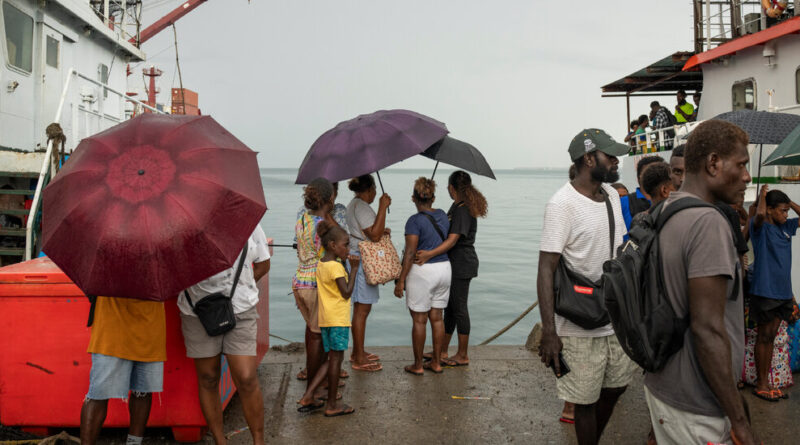
A village in the Solomon Islands had a problem: Young men, buzzed on betel nut and moonshine, were causing trouble. Residents asked the police for help; the officers who responded were Chinese, part of a security pact the country had signed with Beijing.
The officers proposed a solution: collect fingerprints and palm prints from every resident, along with information listing the names, addresses and birth dates of each household member. The playbook was part of a Mao-era community-surveillance system, recently revived under President Xi Jinping of China, that encourages neighbors to spy and snitch on one another to root out political enemies.
China has spent decades perfecting a surveillance state at home. Now it’s exporting its ideology of state control — and the technology to enforce it.
The Fengqiao experience
China casts itself as a model of policing, pointing to its low rate of violent crime. But the same apparatus that keeps citizens safe is also routinely used to crush dissent.
Movement is monitored by a network of surveillance cameras, many equipped with A.I. software that recognizes faces and the way a person walks. Millions of Uyghurs, the mostly Muslim ethnic group from northwest China, have been subjected to biometric data harvesting — DNA samples, iris scans and voice-pattern samples. The police have visited the homes of minority groups to promote party policies. Companies must register their employees in police databases.
Xi calls the system the “Fengqiao experience for a new era” — a reference to a town in eastern China that was notorious during the Mao era for encouraging residents to “re-educate” political enemies. Xi wants to embed the party and its security apparatus so deeply in daily life that no trouble, however minor or apolitical, can arise.
Exporting the model
Beijing’s pitch has appealed to many authoritarian and weak democratic states in Africa, Southeast Asia and Central Asia, where leaders have welcomed the opportunity to use China’s assistance to entrench their power:
-
Since 2000, China has held nearly 900 police-training sessions for at least 138 countries, according to the Carnegie Endowment for International Peace.
-
It’s embedded its officers in police forces in the Central African Republic, Vanuatu and Kiribati.
-
It provided thousands of surveillance cameras to Ecuador in 2011, enabling the country’s domestic intelligence agency to better monitor political opponents.
-
It trained a unit of South African police in 2016 later deployed to intimidate and assassinate political rivals of then-President Jacob Zuma, according to the Africa Center for Strategic Studies, a Washington-based organization that is part of the U.S. Department of Defense.
Exporting police training “allows China to portray their system as a public safety success rather than a human rights failure,” said Sheena Chestnut Greitens, who co-authored the Carnegie study.
The Solomon Islands signed its security pact with Beijing in 2022. Three years earlier, China scored a diplomatic victory, persuading the government to sever decades of ties with Taiwan. But that inflamed tensions between the more developed island of Guadalcanal and the poorer, more pro-Taiwan island of Malaita. Deadly riots targeted the century-old Chinese community, which dominates retail, logging and mining interests, and when protesters tried to storm the home of Manasseh Sogavare, who was prime minister at the time, he signed the deal with China to combat “hard internal threats.”
The backlash
The 10 or so members of the Chinese police team sent to the Solomon Islands have been held up by Chinese state propaganda as an example of Beijing’s benevolence toward its neighbors.
News releases showed Chinese police putting on drone shows and kung fu demonstrations. China also donated riot gear worth $1.5 million, including bulletproof vests, shields, helmets and stab-resistant suits and gloves. Photographs on the Solomon Islands government website show Chinese police training local police how to wield batons and anti-riot forks, a tool commonly seen in China that is about the length of a pitchfork with a U-shaped prong to pin down a person.
But when the news emerged that the Chinese police team had proposed collecting biometric data, a backlash began.
Celsus Talifilu, a prominent political figure, wrote a blog post arguing that the police had no authority to collect vast amounts of personal information, register biometric data, or conduct neighborhood surveillance. He wrote that the Fengqiao model’s emphasis on monitoring and coercion threatened social harmony and local customs, such as having village chiefs resolve disputes.
“This is against our norms,” he said in an interview. “People will not take lightly to being spied on by their neighbors.”
In the end, the Fengqiao pilot program in the village was suspended. No biometric data was ever collected. And this month, the Solomon Islands elected a new prime minister more skeptical of Beijing.
The noisy youth are still a problem.
MORE TOP NEWS
Trump in the stalemate phase
President Trump likes his military and diplomatic victories quick, clean and decisive. But in Ukraine, Gaza and quite likely now in Iran, his early declarations of easy win have given way to reality, my colleague David Sanger writes.
Perhaps this is the result of overreach. Some experts suggest that it arises from a fundamental misunderstanding of American power. As one of Trump’s close aides said recently, destroying nuclear sites from the air is what the U.S. does best, and controlling political events in countries like Iran, Russia and Ukraine is what the U.S. does worst.
Since Trump’s return to office, the U.S. has been involved in nearly a dozen military operations around the world. Here’s a timeline.
OTHER NEWS
WHAT ELSE IS HAPPENING
-
Edgar Morin, the last survivor of a generation of French intellectuals shaped by their experiences during the Nazi occupation of France, died at 104.
-
Concerts by Ye and Travis Scott set to take place in Italy were canceled over security fears and concerns raised by local Jewish leaders.
-
A new all-electric aircraft made a test flight in New York City. My colleague Niraj Chokshi, who covers transportation, looks at whether this is the future of air travel. Watch his video.
TOP OF THE WORLD
The most clicked link in your newsletter Friday was about the billionaire Peter Thiel’s decision to decamp to Argentina.
SPORTS
Tennis: Naomi Osaka will take on the world No. 1 Aryna Sabalenka today in the first women’s night match at the French Open.
Basketball: Victor Wembanyama led the Spurs to beat the Thunder and advance to its first NBA finals since 2014. Read our preview of the upcoming showdown.
ANNIVERSARY OF THE DAY
The Undercroft Skate Space has long been a place of pilgrimage for skaters from around the world who are drawn to its concrete banks and steep angles. Its survival is an example of a community space that was rescued from gentrification by a grass-roots campaign. The Undercroft is now recognized as the world’s oldest continually used skate spot.
On the streets of Kyiv, it can be hard to tell who is a soldier and who isn’t. That’s because military-inspired fashion is everywhere. University students, I.T. workers and other urbanites have absorbed the visual language of war into their daily dress, a marker of how the conflict has reshaped life in Ukraine’s capital.
Soldiers and civilians alike call it a show of solidarity and not a shallow trend. “We’re not just wearing clothes,” a fitness trainer said. “We’re wearing the time we live in.” Take a look.
Nepal’s 15-minute time warp
Time runs differently in Nepal. Thanks to a unique national time zone, the country is always 15 minutes apart from everywhere else. Nepal has its own calendar, too, based on Hindu precepts. It runs a bit more than 56 years and eight months ahead of the Gregorian calendar.
Nepal Standard Time was officially designated in 1986, 15 minutes ahead of India’s time zone. It’s a declaration of national exceptionalism that Nepalis seem to cherish even if it forces them to do math when traveling or setting meetings outside of the country. You can read the full story in less than 15 minutes.
RECOMMENDATIONS
Skip: Jumping rope is a great way to boost longevity. Here’s how to get started.
Read: Check out these new novels from Maggie O’Farrell, Ann Patchett, Silvia Moreno-Garcia and many more.
This spicy Creole tetrazzini is a recreation of an old family recipe. The noodles are creamy and peppery, with a bite from Creole seasoning and cayenne. If you’re scared, don’t be: The cream cheese helps temper some of that heat.