Children’s Yoga: More than just movement – The Writing Yogini
Last year, I was lucky enough to attend one of Ulrike’s workshops on children’s yoga at an event. Her approach really won me over, and her warm, approachable personality sealed the deal—I just had to invite her to be a guest on my blog! Once again, I got lucky, and she agreed, so now I’m able to share this interview with you. I hope you enjoy reading it as much as I enjoyed the workshop with her!
How did you get into children’s yoga? What drew you to it?
Actually, I come from a completely different world: marketing and PR. I worked in that field for many years, but when I became a mom myself, my perspective on many things changed. My two daughters showed me very clearly what really matters to me. And at some point, it became clear: I wanted to do something professionally that had more to do with children, development, and making a real difference.
I actually came to children’s yoga through a bit of a detour. At the time, I took over my older daughter’s children’s dance group because dance, movement, and music have always been a part of my life. In practice, I quickly realized that children move in very different ways. What comes easily to some is a real challenge for others—walking backward, feeling the rhythm, coordinating their own bodies.
So I began to explore movement for children in greater depth. At the same time, I noticed that many children came into class completely hyper and left just the same way. It was loud, wild, and lively—but I felt something was missing that would help them reconnect with themselves.
Through relaxation training for children, I then came to my first simple massage exercise. The children loved it and kept asking for more. That was the moment of realization for me: Children don’t just need movement. They also need breaks, rituals, body awareness, and adults who notice what’s truly needed in the moment.
That’s how I discovered children’s yoga. Suddenly, everything came together for me: movement, mindfulness, relaxation, imagination, music, and connection. Today, nearly ten years later, children’s yoga is much more to me than just a fun activity for kids. It’s a wonderful way not only to keep children engaged but to truly empower them.
Did it turn out in practice the way you imagined?
No. And that was probably the best part of it.
At first, I pictured children’s yoga as a colorful, creative playground. At the same time, I also felt a sense of respect for this small group of children in front of me. You never know: Are they in the mood? Will they join in? Or will they look at me as if to say, “What does she want from us now?”
The first few sessions were pretty rough. I’d prepared way too much, wanted to do everything right, and of course had my plan. But the kids usually threw that plan out the window after five minutes—politely, but very clearly.
Looking back, that was my most important lesson. I realized: Kids’ yoga doesn’t work if I try to force children through a set program. And it doesn’t get any better just by cramming in even more exercises, even more games, or even more great ideas.
At first, for example, I thought a proper children’s yoga class absolutely had to end with an imaginary journey. Today I know: for many children, that’s way too much to handle at first. Some need movement. Some need repetition. Some need clear boundaries. Some just need an adult who doesn’t get nervous right away when things get restless.
It is precisely from these experiences that my approach to bond-building children’s yoga emerged. For me, this means: I don’t stick to a perfect lesson plan, but instead stay connected with the children. I observe: What’s really happening right now? What do these children need today? And how can I support them so that they feel safe, can try new things, and gradually find their way to themselves?
Because for me, children’s yoga isn’t just “cute” yoga, nor is it a colorful entertainment show. Bond-centered children’s yoga means truly seeing children, supporting them in their development, and creating spaces where genuine connection is possible. That’s the concept I share today in my training—and that’s what makes all the difference for me.

Many adults practice yoga to better cope with the demands of everyday life. How do little yogis and yoginis benefit from this?
Children approach yoga very differently than adults. Adults usually come of their own accord. They know: I want to do something good for myself, I want to wind down, I might finally want to enjoy those ten minutes of Savasana at the end.
Children are often just sent to class. They don’t really know what to expect. Some might be familiar with yoga from Mom or Dad and think, “Oh no, now I have to sit still and say ‘Om.’” And then they come to kids’ yoga and realize: Here, I’m allowed to move around. Here, I’m allowed to experiment. Here, I’m also allowed to be skeptical, wild, curious, or silly.
That, to me, is where the real power lies. Children don’t benefit when we simply scale down adult yoga. They benefit when yoga is truly tailored to children: physically, emotionally, and playfully—yet clearly guided at the same time.
In children’s yoga, kids get to know their bodies better. They practice balance, coordination, strength, and flexibility. But they also practice concentration, mindfulness, and self-awareness. They ask themselves: How does my body feel right now? Am I full of energy? Am I tired? Do I need movement, rest, or connection?
And they experience themselves within the group. They do partner exercises, look out for one another, laugh together, help each other, wait their turn, and dare to try new things. Sometimes a quiet child gradually opens up, and suddenly their eyes light up. Sometimes a very energetic child finds their own path to calm—perhaps not through an imaginary journey, but through a massage, a breathing exercise, or a short break on the mat.
For me, children’s yoga is effective when children experience: Here, I’m allowed to be just as I am—and I can learn to get along better with myself and with others. That empowers children—not just for the yoga class, but for their everyday lives.
What do you enjoy most about teaching children’s yoga?
For me, the best thing about children’s yoga is the special atmosphere that develops. We create a space where children are allowed to experiment without constant judgment. There’s no “wrong” in the traditional sense, no “you have to do it this way,” but rather: Look what your body can do. Feel how that feels. Give it a try.
I love this freedom, this creativity, and this natural joy that children bring when they feel safe. Of course, it’s sometimes chaotic. Of course, children say exactly what they think, without holding back. But that’s exactly what makes it so lively. They get involved, tweak ideas, ask questions, and sometimes even disagree—and that’s what makes children’s yoga real.
And then there are those little moments that make it all worthwhile: when children at the daycare call out down the hallway, “The yoga lady is here!” Or when I hear a mantra we just learned outside the door, and a child is singing it through the daycare like a catchy tune. That’s when I know: something has really clicked.
For me, children’s yoga is like a bouquet full of possibilities. It meets every child right where they are—with their body, their temperament, their mood, and their development. A quiet child is allowed to slowly open up. A wild child is allowed to find movement and perhaps, eventually, calm. An insecure child is allowed to realize: I belong here.
That’s what’s so valuable to me: In children’s yoga, kids experience a place where they aren’t pigeonholed. They’re allowed to be who they are, and at the same time, grow. That sounds gentle—but it isn’t. Because it requires a mindset, a method, and genuine practice. That’s exactly what bonding-focused children’s yoga is all about.

How long have you been teaching? What have you learned during that time?
I completed my first children’s yoga teacher training just under nine years ago. But even before that, I’d been working with children in the areas of movement, dance, and relaxation since 2015, and children’s yoga gradually became a bigger and bigger part of that. So, roughly ten years of experience working with children, rounding it off.
I started with preschoolers, then added elementary school kids, later tweens between 10 and 15 years old—and now even the very little ones in daycare, that is, children between one and three years old. Each age group has its own unique qualities. With the daycare toddlers, it’s those wide-eyed expressions of wonder. With the preschoolers, it’s the wild, creative chaos. With elementary school kids, it’s the smart, sometimes wonderfully unexpected questions. And with the tweens, it’s those deep conversations when they realize: I don’t have to pretend here.
What I’ve learned most during this time is that the connection with the children is more important than even the best lesson plan. You can come up with the most creative games, activities, and topics—but if they don’t resonate with the children at that moment, it’s of little use.
I’ve also learned to trust children with much more. Even the very little ones. Children often know with surprising clarity what they’re capable of, what they don’t want, and what they need. And we don’t need to be afraid of tweens either. They don’t need a show. They need authenticity.
To this day, I teach all age groups every week. That keeps me alert, curious, and in touch with real-world practice. For me, children’s yoga isn’t just a career. It’s my passion—and at the same time, very hands-on work with children, groups, bodies, emotions, and real-life situations.
You’ve also started training others. How did that come about?
That step actually came at a time when nothing at all looked like growth: during the pandemic. I’d offered my first children’s yoga classes here in Ahrensburg in 2019; they were full, and in early 2020, I wanted to really get things going. I’d just started my own business—and then the lockdown hit in March.
For me, that was both a curse and a blessing. Of course, it was a shock at first. At the same time, I quickly shifted to online children’s yoga, working directly with the kids. And in doing so, I realized: connection is possible online, too, if we consciously create it.
During that time, I first developed small training programs, such as “Kids’ Yoga to Go,” which still exists as a format today. Later, I also taught kids’ yoga training courses for various academies. At some point, however, it became very clear to me: I don’t just want to pass on the knowledge of others. I want to develop my own concept based on my practical experience.
That’s how my own children’s yoga training program came to be. Today, it’s ZFU-certified—the first and only online children’s yoga training program in Germany. I’m really proud of that, because so much work, experience, and real-world practice went into it.
It’s especially important to me that my training doesn’t just remain theoretical. Participants shouldn’t simply copy “my” children’s yoga, but rather find their own style—one that fits their personality, their target audience, and their daily lives.
That’s why I integrate so many elements: children’s yoga practice, pedagogy, methodology, didactics, developmental knowledge, and even the basics of anatomy, which I teach in collaboration with a physical therapist. And since many women later want to develop their own programs based on this, marketing is also part of the curriculum. I want them not only to understand how children’s yoga works, but also to actually launch their programs and build visibility.
The community is also a huge part of it. For me, support doesn’t end with the certificate. Anyone who has participated in my training and continuing education programs is welcome to stay. For me, training isn’t about just receiving information and then being on your own. It’s a shared journey where women become more confident, more courageous—and bring their own bond-building children’s yoga into the world. That’s not just a nice phrase. It’s the heart of my concept.

From your perspective, what are the benefits of teaching kids?
Actually: there are almost only benefits.
Working with children changes your perspective on the world. Children see things differently—more directly, more curiously, and often much more openly than we adults do. When you work with children, you rediscover a sense of wonder yourself. You’re reminded that joy sometimes starts in the smallest of ways: with a sound, a movement, an image, or an idea that suddenly emerges in the room.
Of course, kids’ yoga isn’t always calm and harmonious. It can be loud, wild, and unpredictable at times. But that’s exactly why it’s so important not only to know beautiful exercises but also to have knowledge about children, groups, nervous systems, development, and different needs. Then you’ll feel more confident, even if a class doesn’t go as planned.
And yes, there are those sessions where everything goes haywire. Then you step outside, take a deep breath, and next time you’ll start fresh. The beauty of children is that they’re usually much less likely to hold a grudge than we adults are. Often, it’s us who think, “Oh dear, that wasn’t really yoga today.” Meanwhile, the children may have long since gone home with a song, an exercise, or a little ritual in mind.
That’s exactly what makes this work so valuable. Children take away little tools: a breathing exercise, a pose, a massage, a sense of “I can calm myself down” or “I’m allowed to try things out.” They experience a space where they aren’t constantly being judged—a space where they don’t have to “perform,” but are allowed to discover themselves. That’s children’s yoga that fosters strong bonds. And for that, it’s worth getting started.
What’s the most significant difference from teaching adults, aside from style?
Children’s yoga and adult yoga are truly two completely different worlds. It’s not just a matter of presenting the exercises in a more playful way. The entire approach to teaching is different.
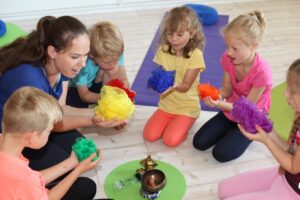
In children’s yoga, we often sit in a circle. We look at each other, we talk to one another, we respond to one another. It’s not a lecture-style class where I demonstrate something up front and everyone quietly follows along. Children actively participate. They comment, ask questions, disagree, come up with new variations, and very honestly show when something isn’t working for them.
And that’s exactly what I love about it. I’m a Hatha yoga teacher myself, but I don’t teach adults. To be honest: that would be too quiet for me. Children give us immediate feedback. Sometimes charming, sometimes challenging, sometimes right to the heart. But always genuine.
For me, the biggest difference is this: In children’s yoga, I’m not just leading a class—I’m creating a space. The children fill it with life—with their ideas, their energy, their questions, and how they’re feeling that day.
As a children’s yoga teacher, I therefore need not only exercises but also a delicate touch. I have to be able to sense: How is the group doing today? How long is their attention span? Do the children need movement, structure, a break, or clear boundaries right now? Which exercise truly suits their age, their bodies, and their development?
For me, children’s yoga also doesn’t mean forcing children into asanas they aren’t yet able to perform. It’s about adapting yoga so that children can experience it physically, emotionally, and socially.
This requires spontaneity, a sense of security, and genuine connection. Rituals help because they give children a sense of direction. Reliable guidance helps because children sense: There’s someone who sees me and holds the space.
For me, that’s the core of it: children’s yoga isn’t just a scaled-down version of adult yoga. It’s a distinct, vibrant form of yoga—with a great deal of connection, close observation, and the willingness to let go of the plan when the children need something else at that moment.
What qualities should a good children’s yoga teacher have?
For me, one thing is very clear: Everything is more important than the perfect asana.
I always say: There’s no “asana police” in children’s yoga. No one comes into your class and says, “You only did five poses today—that wasn’t real children’s yoga.” That’s not what it’s about.
Above all, a good children’s yoga teacher needs a genuine interest in children—the desire to truly see them. Not just the child who follows along quietly, but also the child who is loud, cautious, skeptical, wild, dreamy, or ticks in a completely different way than you do.
It takes sensitivity, clarity, and the ability to make children feel safe. And it takes a willingness to give them something—even if it’s just small things: a breathing exercise, a moment of calm, a sense of well-being in their bodies, or the experience of knowing, “I belong here.”
And to everyone who thinks, “I’m not yogic enough” or “I’m not calm enough”—yoga is truly for everyone. Even for completely ordinary people. We often see these glossy images of slender women doing headstands and the splits, but yoga is so much more than perfect postures.
In children’s yoga, we don’t have to contort ourselves—neither physically nor in our personalities. We adapt yoga to be child-friendly: with movement, mindfulness, relaxation, imagination, and connection. You’re also free to choose the asanas that suit you and that you feel confident teaching.
For example, I’m not an overly spiritual yoga teacher myself. I like sounds, essential oils, and yoga philosophy—yes. But I’m very down-to-earth in my work. For me, children’s yoga isn’t something aloof or religious. It’s a wonderful way to give children tools for their everyday lives—through the body, through sensation, through stillness, movement, and genuine connection.
What tips do you have for anyone who’d like to teach children’s yoga?
My most important tip is: Don’t wait until you’re perfect. Just get started.
If you feel that you want to give children something in this loud, wild, and sometimes pretty unpredictable world, then listen to that feeling. You don’t have to deliver the perfect children’s yoga class right away—complete with an imaginary journey, a mantra, ten asanas, and pedagogical finesse.
You can start small. With a breathing exercise. A little massage. A concentration exercise. A simple asana story or a few yoga cards. It’s not important that everything be spectacular. What’s important is that you’re truly present.
Let go of the need for perfection. Don’t hide behind your notes—look at the children instead. Tune into the group. Build a connection. Often, the most powerful class happens precisely when you don’t stubbornly stick to your plan, but instead sense what the children need in the moment.
And please don’t believe that there’s only one “right” way to do children’s yoga. There are as many types of children’s yoga as there are wonderful women bringing it into the world. Your way can be different from mine. In fact, it should be different. Because that’s exactly where its power lies.
What I can say after nearly ten years of practice: Listen to your gut, take the plunge, and bring your children’s yoga into the world. The children who need your particular style will find you.
And who knows—it might turn out really well.

Looking for more? Click here to learn more about Ulrike and her work!