
Bolivia Has Been Paralyzed by Protests. Here’s Why.
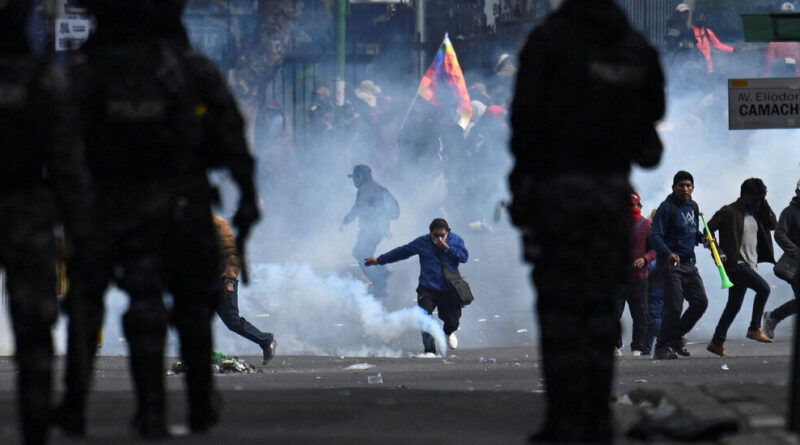
Bolivia has been consumed by crisis as a monthlong wave of protests and road blockades has effectively isolated the administrative capital, triggered shortages of basic food items and disrupted transportation. The upending of supply chains has also caused prices to spike.
The unrest escalated sharply over the past two weeks. Demonstrating miners set off dynamite in clashes with the police last Thursday and local media reported the looting on Monday of at least two government buildings and the burning of a police car.
As economic losses mount and some schools transition to virtual classes, a broad coalition of labor unions and Indigenous groups is demanding the resignation of President Rodrigo Paz. Demonstrators have flooded La Paz, the capital, dragging effigies of government ministers through the streets.
Many government offices and major businesses in La Paz have closed. In the neighboring city of El Alto, widespread blockades have left some streets deserted, with a lone bicyclist riding down an empty highway leading into the capital on Tuesday morning. Some transit workers carry respirators to protect them from tear gas fired by the police to disperse demonstrators.
Why is everyone so angry at the president?
Before Mr. Paz took office six months ago, Bolivia had been governed for two decades by the leftist Movement Toward Socialism, known by its Spanish acronym MAS.
Under MAS rule, rural farmers, Indigenous groups and the working class enjoyed remarkable political inclusion and significant social benefits, though critics accused the government of rampant patronage.
But a sharp economic downturn and deep internal fractures have disillusioned many MAS supporters. In a runoff election last October, many former MAS voters backed Mr. Paz, a senator who presented himself as a centrist alternative to a far-right opponent.
But since assuming office Mr. Paz has alienated many of those voters. Citing a commitment to meritocracy and expertise over political quotas, he filled his cabinet primarily with conservative business leaders, leaving Indigenous people and the labor and agrarian sectors unrepresented in key roles.
He also abolished a wealth tax and passed a contentious land classification law that critics said would make territories vulnerable to corporate takeovers.
The current unrest initially flared over specific grievances, including teachers demanding wage hikes, transport workers protesting contaminated fuel and Indigenous opposition to the land law. (The fuel issue was linked to the quality of supplies provided by the government.)
The government temporarily defused some tension by offering a bonus to teachers and repealing the land law, among other concessions.
The government’s efforts to mollify Bolivians haven’t worked
The concessions failed to address deeper institutional frustrations and could not halt the momentum of a rapidly expanding protest movement unified by a shared sense that the government did not care about the struggles of many Bolivians.
On May 6, Indigenous groups from the Andean highlands began blocking highways around La Paz, demanding the president step down. The mobilization quickly absorbed other factions, including workers whose wage demands weren’t addressed and loyalists of a former leftist president, Evo Morales, who staged a 118-mile march to the capital.
Since then the unrest has shifted from a dispute over specific grievances into an outright demand for Mr. Paz’s removal from office. For Bolivia’s large working class, the administration’s perceived pivot toward corporate interests represents a structural exclusion from a government it had influenced under MAS.
A former president’s supporters are fanning the protest flames
Mr. Morales, a former union leader who served as Bolivia’s first Indigenous president from 2006 to 2019, fundamentally reshaped the country by sharply reducing poverty before a disputed bid for a fourth term forced him into temporary exile.
Though a bitter internal feud within his party ultimately fragmented the left and cleared the way for Mr. Paz’s victory, Mr. Morales still commands a highly mobilized, fiercely loyal base, which has emerged as a central catalyst in the current escalation.
But while past anti-government blockades were largely confined to Mr. Morales’s rural strongholds and driven by his supporters, recent demonstrations have choked off La Paz and involve a broader coalition fueled by widespread economic distress.
René Soliz Villca, a fruit and cassava farmer, traveled to La Paz from the tropical Chapare region, Mr. Morales' stronghold.
He said many in the farmworkers’ organization that he leads voted for Mr. Paz, believing he was the candidate most aligned with the working class. Instead he has seen Mr. Paz seek alliances with other conservative and right-wing presidents, including President Trump, Argentina’s Javier Milei, and Chile’s José Antonio Kast.
“Rodrigo Paz has shifted his government platform to the far right, to the detriment of the majorities,” Mr. Soliz said.
How is the government dealing with the unrest?
The government has called for dialogue, while at the same time claiming without evidence that the protests are financed by drug trafficking. A presidential spokesman also accused Mr. Morales of attempting to destabilize the country to regain power.
So far, the authorities have been cautious about declaring a state of emergency or repressing the protests with greater police force.
Benjamin Swift contributed reporting from La Paz.

![Hossam Badran, a member of the Hamas Political Bureau, spoke exclusively to Al Jazeera about the group's vision for a long-term Hudna in Gaza. [Mohammad Mansour/Al Jazeera]](https://themuslimpress.com/wp-content/uploads/2026/06/Hamas-says-wont-surrender-arms-offers-‘no-visible-weapons-in-390x205.jpg)