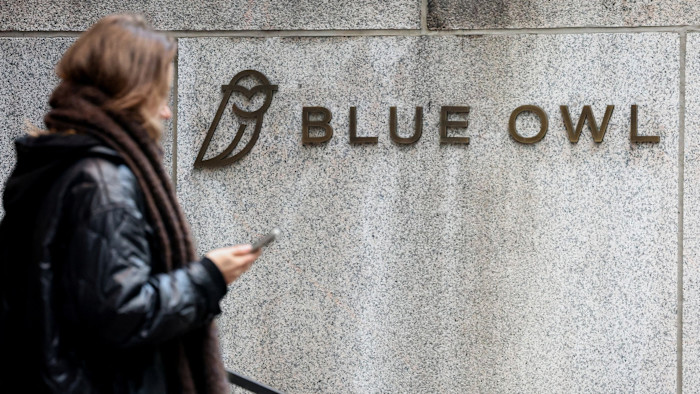
Blue Owl draws in $9bn as private credit market cools
Unlock the Editor’s Digest for free
Roula Khalaf, Editor of the FT, selects her favourite stories in this weekly newsletter.
Blue Owl Capital said investors committed $9bn to its funds in the first quarter, its lowest capital haul in a year, as fatigue around private credit cooled interest for some of its flagship vehicles.
The private credit-focused investment manager said its assets under management rose to $315bn at the end of March, just short of Wall Street forecasts.
Blue Owl shares rose from near multi-year lows after its leadership told investors they had not seen signs of growing stress in their lending portfolio. Sophisticated institutional investors continued to invest billions of dollars in new cash into their funds, management said on a Thursday conference call.
The company also noted its fundraising haul in the quarter was more than a third higher than a year before. Shares in Blue Owl closed 9.8 per cent higher on Thursday, but are still down by more than a third this year.
The firm has been in the eye of the storm brewing around private credit, with redemption requests surging at several of the flagship funds pitched to wealthy individuals. Blue Owl permanently gated withdrawals from one fund earlier this year as it moved to wind down the vehicle.
Even as the company continued to draw new clients into its funds, redemptions from some funds and the repayment on a number of loans it had originated limited the growth of the assets it can charge management fees on. Investment groups such as Blue Owl typically only collect management fees on the cash they have deployed.
So-called fee-paying assets under management rose about $700mn from the end of 2025 to $188bn, Blue Owl said on Thursday, below the $192bn analysts had forecast.
The pullback from private credit has hit the entire industry, as investors raise questions about the quality of loans made to private equity-backed software companies seen as vulnerable to advances in AI.
The $2tn industry had been at the forefront financing those software deals, with Blue Owl in the centre of the action with a handful of technology-focused private credit funds.
Blue Owl executives said on Thursday they had not seen any meaningful increase in defaults or warning signs of financial stress, like companies drawing down credit lines. However, co-chief executive Marc Lipschultz and chief financial officer Alan Kirshenbaum said the firm had made haircuts to valuations of software companies in their portfolio.
Loan-to-value ratios of Blue Owl’s software loans had risen from 30 per cent on average to 40 per cent, Lipschultz said, as the group reassessed the value of many companies they had lent to. But credit metrics remained healthy, he said. “I think there’s a lot of spring and cushion.”
Lipschultz warned that many large software private equity deals would require new capital when their debts matured in the coming years.
“You’re going to end up in a circumstance where you’re going to need to see a lot of equity injected by private equity firms into these companies in order to continue forward, even when they have many billions of dollars of equity value,” he said.
Investors have pummelled the New York-headquartered group’s stock as its shares have traded below the $10 price it listed at when the asset manager went public through a blank-cheque merger in 2021.
The company said its overall revenues continued to rise, bolstered by the management fees it charged on its funds. Overall fee-related revenues climbed 13 per cent from the same period last year to $700mn, while fee-related earnings increased 14 per cent to $394mn. Both figures eclipsed Wall Street expectations.
“Our financial results reflect stability, stemming from our durable capital base, and growth, driven by fundraising and ongoing capital deployment,” said Blue Owl co-chief executives Doug Ostrover and Lipschultz in a statement.