Google and Amazon's Earliest Backer Calls AI “Underhyped”
Topline
Venture capitalist John Doerr, whose early checks into Amazon and Google helped underwrite the modern internet, called artificial intelligence the “biggest tsunami” of innovation he’s ever tracked in his more than four decades of investing and has actually been “underhyped”—joining a growing group of tech power players making maximalist claims about where the technology is headed.
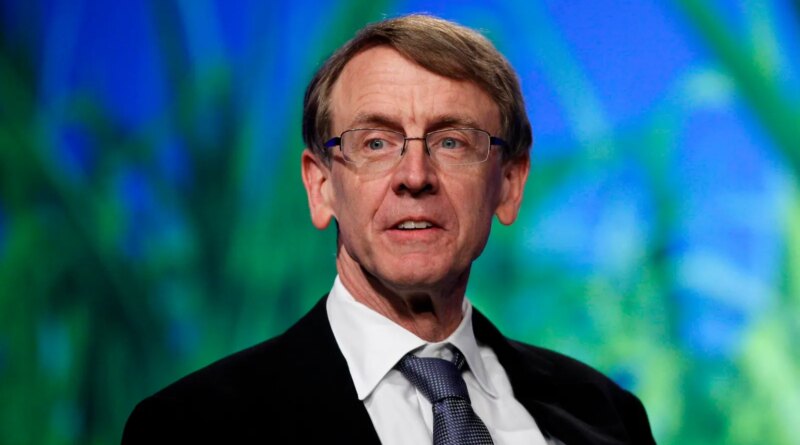
Venture capitalist John Doerr at Renmatix’s planned new headquarters and research center on September 27, 2011, in King of Prussia, Pennsylvania. (AP Photo/Matt Rourke, File)
AP2011
Key Facts
Doerr, 74, told The Wall Street Journal in an interview published Monday the latest AI wave is the “biggest thing ever. Since everything,” arguing the public still does not grasp how it will reshape education, employment, healthcare and “life as we know it.”
He framed AI as the fourth major “tsunami” in a roughly 13-year cycle he traces back to the 1980 PC and microchip revolution, followed by the internet wave and then the iPhone and cloud computing era.
Doerr cited adoption data to support the case, telling the Journal that “just three years after ChatGPT was launched, 50% of Americans say they use generative AI”—a figure consistent with an April 2026 Ipsos survey finding half of Americans had used an AI service in the past week.
He said his personal investing, now run through his family office after he stepped down as venture capital firm Kleiner Perkins’ chairman, is focused on entrepreneurs using AI to tackle the climate transition and transform healthcare.
On top of early bets in Google and Amazon, Doerr is known for his investments in companies including Twitter, DoorDash, Slack and Intuit.
Key Background
Doerr’s “underhyped” framing slots into an increasingly crowded field of tech billionaires and AI executives making sweeping, civilization-scale predictions about the technology. “We are heading toward a system that will be capable of doing innovation on its own. I don’t think most of the world has internalized what that’s going to mean,” OpenAI CEO Sam Altman told Forbes earlier this year. In late January, Anthropic CEO Dario Amodei warned in a blog post that humanity is entering “a rite of passage…which will test who we are as a species,” calling powerful AI potentially “the single most serious national security threat” of the century. Nvidia CEO Jensen Huang, whose company has ridden the buildout to a roughly $4 trillion market cap, told the World Economic Forum in Davos in January that AI has already triggered “the largest infrastructure build-out in human history” and told Carnegie Mellon graduates during his May commencement speech: “AI is not just creating a new computing industry, it is creating a new industrial era.” Bill Gates wrote in January that “there is no upper limit on how intelligent AIs will get or on how good robots will get,” and told “The Tonight Show” last year that within a decade humans “won’t be needed” for “most things,” with AI replacing doctors and teachers. Last week, the world’s richest man Elon Musk said at the Forbes Innovation 250 celebration dinner, “In five years, digital intelligence will exceed the sum of all human intelligence. In five years, there might be at least 100 million humanoid robots, but maybe a billion.”
Forbes Valuation
Doerr’s net worth sits around $24.4 billion thanks largely to his stake in Alphabet, per Forbes estimates. Doerr famously wrote Kleiner Perkins’ largest-ever check at the time—$12 million for 12% of a $100 million Google—after meeting Larry Page and Sergey Brin in a Menlo Park garage in 1999. Alphabet’s market cap has grown to $4.62 trillion today and shares are up more than 120% since last May thanks to the company’s AI pivot, from the Gemini model and AI overviews in its search function to its custom AI chips.
Tangent
Doerr has also conspicuously skipped investing in crypto, telling the Journal he didn’t see crypto as the kind of founder- and team-driven business that built his career in software, though he said “there is still plenty of time for me to be wrong.” His misses have a track record of their own: He infamously backed the Segway and Fisker Automotive, telling the Journal his partners reminded him “never invest in anything with wheels.” (He missed Tesla.)