Berlin Pride Event Attacker Killed in Police Shootout, Officials Say
The police on Sunday evening shot and killed the man suspected of killing a woman and injuring 29 other people near a Berlin gay Pride celebration after he charged at officers with a weapon, the German authorities said.
The man, a 21-year-old German citizen whose family members migrated from Lebanon, had been the subject of a protracted nationwide manhunt since the Saturday evening attack. The suspect used a rented van and what appeared to be a machete in the attack, which German officials called an act of Islamist terrorism.
In a brief statement, the police said they had tracked the suspect to an area in a western corner of the city where residents maintain large garden patches. After officers shot him, emergency responders tried to revive him, but he died at the scene, the police said.
The authorities said that their investigation into the attack was continuing, even after the death of the target of their manhunt, and that they had been looking for additional suspects.
“There is one other person under consideration, though nothing has been substantiated so far — nor has that line of inquiry been closed,” Alexander Dobrint, the federal interior minister, said in a televised interview on Sunday evening with the public broadcaster ARD. “Further measures are being taken, but we do not currently believe there is any further threat.”
From the time of the attack late on Saturday night, in the city’s central Tiergarten park, the authorities had scoured Berlin, along with the nation’s rail stations, airports and border crossings. They were searching for a man the police had identified only as Abdul B., in keeping with German privacy laws.
“These criminals, these extremists, have no place in the middle of our society,” Mr. Merz said on Sunday afternoon before entering a memorial service at St. Mary’s Church in central Berlin. “And we will not allow this poison of terrorism and this poison against our freedom to spread further.”
Kai Wegner, the mayor of Berlin, told reporters at a news conference on Sunday afternoon near the site of the attack that “we are presumably looking at an Islamist terror attack directed at our way of life, our liberal democracy, our openness and our freedom.”
Mr. Dobrindt echoed that assessment, saying the attack was most likely Islamist terrorism.
He said the suspect had a history of radicalization and a criminal record, including a conviction, for a crime authorities did not detail, for which he had recently received a suspended sentence that prosecutors had appealed. In his evening interview, Mr. Dobrint confirmed news reports that the suspect had been undergoing a court-ordered “de-radicalization” course.
The manhunt ended around 6 p.m. in the western Berlin neighborhood of Spandau, in a cluster of garden plots where the suspect had apparently fled.
“The suspect approached our police force with a stabbing weapon,” Florian Nath, a spokesman for Berlin’s police, said in a brief video posted to social media on Sunday evening. “This triggered a response. Our police force used its firearms. The suspect suffered severe injuries. Emergency doctors were able to revive the suspect for a brief time. The suspect died moments later.”
The police first said early Sunday that they were searching for “at least one suspect” after the attack on the periphery of the annual Christopher Street Day parade, which drew hundreds of thousands of revelers to the city center on Saturday. The festivities included a concert on Saturday evening near the Brandenburg Gate and the Tiergarten.
Shortly after 10 p.m., the authorities said, a white minivan sped through a side street leading out of the park, outside of the official festival grounds and security complex, striking pedestrians on a sidewalk and eventually crashing into a tree. The driver ran away. Video footage showed the car’s front grille smashed and its body heavily dented.
Mr. Dobrindt said the attacker had wielded what appeared to be a machete during his rampage. Some victims had suffered stab wounds. Emergency workers quickly arrived and began administering first aid, he said.
“It was a horrific scene,” Mr. Dobrindt said.
Berlin’s Charité hospital treated eight of the injured and had released four of them by midday Sunday, with the other four remaining in intensive care with non-life-threatening injuries, hospital representatives said.
The attack reignited a debate in Germany about migration, religious extremism and public safety. It came months before Berlin and two other eastern states are set to hold closely watched regional elections in which polls have already suggested far-right parties are poised to make gains, partly on the basis of Germans’ anxieties over public violence.
In recent months, as the United States and Israel have engaged in war against Iran, German intelligence officials have privately warned of the threat of Tehran-sponsored attacks on German soil. In his evening interview, Mr. Dobrint said that based on mounting intelligence, the government had recently raised its national threat level to “high.”
“The Islamist threat has not been underestimated,” he said. “It is being monitored very closely.”
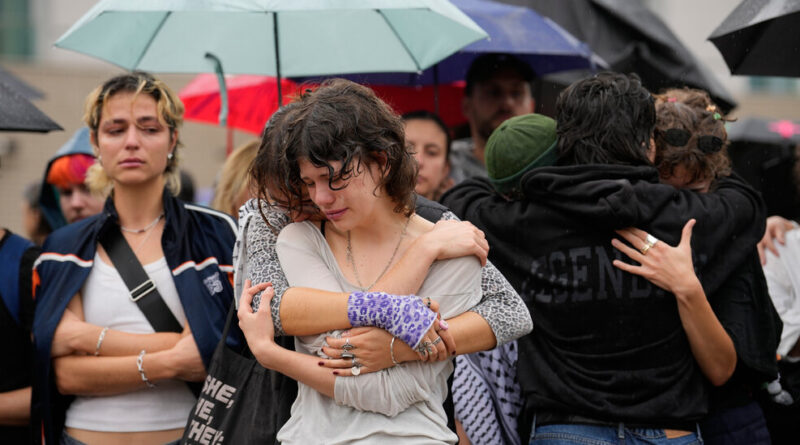
The Christopher Street Day celebration drew hundreds of thousands of revelers to Berlin, with organizers canceling a final slate of planned events on Sunday morning. The attack near it plunged into grief a community that only hours earlier has spent much of the day dancing in colorful costumes under idyllic summer skies.
The event is named for the New York City street known for its association with the Stonewall riots that inspired the modern gay rights movement.
Early Sunday, roads near the site of the attack were blocked off by a heavy police presence. Nearby, emergency personnel had erected a tent to take care of distraught witnesses. Some were seen hugging each other, and some had thermal blankets wrapped around them.
Hours earlier, barricades had blocked vehicle traffic on roads leading through the Tiergarten, while throngs of revelers, many wearing glittery, colorful outfits, danced to the throbbing sounds of techno music, spilling into cafes and beer gardens nearby.
By late evening, the sounds of celebration had given way to the blare of sirens and the drone of helicopters circling over the area.
Alfonso Pantisano, the L.G.B.T.Q. affairs commissioner for Berlin’s state government, said in an interview on Sunday that he was in the crowd at the celebration when organizers announced an evacuation order immediately after the attack. He stayed to help others evacuate, he said.
Mr. Pantisano has helped lead an effort meant to respond to growing acts of violence against Berlin’s L.B.G.T.Q. community. He said the attack “was a surprise, even though we were all thinking that at some point it would and could happen.”
“It could have been all of us” targeted by the attacker, he said. “And that is the scary thing about it.”
Phillip Kaleta contributed reporting from Berlin.