Berkshire cash pile climbs to $380bn as stock sales streak hits 14th quarter
Unlock the Editor’s Digest for free
Roula Khalaf, Editor of the FT, selects her favourite stories in this weekly newsletter.
Berkshire Hathaway continued to sell stocks in its first quarter under the command of new chief executive Greg Abel, pushing its cash pile above $380bn as it held off on using its war chest to dive into a volatile market.
The sprawling insurance-to-industrials conglomerate said its cash and short-term Treasury bills climbed by $7bn from the end of 2025, excluding the value of US government debt it had bought but still had to pay for.
That cash has been a focus for investors, given the company has been shedding stocks for more than three years.
Some of it must be held to meet regulatory limits designed to safeguard insurance policyholders, but analysts and investors believe the company still has considerable dry powder that it could use to clinch a mammoth acquisition or buy minority stakes in publicly traded stocks.
Berkshire disclosed that it had sold $24bn worth of stocks, with purchases of $15.9bn, stretching its net sales streak to 14 consecutive quarters. It generated taxable gains on those stock sales of $7.2bn.
The sales marked Berkshire’s largest quarter of stock disposals from its $288bn equity portfolio since 2024, when it dumped a large portion of its stake in Apple.
The quarterly report indicated that Berkshire sold stocks in the banking, financial services and consumer products industries. It will set out the exact changes Abel and Berkshire investment lieutenant Ted Weschler made to the portfolio this month.
Net income more than doubled from a year earlier to $10.1bn. Berkshire’s preferred measure of profitability, the operating earnings of its hundreds of subsidiaries, rose 18 per cent year-on-year to $11.3bn.
Those figures strip out the price movements in Berkshire’s stock portfolio, which US accounting rules dictate the company must report in its net profit figure.

The company’s results are widely scrutinised by investors and economists for signs of the health of US consumers and industries, as its portfolio of companies touches nearly every part of the economy.
In the first quarter they indicated strong US growth, albeit with pockets of weakness.
Profitability at Berkshire’s railroad BNSF increased as it benefited from stronger demand to ship products across the US. But it noted weakness in homebuilding and building products, attributing it to “lower customer demand, attributable to prevailing general economic conditions”.
The company’s core insurance operations reported a 29 per cent jump in profits as its reinsurance division helped to offset declining earnings at auto insurer Geico, where it increased spending to draw in new customers but paid out higher claims.
Berkshire disclosed that it purchased $234mn-worth of its own stock in March, the first time it had bought its shares for 22 months and the first such purchases to be directed by Abel.
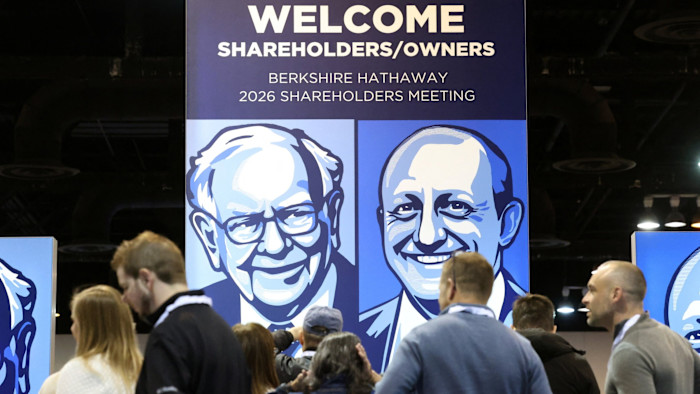
The results came hours before Abel takes the stage at the company’s annual meeting, an event sometimes referred to as the “Woodstock for capitalists”.
Abel replaced longtime Berkshire chief executive Warren Buffett at the helm of the company this year.
In classic Berkshire style, at this weekend’s gathering the company was selling novelty cards adorned with Abel’s and Buffett’s faces and the phrase “Card Carrying Capitalist”. They cost $2, with the proceeds going to the non-profit organisation Girls Inc.
The event, which takes over an arena and exhibition hall in downtown Omaha, has attracted tens of thousands of Berkshire shareholders.
On Friday afternoon Abel walked through the convention area, where dozens of Berkshire subsidiaries including chocolatier See’s Candies and BNSF had stands to sell products and meet shareholders.
The company’s rodent control business, Bell Laboratories, was selling limited-edition rat traps branded with the Berkshire Hathaway name.
Security guards flanked Abel as he stopped to take pictures and hear from shareholders.
Dan Sheridan, the chief executive of Berkshire subsidiary Brooks Running, said the question for most of those gathered in Omaha was how the transition from Buffett to Abel was progressing and whether the new chief executive would deviate from his predecessor.
“It’s the question of the weekend: How’s the transition going?” he said. “Greg is his own man. He’s going to make changes. I don’t know what those are, but I can tell you initially it’s been very consistent with how he led in his other roles.”