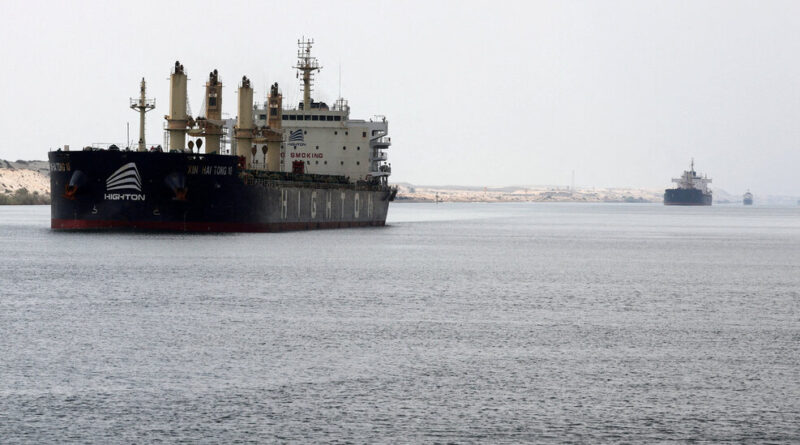
Attack on Egyptian Port Shows Suez Canal’s Vulnerability
An attack on an Egyptian port near the Suez Canal demonstrated the important waterway’s vulnerability and showed how the widening conflict in the Middle East could further disrupt global trade, analysts said on Thursday.
Two ships, including a U.S.-owned gas storage tanker, caught fire in the Wednesday attack at the Port of Damietta, which Egypt said on Thursday appeared to have been carried out with a drone. The episode did not appear to disrupt traffic to the Suez Canal, which is southeast of the Mediterranean port.
But two Iranians, who asked not to be named to discuss security matters, said on Wednesday that the strike was meant to show that global shipping and energy supplies could be disrupted further if Iran chose to escalate. The Iranians did not say whether Iran or one of its allies had carried out the strike.
About 10 percent of seaborne trade moves through the Suez, with about 50 ships passing through the 120-mile canal each day, according to the Suez Canal Authority, an Egyptian government agency.
The canal, which connects the Mediterranean Sea and the Red Sea, is the shortest maritime route between Europe and the Indian Ocean, linking supply in Asia and the Gulf to demand in Europe and North America.
It is not an alternative to the Strait of Hormuz, which has been mostly blocked since the United States and Israel attacked Iran in February, because it supplies a different trade route. But a disruption of traffic through the Suez would force ships to undertake longer, costlier journeys around Africa, via the Cape of Good Hope, analysts said.
“The Hormuz and Suez risk stories are increasingly separate but compounding,” said Dimitris Ampatzidis, a maritime risk analyst at Kpler, a maritime-tracking firm.
The Wednesday attack — the first on Egyptian territory since the war began — effectively reinforced the blockade declared in the Red Sea last week by the Houthis, the Iran-backed militia in Yemen, said Nitya Labh, an analyst at Chatham House in London who focuses on maritime security. “It raises the stakes of the conflict and increases the leverage that the Houthis and Iran share,” Ms. Labh said.
The Houthis control the Bab al-Mandeb Strait, a narrow waterway between the southern end of the Red Sea and the Gulf of Aden. The militia has fired missiles and drones into Saudi Arabia and at ships in the Red Sea, widening the conflict and adding to the strains put on global trade since the war began.
President Trump said on Wednesday that he had been briefed on the attack on the Port of Damietta and implied that Iran was responsible for it. Egypt has not publicly blamed anyone for the attack. Ms. Labh said Egypt was being careful not to point fingers, hoping to avoid reprisal attacks and shocks to its economy.
A sustained disruption to traffic through the Red Sea would be a direct blow to Egypt’s economy. The country is deeply in debt, and revenue from the Suez is one of its major sources of hard currency, Mr. Ampatzidis said. The Suez Canal Authority said at the end of last year, before the Iran war began, that it expected the canal to generate $8 billion in revenue this fiscal year and $10 billion the next.
When the Ever Given, one of the world’s largest container ships, was stuck in the Suez for nearly a week in 2021, the global traffic jam held up nearly $10 billion of cargo a day and cost the Egyptian government up to $90 million in lost toll revenue.