Iren's Earnings Weren't Groundbreaking, but 2027 Looks Very Promising | The Motley Fool
Iren (IREN -12.53%) isn’t a 2026 story. Many investors rushed to sell their shares after the company’s fiscal 2026 fourth-quarter results were released. Iren delivered $137.2 million in revenue in Q4 of fiscal year 2026 (FY26), a 26.7% year-over-year decline.
A $684 million net loss in the quarter and a projected $25 billion to $30 billion in capital expenditures (capex) for fiscal 2027 made things worse and accelerated the sell-off. It’s hard to call it disappointing, since it was expected this quarter. The catalysts that make people think Iren is a generational buying opportunity are on the horizon, and this earnings result strengthened the long-term thesis.
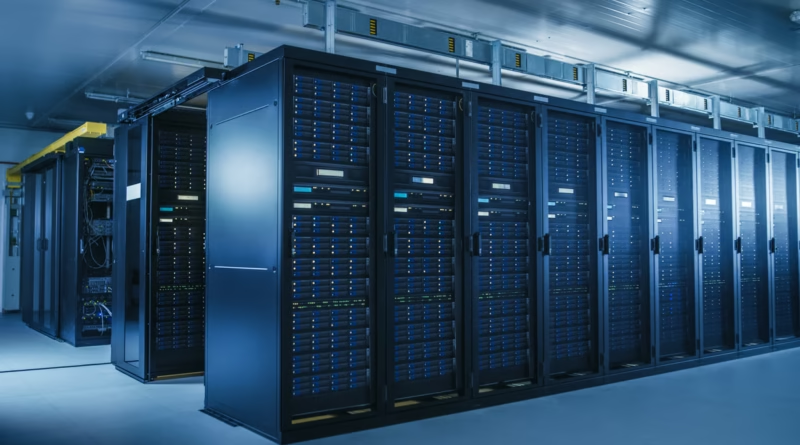
Image source: Getty Images.
Iren is taking its sweet time to secure deals
Iren is aiming for 300 megawatts of delivered power by 2026 and intends to boost that number to 800 megawatts by the end of 2027. That’s a small slice of the company’s 5.8 gigawatt portfolio.

Today’s Change
(-12.53%) $-5.08
Current Price
$35.45
Key Data Points
Market Cap
Day’s Range
$34.81 – $38.05
52wk Range
$25.31 – $76.87
Volume
89.9M
Avg Vol
45.6M
Gross Margin
9.84%
Although the company announced a “multi-year AI Cloud contract with a leading frontier AI lab” in the Q4 FY26 press release, that hasn’t been enough for investors. Iren will be forever compared to Nebius, which is closing bigger deals at the moment and realizing AI cloud revenue at a faster rate.
However, the decision to wait has been fruitful. Iren has been closing deals that come to $20 million per megawatt annually. It’s even working on deals with tech companies that will provide $25 million per year for each contracted megawatt.
For comparison, the 5-year, $9.7 billion deal with Microsoft was for 200 megawatts. The annual $1.94 billion from that deal puts it at $9.7 million per megawatt. That’s less than half of what Iren is getting right now.
If Iren were negotiating that same deal today, it could have ended up with more than $20 billion over five years. This math justifies Iren’s decision to be selective with deals. The longer they wait, the more valuable their compute becomes.
The major catalyst did not show up in fiscal 2026 results
The Microsoft deal put Iren on the map. While the stock rallied long before this deal as investors speculated about the opportunities, the thesis truly materialized with that deal.
Iren finally announced that it delivered Horizon 1 on Aug. 13. It covers 50 megawatts out of the 200 megawatts included in the deal. Iren CEO Dan Roberts said the company is working to deliver Horizons 2 to 4 “later this year.” When that happens, Iren will start to realize all $1.94 billion in annual recurring revenue instead of just a quarter of that figure.
Naturally, a project delivered in August will not appear in the financial results for the quarter ended June 30, 2026. That’s why AI cloud revenue only came in at $70.5 million. Horizon 1 will only show up in part of next quarter’s results. It will take a little longer for Horizons 2 to 4 to show up in results, but they should be in all future results when the calendar flips to 2027.
Horizon 1 unlocks $485 million in annual recurring revenue. The next two fiscal quarters will feature meaningful sequential growth for Iren’s cloud segment just due to the timing of Horizon 1. The delivery of additional projects will fuel the compounding.
Iren can cover its capital expenditures without diluting shareholders
The $25 billion to $30 billion capital expenditure figure also spooked investors. That’s how much Iren expects to spend in its fiscal 2027. However, Iren CFO Anthony Lewis put those concerns to rest when explaining how the company would raise the necessary capital.
Iren already has $14 billion sitting on its balance sheet. Lewis said the company intends to close the gap with an additional $8 billion in graphics processing unit (GPU) financing and prepayments. He also said that data center financing was on the table.
This news means shareholder dilution, a major point of contention, may be in the past. Prepayments are also rising because Iren can command higher revenue per megawatt. Iren said in its Q4 FY26 press release that prepayments have been representing 45% to 55% of GPU capex.
Iren closed out Aug. 26 with $1 billion in operating annual recurring revenue. That figure includes Horizon 1. It’s also expecting $4 billion in operating annual recurring revenue by the end of the year, which puts future AI cloud revenue at $1 billion per quarter. That’s vastly higher than the $70.5 million in Q4 FY26 cloud revenue.
The sell-off is an extreme miscalculation from investors who expected Iren to deliver meaningful results right now. That was never in the cards, but the foundation has been set for a big rally in 2027 and beyond.