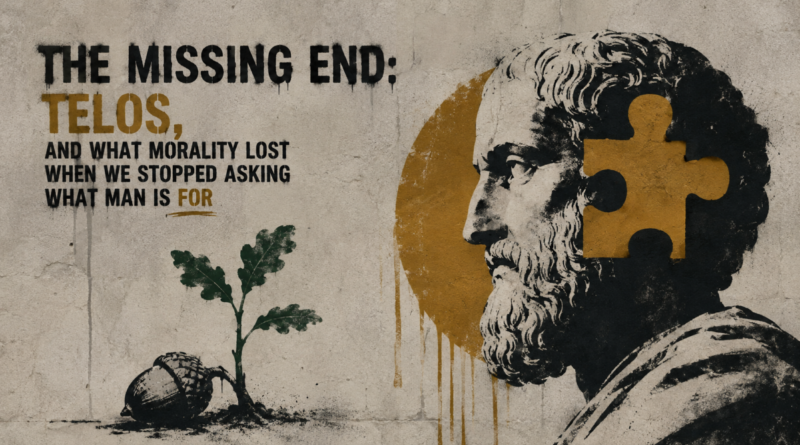
The Missing End: Telos, and What Morality Lost When We Stopped Asking What Man Is For
Start with an acorn. Bury it, water it, wait. If nothing interferes, it does not become a tulip or a stone or a puddle. It becomes an oak. The oak is not an accident that happens to the acorn; in a real sense, the oak is what the acorn was for all along. The acorn is an oak-in-progress—a thing pointed, from the start, at a particular finish.
The ancient Greeks had a word for that finish: telos. It means end, goal, purpose, completion—the point toward which a thing is moving, the state in which it is fully itself. The study of things in terms of their ends is called teleology. And for most of Western history, teleology was not one theory among others. It was simply how educated people understood the world. To grasp what a thing is, you had to know what it was for.
This one idea—so intuitive that a child grasps it about acorns—turns out to be the hidden foundation of nearly everything we once believed about meaning, human nature, and right and wrong. When it was quietly pulled out from underneath us a few centuries ago, the whole structure of morality began to sag in ways we are still living inside of, mostly without noticing. This is the story of that idea: where it came from, why it was discarded, what fell down when it fell, and why the case for its return is stronger than the modern world likes to admit.
Aristotle and the four questions
The thinker who turned this intuition into a system was Aristotle, in the fourth century BC. Aristotle noticed that when we ask “why does this thing exist?” or “why is it the way it is?”, we are actually asking up to four different questions at once. He called them the four causes, though “cause” here means something broader than our modern use—closer to “the four kinds of explanation.”
Take a wooden chair. You can explain it by its material—it is made of wood. You can explain it by its form—it has the shape and structure of a chair, four legs and a flat seat and a back. You can explain it by its method—what brought it into being: the carpenter who built it. And you can explain it by its purpose—it exists so that someone can sit. That last one, the purpose, is the final cause, from the Latin finis, “end.” It is the telos.
Aristotle’s radical claim was that the final cause is not an optional extra. It is often the most important of the four, because it is the one that makes sense of the others. Why is the chair shaped like that, made of that, built by that person? Because of what it is for. Remove the purpose and the chair becomes an inexplicable arrangement of matter. Keep the purpose and everything else falls into place.
He then did something that would echo for two thousand years: he applied this to living things and to human beings. Every kind of creature, he argued, has a characteristic activity—an ergon, a “function” or “work”—that makes it the kind of thing it is. The function of the eye is to see. A good eye is one that sees well; a defective eye is one that does not. Notice what happens here: once you know what a thing is for, the words “good” and “bad” stop being matters of opinion and become matters of fact. A good knife cuts. A good heart pumps blood. Nobody thinks “this is a good knife” is merely how they happen to feel about it.
And human beings? Aristotle asked what our distinctive function is—the activity that belongs to us and nothing else. Not mere growth, which we share with plants. Not mere sensation and appetite, which we share with animals. What is uniquely ours is reason: the capacity to think, to deliberate, to grasp what is true and choose what is good. The human telos, then, is the full and excellent exercise of that capacity across a whole life. He gave this fulfilled state a name we still reach for and still mistranslate: eudaimonia. We render it “happiness,” but it means something far weightier—a life that has gone genuinely well, a human being flourishing as a human being, the way a healthy oak flourishes as an oak.
The world that ran on purpose
Aristotle’s framework did not stay in the lecture hall. It became the operating system of the Western mind for the better part of two millennia. The medieval world in particular was teleological through and through. Thomas Aquinas, working in the thirteenth century, folded Aristotle into Christian theology and concluded: every created thing has a purpose, those purposes fit together into a cosmic order, and the whole order is oriented toward God as its ultimate end.
In this picture, morality was not mysterious. The moral law was simply a description of how a human being reaches the telos built into human nature—the instructions, so to speak, printed on the inside of the box. Just as there are better and worse ways to be an oak or an eye or a knife, there are better and worse ways to be a human, and the “better” ways are the ones that carry us toward what we are for. Right and wrong were as real, and as knowable, as health and sickness.
This explains something modern people find baffling: how anyone could ever have thought morality was objective, a matter of fact rather than feeling. The answer is that they lived inside a teleological world. In that world, “you ought to be honest” was not a bare command floating in the void. It was more like “you ought to eat vegetables”—advice grounded in what genuinely serves the kind of creature you are. The “ought” grew directly out of the “is.” There was no gap between them, because human nature came with a purpose stitched into it, and the purpose told you what fulfillment looked like.
The great subtraction
Then, over roughly two centuries, telos was quietly deleted from the natural world—and this may be the single most consequential intellectual event of the modern age.
It began with the Scientific Revolution. Figures like Galileo, Descartes, and Newton discovered that you could describe nature with astonishing precision by ignoring purposes entirely and attending only to matter, motion, and mathematical law. You did not need to know what a falling rock was for in order to predict exactly how it would fall. On its own terms, this was one of the most consequential decisions in human history. Nearly all of modern physics, chemistry, and technology flows from the choice to stop asking “what is it for?” and start asking “how does it work?”
But a fateful slide occurred. A method—”leave purposes out of your equations”—hardened into a metaphysics: “there are no purposes.” A useful decision to stop looking for something became a confident announcement that the thing was not there. Nature was recast as pure mechanism, matter in motion, a vast clockwork with no aims, no goals, no built-in point.
The final blow came from Charles Darwin in the nineteenth century. The one place teleology seemed impossible to deny was biology: the eye so obviously seems made for seeing, the wing for flying, that purpose looked undeniable. Darwin’s theory argued for the appearance of purpose without any actual purpose. That the eye was not designed for anything; it was the accumulated residue of countless blind variations, filtered by survival. From this standpoint, what looked like aim was really just the leftovers of a process with no aim at all. Biologists coined a careful term for this—teleonomy, the mere appearance of purposiveness—precisely to avoid saying teleology, real purpose.
So when the cosmos lost its purpose. Then, inevitably, so did man. For if a human being is simply one more arrangement of matter thrown up by a purposeless process, then there is no fact about what a human being is for. The box arrived with no instructions, because there was no manufacturer and no intended use. The telos of man had been erased.
What fell down when telos fell
Most people did not notice anything collapse, because the collapse was invisible and slow. We kept the old moral vocabulary—duty, virtue, rights, good, evil—long after we had demolished the foundation that gave those words their meaning. We are, the philosopher Alasdair MacIntyre argued in his landmark 1981 book After Virtue, like people using the fragments of an ancient science whose theory has been forgotten. We still say the words. We no longer have the framework that made them make sense.
MacIntyre laid out the old scheme with beautiful clarity. Classical morality, he showed, always had three parts. There was human nature as it happens to be—raw, untutored, full of appetites and impulses. There was human nature as it could be if it fulfilled its telos—the flourishing, completed version of ourselves. And between them stood the moral rules, whose entire job was to carry us from the first state to the second. Ethics was the science of that journey. The rules made sense because they were the route from where we are to where we are meant to be.
Now watch what happens when you delete the telos, the destination. You are left holding two things: your raw, untutored nature on one side, and a list of moral rules on the other—but the rules no longer lead anywhere. The bridge has lost its far bank. “Don’t lie,” “don’t be cruel,” “keep your promises” used to be directions to a real place. Now they are directions with the destination torn off. Why follow them? Toward what? The honest answer, once telos is gone, is: no reason in particular.
This is why, MacIntyre argued, every great Enlightenment project to rebuild morality on a new foundation failed—and had to fail. Immanuel Kant tried to ground it in reason alone. The utilitarians tried to ground it in pleasure and pain. Others tried sentiment, or contract, or self-interest. Each was brilliant; each collapsed under objection; none commanded lasting agreement. They were all trying to justify the leftover rules of a teleological system while denying the telos that had justified them in the first place. It is like trying to explain why the pieces of a broken statue should be arranged just so, while insisting there never was a statue.
Out of this failure grew the water we now swim in. If moral claims cannot be grounded in any fact about what humans are for, then what are they? The unsettling modern answer is: expressions of feeling. “Cruelty is wrong” turns out to mean something closer to “I disapprove of cruelty—do so as well.” Philosophers call this emotivism, and whether or not people have heard the word, most now half-believe the thing. It explains why our public moral arguments never end and never persuade: with no shared standard of what human life is for, each side is finally just broadcasting its preferences at higher and higher volume, and there is no court of appeal above the shouting.
The deeper losses ripple outward from there:
The is-ought gap. The philosopher David Hume famously observed that you cannot logically derive an “ought” from an “is”—you cannot get from facts about how the world is to conclusions about how we should act. This is treated as an iron law of ethics. But notice: it is only true after telos is removed. In a teleological world there is no gap to cross. From “this is a heart” you get straight to “this heart ought to pump blood,” because “heart” is a purpose-laden concept. “Human being” used to be exactly that kind of concept. Strip out the purpose, and the gap yawns open—not because it was always there, but because we pried it open ourselves.
The point of a life. If there is no telos, a human life has no built-in destination, no plot, no completion it is reaching for. It becomes one thing after another until it stops. The oldest human questions—What is it all for? What am I here to do? What would it mean for my life to have gone right?—become, strictly, unanswerable, even nonsensical. Friedrich Nietzsche saw this with terrible clarity. When he announced that “God is dead,” he was not gloating; he was raising an alarm. He understood that erasing the source of purpose meant erasing the ground of all value, and that the abyss beneath that erasure—nihilism, the sense that nothing matters—was now open under our feet, whether or not we chose to look down.
The very idea of flourishing. We still speak endlessly of wellness, thriving, living your best life. But flourishing only means something if there is a standard of what a flourishing specimen of our kind actually is. Without a human telos, “flourishing” quietly shrinks to “feeling good”—and feeling good is something a contented pig, or a man on comfortable drugs, can achieve. We keep the word because we cannot bear to lose the thing. But we have kicked away what the word was standing on.
The case for the telos of man
So the modern world tells us that man has no purpose—that the acorn logic stops, mysteriously, at us. But is that actually true? Here is the case that it is not, and that a human telos is real. Not one argument but several, converging from different directions, which is how you can tell you may be circling something real.
First: we cannot actually live without it. The denial of telos is a claim people make in seminars, not one they can enact for a single afternoon. Everyone who deliberates about what to do with their life is already assuming that some ways of living are better and worse, more and less fulfilling, more and less wasted. The person who says human life has no purpose will still call a talented life squandered on addiction a tragedy—and “tragedy” is a purpose-word; it means a thing that failed to become what it could have been. We are simply not able to think about our own lives except as aimed at something. A concept you cannot stop using in practice, even while denying it in theory, is probably tracking something true.
Second: we never denied it for anything else alive. Here the modern position turns out to be strangely arbitrary. No biologist hesitates to call a wolf that cannot hunt, or an oak that cannot sink roots, a defective specimen. This is not sentimental projection; it is grounded in the kind of thing each is—what the philosopher Philippa Foot called natural goodness. A living organism just is the sort of thing for which “good specimen” and “damaged specimen” are plain facts, read off from the form of life itself. Now: a human being is a living organism. On what principled ground does the objective standard that applies to every other creature suddenly evaporate when it reaches us? Either we are exempt from biology, or there is a fact about human flourishing too—fixed by our nature as reasoning, speaking, social, purpose-pursuing animals—just as there is a fact about the flourishing of wolves.
Third: reason itself has a telos, and you must use it to deny telos. Thinking is not aimless. It aims at truth; that is what thinking is for. A belief that gets reality right is a good belief, and one that gets it wrong is a defective one—and no one treats this as mere preference. But this means the very faculty you are using to argue that nothing has a purpose is itself a purpose-laden thing, structured toward an end. The argument against telos can only be made by wielding an instrument that is soaked in telos. The position quietly saws off the branch it is sitting on.
Fourth: every attempt to escape telos smuggles it back in. Look closely at the modern ethical systems that were supposed to replace it. Utilitarianism says: maximize well-being. But “well-being” is a telos—a picture of the human good. Kant says: treat rational agency as an end in itself. But that is a telos too, and Kant even calls it an end. The concept was declared dead and then kept turning up in the will of its executioners, because it turns out to be load-bearing. You cannot build an ethics without it; you can only hide it and hope no one asks where the foundation is.
Fifth: we are the animal that cannot be satisfied by satisfaction. Feed a cat, warm it, and it is content. Give a human being every comfort and appetite fulfilled, and something in us grows restless and asks: is this all? Augustine named it the restless heart. Every tradition has noticed it—the peculiar human refusal to be finally quieted by mere pleasure or safety, the reaching-past of a creature built to aim at something beyond its own appetites. This dissatisfaction is not a malfunction. It is a compass needle. A being with no telos would rest when its needs were met. We do not, because our end lies past them.
Sixth: the world’s wisdom traditions, starting from utterly different places, converge on the same shape. Aristotle’s reasoned flourishing, the Stoic life lived according to nature and reason, the Confucian labor of self-cultivation, the Buddhist release from craving, the Abrahamic ordering of the soul toward its Creator—these grew up in ignorance of one another, from incompatible metaphysics. Yet they arrive at a remarkably common portrait of the human telos: the ordering of desire under reason and wisdom, the patient formation of virtue, and the movement of the self beyond the grasping self toward something larger than it. When independent explorers, setting out from different continents, keep drawing the same coastline, the reasonable conclusion is that there is a coast.
What, then, is man for?
Put the strands together and a picture emerges—not a proof that forecloses all argument, but a case sturdier than the shrug of modern nihilism.
The telos of a human being is the full flowering of what is distinctively human: to bring our defining capacities—reason, love, moral choice, and the reach toward what is greater than ourselves—to their excellent completion across a whole life. It is to govern appetite by wisdom rather than be dragged by it; to become, through practice, the kind of person for whom courage and honesty and justice are second nature; to know truth and to love the good; and to orient the self, restless by design, toward the end that finally answers its restlessness. Aristotle called the fulfilled state eudaimonia. The religious traditions name the ultimate object toward which that whole orientation strains. One need not settle that highest question here to see the shape of the thing plainly: a human being is not a heap of matter that happens to twitch, but a creature built to aim—and its flourishing consists in aiming true.
This is what was lost in the great subtraction, and this is what is at stake. Restore the human telos, and morality stands up again on its feet: right and wrong become, once more, facts about what does and does not carry us toward our fulfillment, the way health and sickness are facts about the body. The bridge regains its far bank. The moral words we never stopped using—good, virtue, ought, meaning—get their meaning back. And the oldest questions become answerable again, because there is once more a target for the arrow of a life.
The modern age asked us to believe that the acorn logic runs through all of nature and then, without explanation, stops at the doorway of the human soul—that everything is aimed at something except the one creature capable of asking what it is aimed at. That is not a discovery. It is a superstition wearing the costume of science. We are the acorn that knows it is meant to be an oak. The only remaining question is whether we will grow.