One Religion, Many Rites
In the introduction to his translation of the Quran, Quran: The Final Testament, Dr. Rashad Khalifa writes:
“While every religion has been corrupted by innovations, traditions, and false, idolatrous doctrines, there may be ‘Submitters’ within every religion. There may be Submitters who are Christian, Jewish, Muslim, Hindu, Buddhist, or anything else. These Submitters, collectively, constitute the only religion acceptable to God. As emphasized by the theme on the front page of this book, all Submitters who are devoted to God ALONE, and do not set up any idols beside God, are redeemed into God’s eternal kingdom (2:62). A criterion of the true submitters is that they will find nothing objectionable in the Quran.”
It is worth pausing on how radical a statement this is to place at the front door of the Quran. Dr. Khalifa is asserting that the saved community cuts across every confessional boundary—that there may be Submitters inside Christianity, inside Hinduism, inside Buddhism, inside institutional Islam itself—and that this dispersed, unlabeled community, defined only by exclusive devotion to God, “constitutes the only religion acceptable to God.” The introduction even enacts the claim typographically: before the reader arrives at a single verse of the Quran, Dr. Khalifa sets the Shema of Deuteronomy and the Gayatri Mantra of the Yajur Veda side by side as witnesses to the same First Commandment. The one religion, he is saying, has left its signature everywhere.
There is a persistent assumption—shared, ironically, by both critics of Islam and many of its defenders—that the Quran presents itself as the founding document of a new religion, one that arrived in seventh-century Arabia to compete with and supersede Judaism, Christianity, and everything else. On this reading, “Islam” is a proper noun, a brand, a bounded confessional community with a start date, and salvation is a matter of holding the correct membership card.
The Quran itself resists this reading at nearly every turn. Read on its own terms, the book makes precisely the claim Dr. Khalifa’s introduction distills: that there has only ever been one religion, revealed to every people through their own messengers, expressed through varying rites and laws, and that the divisions among religious communities are a human corruption of that original unity—not evidence of competing revelations. The Quran does not announce a new religion; it announces the oldest one, and diagnoses everything else as sectarian drift away from it.
The case is worth making carefully, verse by verse, because the argument does not rest on one or two proof-texts. It is woven through the Quran’s account of prophecy, its vocabulary, its salvation criteria, and its polemics. What emerges is not the soft relativism sometimes marketed as perennialism—the claim that all religions are equally true—but something more precise and more demanding: a single, invariant din (religion) beneath a plurality of forms, with a clear criterion for distinguishing fidelity to it from corruption of it. Khalifa’s final sentence above already signals the difference: the true Submitters “will find nothing objectionable in the Quran.” The unity is real, but it is not criterionless—and the criterion, this article will argue, is the Quran’s own.
The Same Religion Enjoined on Noah
The most direct statement of the thesis comes in Surah 42:
He decreed for you the same religion (din) decreed for Noah, and what we inspired to you, and what we decreed for Abraham, Moses, and Jesus: “You shall uphold this one religion, and do not divide it.”The idol worshipers will greatly resent what you invite them to do. GOD redeems to Himself whomever He wills; He guides to Himself only those who totally submit. (42:13)
The verse could hardly be more explicit. The din given to Muhammad is not new; it is the same religion (shara’a lakum mina al-dini ma wassa bihi Nuhan) given to Noah, Abraham, Moses, and Jesus. And the single commandment attached to this shared religion is telling: uphold it and do not divide in it. Division—not disbelief in some yet-unrevealed final dispensation—is named as the primal religious failure.
This is reinforced by the Quran’s repeated insistence that its messenger brings nothing novel:
“Say: I am not producing something new among the messengers.” (46:9)
What is said to you is precisely what was said to the previous messengers. (41:43)
“Indeed, this is in the former scriptures (ṣuḥuf)—the scriptures (ṣuḥuf) of Abraham and Moses.” (87:18–19)
A book announcing a new religion does not go out of its way to insist on its own unoriginality. The Quran does so constantly, because its self-understanding is confirmatory, not foundational: “confirming what came before it” (musaddiqan lima bayna yadayhi) is its stock self-description (2:97, 3:3, 5:48, 35:31, 46:30). The Quran positions itself as a criterion and restoration within an ancient, continuous revelation—not the first chapter of something unprecedented.
A Messenger to Every People
Perennialism in the philosophical tradition—the philosophia perennis of Steuco, Leibniz, and later the Traditionalist school of Guénon, Schuon, and Nasr—rests on the intuition that truth cannot have been the monopoly of one people at one moment. If there is one God and one human nature, the primordial wisdom must be universally distributed, however unevenly preserved.
The Quran does not leave this as an intuition. It states it as doctrine, repeatedly and without qualification:
“For every community (umma) a messenger.” (10:47)
We have sent a messenger to every community, saying, “You shall worship GOD, and avoid idolatry (taqut).” (16:36)
We have sent you with the truth, a bearer of good news, as well as a warner. Every community must receive a warner. (35:24)
Messengers we have told you about, and messengers we never told you about. And GOD spoke to Moses directly. (4:164)
This is a remarkable set of claims, and its implications are rarely taken seriously. The Quran asserts that divine revelation is universal in scope—every ummah, every community, has received a messenger carrying the same core message: worship God alone. The named prophets of the Abrahamic line are explicitly a subset; the unnamed majority extend across all of human history and geography. Whatever genuine wisdom is found in the world’s traditions is, on the Quran’s own account, expected—it is the residue of universal prophecy. The perennialist who finds echoes of tawhid in the Upanishads or the Tao Te Ching is not smuggling foreign generosity into the Quran; the Quran’s doctrine of universal messengership predicts precisely such echoes.
And the content of that universal message is specified as invariant:
We did not send any messenger before you except with the inspiration: “There is no god except Me; you shall worship Me alone.” (21:25)
One message, many messengers, every community. That is the perennialist skeleton, stated as plainly as it could be stated.
Submission (Islam) Is a Verb, Not a Brand
The strongest apparent objection to this reading comes from verses like 3:19—
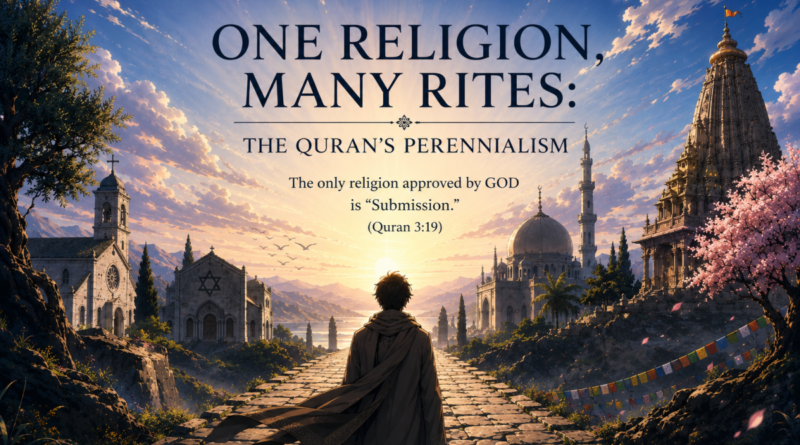
The only religion approved by GOD is “Submission.” Ironically, those who have received the scripture are the ones who dispute this fact, despite the knowledge they have received, due to jealousy. For such rejectors of GOD’s revelations, GOD is most strict in reckoning. (3:19)
Anyone who accepts other than Submission as his religion, it will not be accepted from him, and in the Hereafter, he will be with the losers. (3:85)
If “Islam” names the confessional community founded in seventh-century Arabia, these verses are exclusivist trump cards.
But the Quran’s own usage forbids that reading. Islam in the Quran is a verbal noun—submission, self-surrender to God—and the Quran applies it, and its participle submitter (muslim), across the entire prophetic history and indeed across the cosmos.
For example, just two verses before stating Submission is the only religion (din) accepted by God (3:83), the Quran indicates that everything submits to God. The only question is if one does it willingly or unwillingly.
Are they seeking other than GOD’s religion, when everything in the heavens and the earth has submitted to Him, willingly and unwillingly, and to Him they will be returned? (3:83)
And we see that consistently across all the messengers throughout history, they all submit willingly to God.
Abraham was neither Jewish, nor Christian; he was a monotheist submitter. He never was an idol worshiper. (3:67)
“If you turn away, then I have not asked you for any wage. My wage comes from GOD. I have been commanded to be a submitter.” (10:72)
Jacob’s sons pledge their submission to God alone upon his deathbed.
Had you witnessed Jacob on his death bed; he said to his children, “What will you worship after I die?” They said, “We will worship your god; the god of your fathers Abraham, Ismail, and Isaac; the one god. To Him we are submitters.” (2:133)
The disciples of Jesus declare themselves as submitters.
“Recall that I inspired the disciples: ‘You shall believe in Me and My messenger.’ They said, ‘We have believed, and bear witness that we are submitters.’ ” (5:111)
The Queen of Sheba, at the time of Solomon, was a submitter.
“I have submitted (aslamtu), with Solomon, to God, Lord of the universe.” (27:44)
Submission is naming a universal orientation, not a tribal affiliation. Reading “Islam” in these verses as a proper noun denoting one historical community is an anachronism the text itself has already ruled out—Abraham cannot have belonged to a community that did not yet exist, yet the Quran insists he was a muslim (submitter).
The exclusivism of 3:85, rightly read, is real but different in kind: what is excluded is not other prophetic traditions but the refusal of submission itself—the self-assertion, idolatry, and sectarian pride that the Quran treats as the perennial alternative to the perennial religion.
One Din, Many Shara’i
Perennialism is often caricatured as flattening—as the claim that differences among traditions are illusory or unimportant. The Quran’s version is more sophisticated. It distinguishes sharply between the din—the religion itself, singular and invariant—and the shir’ah and minhaj, the law and the way, which are plural by divine design:
Then we revealed to you this scripture, truthfully, confirming previous scriptures, and superseding them. You shall rule among them in accordance with GOD’s revelations, and do not follow their wishes if they differ from the truth that came to you. For each of you, we have decreed laws (shir’ah) and different rites (minhaj). Had GOD willed, He could have made you one congregation. But He thus puts you to the test through the revelations He has given each of you. You shall compete in righteousness. To GOD is your final destiny—all of you—then He will inform you of everything you had disputed. (5:48)
For each congregation, we have decreed a set of rites (manasak) that they must uphold. Therefore, they should not dispute with you. You shall continue to invite everyone to your Lord. Most assuredly, you are on the right path. (22:67)
Each of you chooses the direction to follow; you shall race towards righteousness. Wherever you may be, GOD will summon you all. GOD is Omnipotent. (2:148)
These verses do something no straightforwardly exclusivist text would do: they attribute the plurality of religious forms to God’s own appointment. The diversity of rites, laws, and orientations is not a regrettable accident awaiting homogenization; it is a deliberate test, and the prescribed response to it is not conversion campaigns but competition in righteousness. The adjudication of the differences is explicitly deferred to God at the return of all communities to Him.
This yields a structure any student of the Traditionalist school will recognize: a transcendent unity at the level of din, a providential diversity at the level of form. But the Quran arguably articulates it with more discipline than Schuon did, because the unity is not an esoteric secret available to a metaphysical elite—it is stated exoterically, in the plain text, as the shared inheritance of every community that received a messenger. The Quran is perennialism without the occultism: the transcendent unity of religion is not hidden behind the forms but declared through all of them.
The Salvation Criterion
If the Quran meant to found an exclusive confessional community, its statements on salvation would be the natural place to say so. Instead we find, twice, a criterion that pointedly ignores communal boundaries:
Surely, those who believe, those who are Jewish, the Christians, and the converts; anyone who (1) believes in GOD, and (2) believes in the Last Day, and (3) leads a righteous life, will receive their recompense from their Lord. They have nothing to fear, nor will they grieve. (2:62 & 5:69)
The verse enumerates the religious communities of its milieu and then dissolves the enumeration into a three-part criterion: God, the Last Day, righteous work. Not affiliation. Not ritual conformity. Not recognition of any particular messenger by name. The same criterion recurs in generalized form:
Indeed, those who submit themselves absolutely to GOD alone, while leading a righteous life, will receive their recompense from their Lord; they have nothing to fear, nor will they grieve. (2:112)
Tellingly, 2:112 is the Quran’s direct rebuttal to the claim, quoted one verse earlier, that “No one will enter Paradise except Jews or Christians!” (2:111). The Quran’s response to confessional exclusivism is not to substitute a new exclusive confession—it is to reject the category. “Such is their wishful thinking. Say, “Show us your proof, if you are right.” The proof demanded is not membership but submission and good work. A book intent on replacing “no salvation outside the Church” with “no salvation outside the mosque” had its opening here and conspicuously declined it.
The classical tradition, uncomfortable with 2:62, claimed it was abrogated by 3:85. But abrogation is a doctrine imported into the text, and the alleged abrogation fails on its own terms, as 5:69 repeats the criterion and, even under the traditionalists’ paradigm, is considered one of the last revelations before the prophet’s passing. The criterion was not a temporary concession; it was restated at the end.
The Fitra: Religion as Primordial Nature
The Quran grounds this universalism in an anthropology. The one religion is not merely historically distributed through messengers; it is constitutionally inscribed in the human being:
Therefore, you shall devote yourself to the religion (din) of strict monotheism (hanif); the natural instinct (fitra) placed into the people by GOD. Such creation of GOD will never change. This is the perfect religion, but most people do not know. (30:30)
The din is here identified with the fitra, the primordial nature on which humanity was created. Religion, in the Quran’s account, is not an institution one joins but a nature one recovers. This is the deepest layer of the perennialist claim: the perennial religion is perennial because it is anthropologically prior to every historical tradition—older than Judaism, older than the Vedas, older than any name. The covenant scene of 7:172, in which all the descendants of Adam testify to God’s lordship before history begins, dramatizes the same point: recognition of the one God is humanity’s pre-historical baseline, and every messenger is a reminder (dhikr), not an innovator.
This also explains the Quran’s chosen exemplar. The figure it holds up as the model of true religion is not the founder of any community but Abraham the hanif—the pre-confessional monotheist, “neither a Jew nor a Christian” (3:67), who arrives at the one God before and beneath every institutional form. The millat Ibrahim, the religion of Abraham, which Muhammad himself is commanded to follow (16:123), is precisely religion in its primordial, pre-sectarian state.
The Real Target: Sectarianism
If the Quran’s positive doctrine is perennialist, its polemic confirms it from the negative side. The Quran’s sustained religious critique is directed not at other traditions as such but at three corruptions common to all traditions—including, by clear implication, the community that would form around the Quran itself.
First, shirk: the association of partners with God, the one non-negotiable violation of the universal message.
Second, clerical usurpation: “They have taken their rabbis and their monks as lords besides God” (9:31)—religion captured by a professional class that interposes itself between the human being and God.
Third, and most relevant here, sectarian division itself:
“Do not be among those who associate partners with God—those who divided their religion and became sects, each party rejoicing in what it has.” (30:31–32)
“Those who divided their religion and became sects—you have nothing to do with them.” (6:159)
“They did not become divided until after knowledge had come to them, out of rivalry among themselves.” (42:14, cf. 2:213, 3:19, 10:19)
Note the diagnosis in 42:14 and its parallels: division came after knowledge, baghyan baynahum—out of mutual envy and rivalry. The plurality of hostile religious communities is not, on the Quran’s account, the result of God sending incompatible revelations; it is the result of human factionalism corrupting a shared revelation.
The people used to be one congregation, then they disputed. If it were not for a predetermined word from your Lord, they would have been judged immediately regarding their disputes. (10:19)
Sectarianism is not religion’s natural state but its disease—and 30:32 goes so far as to classify it as a species of shirk, since the sect that rejoices in itself has made itself an object of devotion.
Therefore, you shall devote yourself to the religion of strict monotheism. Such is the natural instinct placed into the people by GOD. Such creation of GOD will never change. This is the perfect religion, but most people do not know. You shall submit to Him, reverence Him, observe the Contact Prayers (Salat), and—whatever you do—do not ever fall into idol worship. Like those who divide their religion into sects; each party rejoicing with what they have. (30:30-32)
The Quran’s positive counterpart is stated with equal force: “Your congregation is but one congregation, and I alone am your Lord; you shall worship Me alone.” (21:92)—immediately followed, in both occurrences, by the lament that “However, they divided themselves into disputing religions. All of them will come back to us (for judgment).” (21:93, 23:53). The one ummah in these verses is not the “Muslim” confession; the context is the whole prophetic line just recounted, from Abraham through Jesus. The community of all who serve the one God, across all dispensations, is a single community—and every wall run through it is human masonry.
Consistent with this, the Quran extends its protection to the worship sites of the other Abrahamic communities as sites of genuine devotion: had God not restrained people by means of one another, “monasteries, churches, synagogues, and masjids—where the name of GOD is commemorated frequently—would have been destroyed” (22:40). Monasteries, churches, and synagogues are listed alongside masjids, without hierarchy, as places where God’s name is commemorated. And this is consistent with the respect the Quran places upon all the people of the scripture.
Do not argue with the people of the scripture (Jews, Christians, & Muslims) except in the nicest possible manner—unless they transgress— and say, “We believe in what was revealed to us and in what was revealed to you, and our god and your god is one and the same; to Him we are submitters.” (29:46)
This is what you shall preach, and steadfastly maintain what you are commanded to do, and do not follow their wishes. And proclaim: “I believe in all the scriptures sent down by GOD. I was commanded to judge among you equitably. GOD is our Lord and your Lord. We have our deeds and you have your deeds. There is no argument between us and you. GOD will gather us all together; to Him is the ultimate destiny.” (42:15)
What Kind of Perennialism?
It matters to be precise about what has and has not been established. The Quran’s perennialism is not the pluralist relativism of John Hick, in which the traditions are equivalently valid human responses to an unknowable Real. The Quran has a definite theology—strict monotheism, accountability, the Last Day—and it freely judges beliefs and practices against it. It criticizes trinitarian formulas (4:171, 5:73), it condemns idolatry everywhere it finds it, and it insists that the earlier scriptures suffered distortion and selective concealment at human hands (2:75–79, 5:13–15). Any tradition, on its account, can drift from the din; most have.
But this is exactly what distinguishes serious perennialism from sentimental pluralism, and the Quran’s version is the serious kind. Its structure is:
One God; one primordial religion inscribed in human nature; one message carried by messengers to every people without exception; a divinely intended plurality of laws and rites; a single trans-confessional salvation criterion of faith and righteous work; and a universal pattern of corruption—clericalism, textual tampering, and above all sectarian self-congratulation—against which every community, emphatically including the Quran’s own, must be perpetually measured.
On this account, the Quran does not stand outside the world’s religious history as a rival brand. It stands inside it as a furqan—a criterion—recalling every tradition, its own included, to the one din they jointly inherited and severally corrupted. The scandal of the Quran, rightly read, is not that it damns the other religions. It is that it refuses to let any religion—including the one that bears the name of submission—mistake itself for the object of submission.
The last word belongs to the verse that closes the argument of Surah 5:
…Had GOD willed, He could have made you one congregation. But He thus puts you to the test through the revelations He has given each of you. You shall compete in righteousness. To GOD is your final destiny—all of you—then He will inform you of everything you had disputed. (5:48).