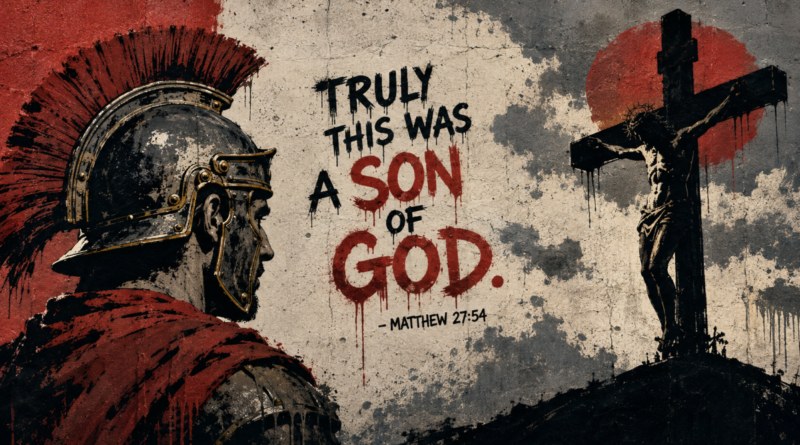
What Did the Centurion Mean by Calling Jesus the Son of God?
There is a line at the end of the crucifixion scene in Matthew’s Gospel that Christians have quoted for two thousand years. A Roman officer, standing guard over a dying man, watches the sky darken, and the ground shake, and says:
“Truly this was the Son of God.” (Matthew 27:54)
It is a dramatic moment, and it is easy to see why it became a favorite proof-text. Here, at the foot of the cross, a hardened pagan soldier—an outsider, a representative of the empire that was executing Jesus—seems to confess the central claim of Christianity. For many readers, the centurion is speaking for all of us: the veil drops, and even a Roman can see the truth.
But there is a question almost nobody stops to ask. What did he think he was saying?
Not what a bishop in the fourth century would later mean by those words. Not what a modern churchgoer means when reciting the Nicene Creed. What did this specific person, in this specific place, with this specific background, actually understand by the phrase “son of God”?
Once you ask that question honestly, the famous confession turns out to mean something very different from what it is usually made to prove. And that difference has serious implications for the doctrine of the Trinity.
The man behind the words
Start with who the centurion was. A centurion was a professional Roman army officer, roughly the equivalent of a senior sergeant or captain, commanding about eighty men. He was not a Jew. He was not a theologian. He was not a philosopher. He was a career soldier stationed in a troublesome province, and his mental furniture—the ideas, stories, and images he carried around in his head—came from Roman culture and Roman religion.
This matters enormously, because words do not carry meaning on their own. They carry the meaning a speaker’s world gives them. When this man said “son of a god,” he reached for a category that already existed in his mind. He was not inventing a new metaphysics on the spot. He was reaching for the nearest familiar shelf.
So the real question becomes: when a first-century Roman soldier heard or used the phrase “son of a god,” what shelf did he reach for?
What the Greek actually says
Before we get there, a small but important detail about the text itself.
In English, “the Son of God” sounds like a unique title—capital S, capital G, one and only. But the Greek of Matthew does not have that emphasis. The phrase is theou huios, and crucially it has no definite article. There is no “the.” A more literal rendering would be “a son of God” or, just as fairly, “son of a god.”
Mark, whose Gospel is generally considered the earliest, records the same scene with the same grammar: huios theou, again without the article—”this man was a son of a god.”
This is not a translator’s quibble. In the mouth of a Roman, “son of a god” is not a strange phrase at all. It is an ordinary one. And there is a further clue that the early tradition itself did not treat these words as a fixed creedal confession: Luke, telling the same story, does not have the centurion say anything about sons of gods at all. In Luke’s version the soldier says, “Certainly this man was innocent” (Luke 23:47). Three Gospels, three different endings to the same character’s line. That is not how people transmit a settled doctrinal formula. It is how people remember and reshape a striking moment.
The Roman playbook: how mortals became gods
Here is the key that unlocks the whole passage. The Romans had a well-worn, culturally central idea that a great man could be, or could become, a god—and could be called the son of a god. The technical word for it is apotheosis: the elevation of a human being into the divine.
This was not a fringe belief. It was woven into Roman public life, Roman coinage, Roman festivals, and above all Roman politics. A soldier would have absorbed it the way a modern person absorbs the idea of a national anthem or a flag. Consider the figures he grew up hearing about.
Romulus, the legendary founder of Rome, did not simply die. According to the Roman historian Livy and the biographer Plutarch, he vanished during a sudden, violent storm that plunged the day into darkness. Afterward, a respected citizen named Proculus Julius swore that Romulus had appeared to him, radiant, and announced that he was now a god, to be worshipped under the name Quirinus. Notice the pattern: a great man’s departure, marked by unnatural darkness, followed by the declaration that he has become divine.
Hercules was the son of the god Jupiter by a mortal woman. He lived a life of superhuman labors, died in agony on a burning pyre, and was then taken up to join the gods on Olympus. A being born of a god, who suffered, died, and was exalted to full divinity. Every Roman knew the story.
Julius Caesar is the most important case, because he was recent history, not myth. After Caesar was assassinated in 44 BC, a comet blazed in the sky during games held in his honor. The Romans read it as his soul ascending to heaven. Two years later, the Roman Senate formally declared him a god: Divus Iulius, “the Divine Julius.” A murdered politician, officially voted into the ranks of the gods by a show of hands.
Augustus, Caesar’s adopted heir and the first Roman emperor—the man who ruled when Jesus was born—took as one of his official titles Divi filius. Translated directly, it means “son of the divine one,” or simply “son of god.” It appeared on coins that passed through the hands of ordinary people across the empire. It was stamped into inscriptions, proclaimed in temples, and built into the ideology of the imperial cult that every soldier served.
Think about what this means. The centurion at the cross belonged to an army whose supreme commander, the emperor, was routinely and officially called “son of god.” The phrase was not exotic to him. It was, quite literally, on the money in his pocket. When he looked at a dying man and said “son of a god,” he was applying to Jesus a category his whole civilization used for heroes, founders, and emperors: an extraordinary human being touched by, descended from, or elevated to the divine.
Reading the signs
Now put the centurion back into Matthew’s scene. What triggers his exclamation is not a theological argument. It is a set of omens—the sky going dark, the earth shaking. To Roman eyes, these were exactly the kind of cosmic signs that accompanied the death of a great man.
The darkness at Romulus’s disappearance. The comet at Caesar’s death. Portents in the heavens were the standard Roman vocabulary for saying: the universe itself is marking the passing of someone extraordinary. The centurion is not reasoning his way to the second person of a divine Trinity. He is reading familiar omens in the only idiom he has, and concluding what any Roman would conclude: this was no ordinary man—this was one of the sons of the gods.
He is being entirely consistent with his culture. And his culture had no concept remotely like the one the words are later made to carry.
The Jewish sense didn’t help either
Someone might object: fine, the Roman didn’t mean the Trinity, but surely the phrase “son of God” already meant something divine in the Jewish world Jesus came from. It did carry weight—but not the weight people assume.
In the Hebrew scriptures, “son of God” is a title of chosenness and office, not of shared divine essence. The nation of Israel is called God’s “firstborn son” (Exodus 4:22). Angels are called “sons of God” (Job 1:6). Most importantly, the king of Israel is called God’s son at his coronation: “You are my son; today I have begotten you” (Psalm 2:7), and of the Davidic king God says, “I will be his father, and he shall be my son” (2 Samuel 7:14).
In other words, in the Jewish frame, “son of God” meant the anointed king—the messiah—a specially chosen human being, not a co-eternal member of the Godhead. So whether you approach the phrase from the Roman side or the Jewish side, you arrive at the same place: in the first century, “son of God” did not mean what it would come to mean three centuries later. Nobody in the story—not the soldier, not the crowd, not the disciples—was working with the later category.
The three-hundred-year gap
The developed doctrine of the Trinity holds that God is one substance existing eternally as three co-equal, co-eternal persons—Father, Son, and Holy Spirit—and that the Son is of the same substance as the Father, fully God, not made or created, existing before all time. To describe this, theologians eventually built a precise technical vocabulary out of Greek philosophy: terms like ousia (substance or essence) and hypostasis (person), and the decisive word homoousios, “of the same substance.”
None of this machinery existed in the first century. The Latin word “Trinity” was not even coined until around the year 200, by the writer Tertullian. The formula that the Son is “of the same substance” as the Father was hammered out and imposed at the Council of Nicaea in 325, in a fierce fight against other Christians who read the evidence differently. The doctrine was completed only at the Council of Constantinople in 381, which settled the status of the Holy Spirit.
So the timeline looks like this. A Roman soldier says “son of a god” at a crucifixion around the year 30. Nearly three hundred years later, a council of bishops, using philosophical terms the soldier had never heard, working out problems the soldier could not have imagined, defines a doctrine and reads it backward into his mouth.
The centurion could no more have meant Nicene trinitarianism than a medieval peasant saying “the sun is rising” could have meant heliocentric astrophysics. The words survived; the meaning poured into them was built centuries later, out of materials that did not yet exist.
“But the author meant more than the centurion did”
There is a thoughtful counterargument, and it deserves a fair hearing. Many scholars point out that Gospel writers use irony: a character can say something truer than he knows. On this reading, the pagan centurion means “son of a god” in the ordinary Roman sense, but Matthew, telling the story, intends the reader to hear a deeper Christian meaning. The soldier speaks better than he understands.
This is a genuine literary insight, and it may well be right about Matthew’s intentions. But notice carefully what it does and does not rescue.
First, it concedes the central point of this article: the centurion himself, as a character in the scene, could only have meant the Roman thing. The “deeper” meaning is not his. So the verse cannot be used as evidence that a first-century eyewitness recognized the divinity of Christ in the trinitarian sense. He didn’t, and the irony argument agrees he didn’t.
Second, even the “deeper” meaning that a first-century author like Matthew could have intended was not yet Nicene doctrine. Matthew was a Jewish Christian writing in roughly the 80s, drawing on the Jewish idea of the messianic son of God we saw above. Whatever richness he loaded into the phrase, he was not thinking in the categories of homoousios and eternal consubstantiality, because those categories were still two and a half centuries away. The irony argument moves the meaning from the soldier to the author—but it cannot move it forward in time to Nicaea.
So the counterargument, taken at its strongest, still leaves the trinitarian reading of this verse without support. It simply relocates the problem.
What the confession really shows
The centurion’s line is usually offered as a small window into the truth of the Trinity: even a Roman could see it. Read in its own world, it shows something closer to the opposite.
It shows a man reaching for the only category his civilization gave him—the category of the deified hero, the exalted emperor, the son of a god in the sense Rome had always used—and applying it to a remarkable man dying under omens in the sky. It shows that the phrase “son of God,” in every framework available in the first century, whether Roman or Jewish, meant a chosen or exalted figure and not a co-equal person of a triune deity. And it shows that the gap between what such words could have meant then and what they were later declared to mean is measured not in nuances but in centuries.
Trinitarian Christian apologists attempt to defend the Trinity on many grounds, but the centurion can no longer be one of them. He was a witness to a death, and he described it in the language of his world. To make him a witness to Nicaea is to put words in a dead man’s mouth that no living person in his time could have spoken.
He said a son of a god. He did not, and could not, say God the Son.