The Romans, the Christians, and a Death They Could Not Understand
In the baking August of 111 CE, a middle-aged Roman bureaucrat named Pliny the Younger (c. 61–c. 113 CE) rounded the foot of the Peloponnese in suffocating heat, running late for the most important posting of his career. The emperor Trajan (r. 98–117 CE) had sent him east to govern Bithynia-Pontus, a wealthy, mismanaged province on the Black Sea coast of what is now Turkey, and to whip its finances and public works back into order. Pliny was not the persecutor of later Christian legend—not a frothing agent of Satan hungering for the blood of the faithful. He was a meticulous administrator with a weakness for vanity and a talent for correspondence, more likely to hold forth on the correct wine to serve at dinner than to thunder about the gods. His surviving letters to Trajan read like the diary of a conscientious middle manager: a crumbling theater needs urgent attention, a canal ought to be surveyed, an aqueduct has been left half-finished at ruinous expense, a beautiful street in Amastris is disfigured by an open sewer giving off a noxious stench.
And then, buried among the drains and the budgets, comes a letter now cataloged with the deadening title Letter 10.96. It is the first surviving description of Christians by a Roman writer—and it does not read the way two thousand years of martyrology have trained us to expect.
The Governor’s Problem
What is striking about Pliny’s letter is what is absent from it. He is not offended in his piety. He does not care that Jupiter has been neglected or Hera slighted. His complaint about the “wretched cult” spreading through the towns and villages of his province is not theological but administrative. The temples were emptying; anonymous pamphlets naming local Christians had begun to circulate; the citizens were becoming disgruntled. Someone, it has long been suspected, was losing money—possibly the local butchers, whose trade in sacrificial meat had collapsed as conversions rose. Anti-Christian feeling was driven less by Satan than by a slow trade in sausage.
Pliny’s duty was order. As a later digest of Roman law put it, a good governor took care that his province was peaceable and quiet, and would manage it easily enough if only he exerted himself to expel bad men. Riots were the nightmare; riots were what got a governor recalled. So Pliny did what governors did: he interrogated the accused, asked them three times whether they were Christians, warned them of the consequences, and executed those who refused to recant. He had two deaconesses tortured to get at the truth, he tells us, with the same flat efficiency he would bring to surveying a canal. He was no champion of conscience.
But he was baffled, and he said so plainly. “I have never been present at an examination of Christians,” he wrote. “I do not know the nature or the extent of the punishments usually meted out to them, nor the grounds for starting an investigation and how far it should be pressed.” And crucially, as the numbers hauled before him grew—people of every age, every rank, men and women alike—he did not gloat over the ripe harvest. He was distressed by it. The word he reaches for to describe the accused is not wicked or impious but periclitantium: those “in danger.” He is, of course, the very source of that danger. Yet the whole letter carries the unmistakable weight of a man who would rather not be killing anyone at all, and has written to his emperor mostly to ask whether he really has to.
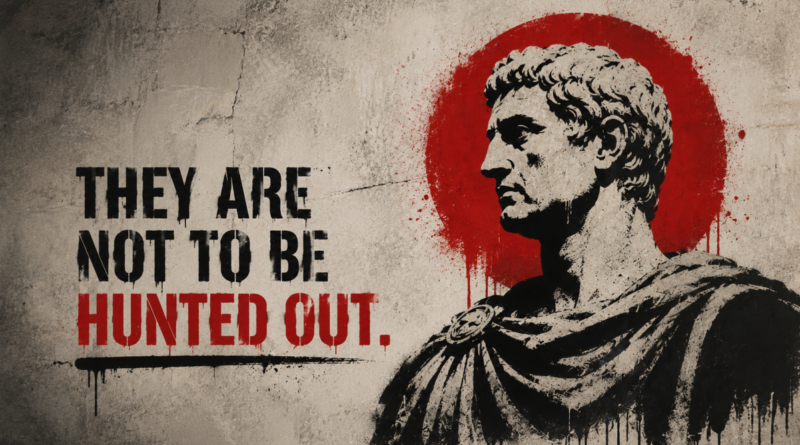
Trajan’s reply, when it came, would have reassured him. The emperor confirmed that convicted Christians must be punished—for what precise crime he does not bother to specify—but he refused to build a machinery of persecution. Anonymous denunciations, he wrote, “create the worst sort of precedent and are quite out of keeping with the spirit of our age.” And then three of the most important words in the history of early Christianity, words that ought to be far better known than they are: conquirendi non sunt—”they are not to be hunted out.”
For roughly the first two and a half centuries after the birth of Jesus, apart from Nero’s local savagery at Rome in 64 CE, that was the imperial posture toward Christians: first to ignore them, then to insist that they not be sought. The persecutions that later loomed so enormous in Christian memory—under Decius (250–251 CE), Valerian (from 257 CE), and Diocletian’s Great Persecution (from 23 February 303 CE)—were, by the standard of what states are capable of, brief, intermittent, and geographically patchy. In the whole province of Africa, no governor is known to have executed a Christian before 180 CE. The scholar W.H.C. Frend estimated that Christian martyrs across the entire period number in the hundreds, not the thousands.
The Reluctant Executioner
This is the first surprise the sources hold: the Romans, cast forever as the villains of the story, were often the ones trying to talk the Christians out of dying.
The pattern recurs so consistently across the martyr literature that it cannot be dismissed as a stray exception. Consider Arrius Antoninus, a proconsul of Asia in the later second century, who had put a number of Christians to death. Rather than fleeing, the Christians of his province marched up to his tribunal en masse and presented themselves for execution. He killed a few—there is, one imagines, only so much provocation a Roman governor can absorb—and then turned to the rest with what still reads, across nearly two millennia, as pure exasperation: “You wretched people, if you want to die you have cliffs to jump off and ropes to hang yourselves with.” The story survives because a Christian, Tertullian (c. 155–c. 220 CE), thought it flattering. He recorded it to boast that Christians did not fear death. To modern eyes it reads rather differently—as a portrait of an official who could not fathom the people in front of him.
The would-be martyrs, meanwhile, went to remarkable lengths to be obliged. Some turned up before magistrates already in chains, saving everyone the trouble. In 311 CE, the desert ascetic St. Antony (c. 251–356 CE) heard that a persecution was raging in Alexandria and hurried in from the wilderness, dressing in white to catch the judge’s eye as he passed, “burning,” his biographer says, “with a desire for martyrdom.” The judge did not notice him, or could not be bothered. Antony trudged home crushed that martyrdom had been denied him, and consoled himself by adding a hair shirt to his daily wardrobe and never washing again.
When the state would not do the killing, some Christians did it themselves. In fourth-century North Africa, horrified locals watched groups of what one contemporary called “deranged men”—because they loved the name of martyr and craved human praise more than divine charity—kill themselves outright: hurling themselves off cliffs, drowning, walking into fire. The most notorious of these were the circumcellions, itinerant farm laborers near the bottom of a brutally hierarchical world. As the historian Brent D. Shaw has argued, their lives were precarious and grim; suicide transformed them, in an instant, from the least of the empire into its most venerated dead, with a guaranteed seat in heaven. They marked the anniversaries of martyrs with riotous drinking and dancing; the day of an actual death brought celebrations wilder still. “Drink up! Live long!” reads one inscription raised to a martyr, apparently without irony. Augustine (354–430 CE), who fought them with propaganda as much as argument, dismissed their high calling as a game—the “daily sport,” he sneered, of people who threw themselves off precipices and into rivers and fires. Another bishop called them, more bluntly, a “death sect.”
The trial records tell the same story from the magistrate’s chair. In one account, a prefect named Probus asks the Christian before him to sacrifice and go free—not once but nine times. Think of your weeping family, he pleads; think of your youth; spare yourself. “At least offer sacrifice for the sake of your children!” The Christian refuses and dies, but not for any want of trying on the prefect’s part. When a young girl named Eulalia presents herself, her governor begs her to think of the marriage and the joys she is throwing away, of the family she is leaving in tears. She spits in his eye. A soldier named Julius is offered a cash bonus by the prefect Maximus if he will only sacrifice; when Julius refuses, Maximus reaches for an almost lawyerly loophole—let me take the blame, I am the one forcing you, so no one can say you consented; afterward you go home in peace and collect your bonus, and no one will trouble you again. Julius tells him the money is Satan’s, and that “to live with you would be death for me.” Maximus, with a terseness that earns a flicker of sympathy, replies that in that case he is going to cut Julius’s head off. He does.
Even the demand to sacrifice—the pivot of every martyr story—looks different once you stop reading it through the Christian lens. In the tales, the official’s request that the Christian burn a pinch of incense is proof of demonic malice, an attempt to drag a soul down to hell. But listen to the officials in their own words, and the meaning inverts. They ask for the sacrifice because they want the Christian saved—not in the next life but in this one, saved from the executioner. So they haggle. Realizing that a full meat offering revolts the Christian, they propose smaller gestures: just put out your fingers and touch a little of the incense, one judge tells Eulalia, and you will escape all this suffering. Another offers a formula stripped almost to nothing: take a little incense and wine and a branch and simply say, “Zeus most high, protect this people,” and you may go. They are not trying to damn these people. They are trying, with visible frustration, to find any words at all that will let them avoid signing a death warrant.
Two Worlds That Could Not See Each Other
Underneath the bafflement lay a genuine collision of two ways of understanding the sacred—and neither side could quite believe what it was looking at.
The Roman religious world was, by instinct and long habit, additive. Gods were many; more gods meant more protection; the pantheon had room. Rome had spent centuries absorbing the deities of the peoples it conquered, setting them up alongside its own without much anxiety. Worship was less a matter of inner conviction than of correct public practice—the right offering, at the right altar, at the right time, to keep the pax deorum, the peace between the community and its gods, intact. In that framework the Christian demand was not so much offensive as unintelligible. Why couldn’t these people simply add their Christ to the roster and be done with it? The Jews, after all—whose religion was older and more respectable precisely because it was ancient—had for generations offered prayer and sacrifice on the emperor’s behalf in their Temple without abandoning their own God. If they could manage the gesture, why not the Christians? “If you have recognized Christ,” one official demands in a trial record, “then recognize our gods too.” To a polytheist, monotheism in the rigid Christian form was close to a contradiction in terms—not a deeper faith but a stubborn refusal to be reasonable. “What is so serious,” another prefect asks wearily, “about offering some incense and going away?”
To the Christians, that “little incense” was the whole of the matter. To sacrifice was apostasy, a betrayal of the one true God for a demon wearing a god’s mask—for the Christians did not regard the old gods as fictions but as real and malevolent powers, the daemones who stood behind every altar. The pinch of incense the governor kept pushing across the table was not a formality. It was a soul.
And the Christian relationship to death itself had been, from the beginning, of a wholly different order. The old world did not, on the whole, love death. It could face death with dignity—the philosophical suicide of a Seneca or a Cato was admired as a considered exit—but the classical instinct was to make the most of a bright and finite life, and to regard the willful throwing-away of that life as, at best, a kind of madness. Marcus Aurelius (121–180 CE), the philosopher-emperor, dismissed Christian eagerness for martyrdom as mere theatrics, “stage heroics.” The satirist Lucian of Samosata (c. 125–after 180 CE) put it more cuttingly still: these poor wretches, he wrote, have talked themselves into believing they are immortal and will live forever, which is why they despise death and rush so readily into custody. To the cultivated pagan mind it looked like a delusion, and a slightly embarrassing one.
But for the Christian, death was not the end of the story; it was the door to the best part of it. The conviction that martyrdom washed away every sin in a single stroke of blood, and purchased not only eternal life but eternal glory, turned the prospect of execution from a horror into a prize. This is why the atmosphere in the death cells could turn festive, to the dismay of watching bishops—one recorded “with groans and sorrow” the frauds and fornications and adulteries breaking out among the condemned as they crammed the pleasures of a lifetime into a final few hours, secure that the coming death would wipe the slate clean regardless. A glamour clung to the doomed. Their anniversaries became holidays. Their bones became relics. In a hard and hierarchical world, martyrdom was the one ladder anyone could climb: a slave, a laborer, a girl, could in an afternoon become one of the most worshipped human beings on earth.
Set those two worlds side by side, and the incomprehension becomes almost structural. The Roman governor sees a person needlessly courting death over an empty formality and reaches, with mounting frustration, for any compromise that will spare a life. The Christian sees the governor’s mercy itself as the deepest of temptations—the devil offering, in the kindly voice of a magistrate, to talk him out of heaven. The kinder the official, the more dangerous he became. When one governor gently suggested that the weather was pleasant and life was sweet and surely worth keeping, the Christian answered that the death coming to him was more pleasant than any life the governor could offer. The tempter’s every reasonable word only sharpened the appetite for the rope.
The Deeper Irritation
What finally seems to have galled Pliny was not, in the end, the theology at all. It was the contempt. He had been sent to Bithynia to restore order and command respect, and here were people who, brought before the representative of Rome, would not so much as tell him their names. In one celebrated trial a martyr named Sanctus met every question—his name, his birthplace, his rank, whether slave or free—with the same two words, over and over, in Latin: Christianus sum, “I am a Christian.” Nothing else. His fellow believers recorded it as glorious defiance. The presiding governor recorded it by ordering more torture.
To a Roman magistrate this was contumacia—obstinacy, contempt of court—and contempt before the tribunal was itself a punishable thing, quite apart from whatever the accused believed. “Whatever the nature of their admission,” Pliny wrote of those who would not bend, “I am convinced that their stubbornness and unshakable obstinacy ought not to go unpunished.” It was not the disrespect to his gods that stung. It was the disrespect to his authority—the flat refusal to grant the rituals of the state even the outward courtesy of compliance. Rome could tolerate almost any belief. What it could not abide was a public and theatrical refusal to play along.
And here lies the sharpest irony in the whole encounter. The Roman state, for all its cruelty, had no interest in what a man believed in the privacy of his own soul. It wanted the gesture, the incense, the outward act of loyalty—and having got it, it asked no further questions and pried into no consciences. Trajan was explicit: a man who denied being a Christian and proved it by praying to the gods was to be pardoned outright, “however suspect his past conduct may be.” The emperors wanted obedience, not sincerity; they had no wish to open windows into men’s souls or to police what went on behind them.
That—the policing of the interior, the demand not merely for outward conformity but for inner belief—would be a Christian innovation.
The Grace They Would Not Return
There is a final turn to the story, and it is the one Pliny and Trajan could not have foreseen. The tolerance the empire extended to the Christians in their weakness—the refusal to hunt them, the century of legal protection Trajan’s three words secured—was not a grace the Christians would extend to anyone else once they held the power.
A little over a decade after the first Christian emperor, Constantine (r. 306–337 CE), took control, laws began to appear against “the pollutions of idolatry.” Within Constantine’s own reign, it seems to have been decreed that no one should set up cult objects, practice divination, or sacrifice at all. Less than fifty years after Constantine, the death penalty was announced for anyone who dared to offer sacrifice—the very act the pagan magistrates had once begged Christians to perform in order to save their lives now became itself a capital crime. And in 423 CE, the Christian government issued an order that any pagans still surviving were to be suppressed, adding, with chilling confidence: “We now believe that there are none.”
The Romans never really did work out what to do with the Christians. They tried ignoring them, tried arguing with them, tried bribing and reasoning and pleading with them, and at last tried, half-heartedly and intermittently, killing them—and none of it took. What they were confronting was not a rebellion they could crush or a heresy they could out-argue, but a wholly different relationship to death, to belief, and to the boundary between the state’s authority and the soul’s. They kept offering life, and could not understand a people who kept choosing otherwise. In the end, it was not the Christians who failed to understand the Romans. It was the Romans, reaching across the tribunal with a pinch of incense and a way out, who never once understood the people standing in front of them.