With fields destroyed and hives lost, Gaza's beekeepers struggle to start over
By Ebrahim Hajjaj , Dawoud Abu Alkas and Nidal al-Mughrabi
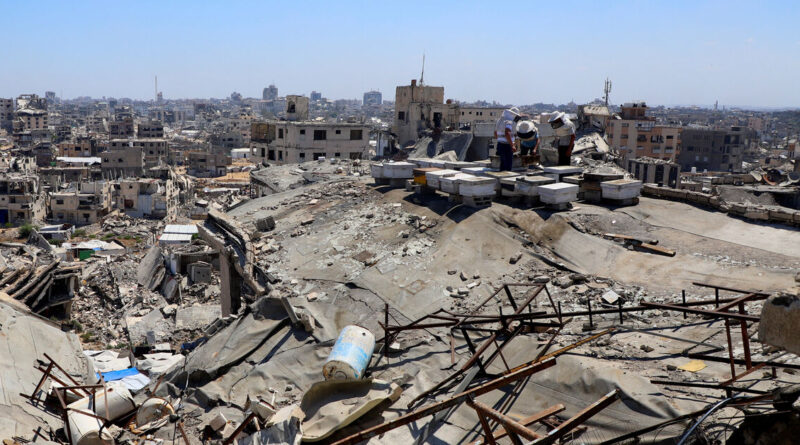
GAZA/CAIRO, July 30 (Reuters) – Standing on the roof of a war-damaged building overlooking the ruins of Gaza City, beekeeper Ibrahim al-Dabba gently lifts a honeycomb frame as bees buzz around him.
“Bees require trees, we are raising bees amongst rubble,” he said.
For Gaza’s beekeepers, the struggle to rebuild their livelihoods after more than two years of war is about much more than honey. It is also about preserving one of nature’s most important pollinators in a territory where farmland has been devastated and access to orchards near the border with Israel has been cut off.
Before the war, the beekeepers kept around 30,000 hives, according to agricultural engineer and beekeeper Rateb Sammour.
Honey production had already been declining from some 400 metric tons annually several years ago to roughly half that amount as climate change affected the flowering seasons.
HONEY PRODUCTION HIT
The conflict dealt a far greater blow, however. Sammour, a well-known Gaza beekeeper and honey producer, estimates around 700 hives remain, with beekeepers dividing hives to help maintain the numbers.
Sammour puts the honey production at only 10% of what it was before the war.
Across much of Gaza, where vast neighbourhoods remain reduced to wreckage, beekeepers are salvaging what they can.
Some have placed hives on rooftops because agricultural land is inaccessible or destroyed. Others are using sugar supplements to increase the food for their bees in places where there is no meaningful forage.
Israel effectively controlled an estimated 64% of Gaza by late April. Nearly all of the territory’s roughly 2 million residents are concentrated in a narrow coastal area under Hamas control, living largely in damaged buildings or makeshift shelters and facing dire humanitarian conditions.
After the ceasefire last October, Dabba, 49, hoped to return to a trade passed down through generations. Instead, he found almost nothing left.
“We couldn’t find bees, we couldn’t find equipment, we couldn’t find frames, we couldn’t find anything to get us back to bees,” he said.
“We are even forbidden from entering agricultural areas,” Dabba said, explaining how they are within the yellow line military demarcation established under the ceasefire.
Starting over came at a steep cost. Dabba said he paid 10,000 shekels ($3,245) for just three hives, excluding equipment.
In the central Gaza camp of Nuseirat, beekeeper Fahd al-Dahdouh, 32, spends his days repairing shattered hive boxes recovered from destroyed farming areas.
“I collected these beehives, as you can see, I brought them and put them together,” said Dahdouh.
“I collected the lids, the boxes, and even the flooring.”
(Reporting by Ebrahim Hajjaj and Dawoud Abu Alkas in Gaza and Nidal al-Mughrabi in Cairo; Writing by Nidal al-Mughrabi; Editing by Alison Williams)
AL-MONITOR All-Access gives you unlimited access to all our journalism, the full Daily Briefing, exclusive interviews, premium newsletters, and live events — for less than $2/week.