What to expect after the US reimposes naval blockade on Iran’s ports?
Tehran, Iran – The United States has reinforced its naval blockade on Iran’s southern portsamid the escalating military confrontation between them.
The US blockade on Iran was first imposed in mid-April and remained for over nine weeks. It was only lifted after the two sides signed a Memorandum of Understanding (MoU) in June to end four months of fighting and reopen the Strait of Hormuz.
Iran immediately began exporting tens of millions of barrels of crude oil, much of it stored on supertankers anchored close to its oil terminals. However, after the recent resurgence in military strikes over control of the Strait of Hormuz, Washington rescinded oil and banking waivers issued as part of the MoU and prevented vessels linked to Iran from returning to port to load more Iranian oil.
Since the MoU effectively fell apart due to recent strikes, US Central Command (CENTCOM) has redirected several ships operating in the Strait of Hormuz. It also launched a strike to disable the Curacao-flagged supertanker Belmawhich had allegedly been transporting Iranian crude during the war.
Iran has also been accused of striking ships in the waterway, leading to the US bombing Iranian coastal areas.
Iranian authorities have acknowledged the previous blockade drastically reduced Iranian crude exports. Iran’s parliament speaker and chief negotiator, Mohammad Bagher Ghalibaf, said in a TV interview at the end of June that “we did not export even one barrel” during the blockade.
Energy analyst Hamidreza Shokouhi told Al Jazeera that the new US siege means that at least 1.5 million barrels per day of Iranian oil exports will be taken off the market. That has contributed to pushing oil prices up to around $90 per barrel and sustained conflict could cause further increases.
“That means more pressure on global strategic reserves, which have already been tapped during the war and are facing unprecedented pressure,” he said.
Washington’s insistence on vessels using the southern route of the Strait of Hormuz close to the coast of Oman for the duration of the MoU has contributed to the current military escalation, the analyst said.
Shokouhi noted that Iran responded to the siege by trying to ensure that no other regional country could export their oil via the strait, piling pressure on the US and its allies.
“When the US acts this way, Iran also moves in the direction of not prioritising the economy and using the leverage at its disposal,” Shokouhi said.
A broadening conflict
Seven nights of tit-for-tat strikes between the US and Iran have quickly escalated and intensified as the week progressed.
The attacks left a trail of destruction in both Iran and countries across the region, with Kuwait and Bahrain heavily targeted by Iranian missiles and drones in recent days.
The US military has also heavily targeted provinces across Iran, particularly areas in the south closer to the strait.
Civilian infrastructure – including bridges and tunnels, ports and dock facilities, power stations and water plants – have been systematically hit, along with military sites. Some have speculated that could be in preparation for a ground invasion of Iranian coastal regions.
The Aq Tekeh railway bridge in the northern Iranian province of Golestan was among the first targets to be struck by US forces last week after the fighting re-erupted.
Iranian authorities said damage to the bridge was quickly repaired, but the strike signalled US willingness to attack potential import-export routes to exacerbate the impact of the naval blockade.
Aq Tekeh is on the Gorgan-Incheh Borun line, which connects Iran to the east, including Turkmenistan, Russia and China. It is where food and other essentials are imported from Central Asia and Iranian goods are exported, such as iron ore and polyethylene.
Rising inflation
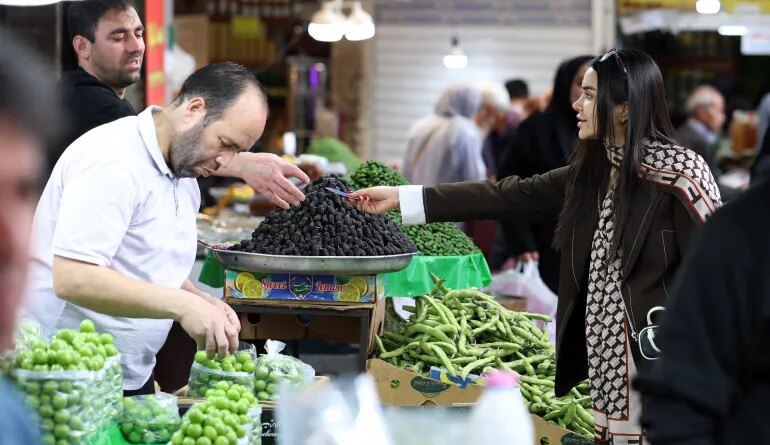
The previous US naval blockade had also significantly impacted goods and markets in Iran, making everyday life for over 90 million people more difficult.
Although there were no widespread shortages of staples, Iran’s inflation rate – already one of the world’s highest – surged. The price of some basic foodstuffs, such as eggs, chicken and cooking oil, has more than tripled compared to a year ago.
Price increases have also damaged other sectors of the Iranian economy and industries.
“Our sales are very inconsistent. The market is struggling to find prices, there’s too much instability and uncertainty about the future,” said Borzou, a merchant dealing in industrial motors and equipment at Tehran’s Grand Bazaar.
“It looks like most distributors here are still tapping into imported inventories from before, we don’t know what to expect in a few months since many of these goods came through China and the UAE and not all can be imported through inland routes,” he told Al Jazeera.
Rial hits all-time low
There has also been intense pressure on the Iranian rial from the renewed military escalation and reimposition of the naval blockade.
The rial changed hands for over 1.93 million against the US dollar in Tehran’s open market on Saturday, the first day of the Iranian week, registering a new all-time low.
The Tehran Stock Exchange continued its downward trend over the past week, with its main index losing another 120,000 points or 2.4 percent on Saturday to stand at 4.77 million.
Iran’s armed forces have warned they will retaliate against any US strikes on Iran’s civilian infrastructure by attacking similar targets in regional countries hosting US military bases.
“Let’s not forget that the US and Israel started attacks against infrastructure, when they hit South Pars gas fields, Tehran’s oil depots and the petrochemicals in Mahshahr,” said energy analyst Shokouhi.
Utilising help from the Houthi group in Yemen, Tehran could also cause significant disruptions to shipping in the strategically important Bab al-Mandab strait off Yemen’s coast – if US President Donald Trump realises his threat to hit more civilian infrastructure in Iran such as power plants and bridges.
“Trump’s actions over recent months, and particularly over recent days, have only made the situation more intractable and the outlook more uncertain. The current situation cannot continue for much longer, but it is broadening the scope of the conflict and that is concerning,” Shokouhi said.