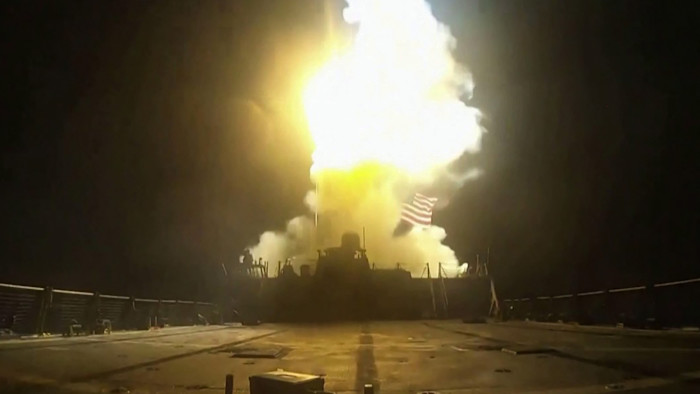
US strikes Iran after two American troops are killed in Jordan
Unlock the Editor’s Digest for free
Roula Khalaf, Editor of the FT, selects her favourite stories in this weekly newsletter.
The US began a fresh night of strikes on Iran in response to the deaths of two of its soldiers in Jordan as Tehran launched attacks on American allies across the Gulf.
US Central Command, which oversees American military operations in the Middle East, said on Saturday that the troops had been killed while defending against Iranian ballistic missile and drone strikes.
Centcom said it resumed strikes Saturday night to “swiftly punish Islamic Revolutionary Guard Corps forces” for the attack that killed the Americans, while further degrading “Iran’s ability to threaten commercial shipping in the Strait of Hormuz”.
The US military said one service member was unaccounted for while another four US personnel were treated in Jordanian hospitals and discharged.
The deaths come at a tense moment in the Middle East as the regional conflict intensifies in the wake of a collapsed ceasefire.
Iran has stepped up attacks across the Gulf in recent days, including striking Saudi Arabia for the first time in nearly four months.
Tehran also launched strikes against Kuwait and Bahrain on Saturday, as US President Donald Trump sought to pile economic pressure on Tehran in the battle for control of the Strait of Hormuz.
Trump — who is confronting record-low approval ratings as a growing share of US voters sour on his handling of the conflict — reimposed a naval blockade on Iranian ports this week. The US president had lifted the blockade last month after the warring parties signed a memorandum of understanding that extended an April ceasefire by 60 days and was supposed to reopen the strait.
The death of more US troops is likely to pile further political pressure on the president.
The tit-for-tat strikes raise the risk of a return to full-scale war and have upended diplomatic efforts to reopen the vital waterway.
The US military said it targeted “surveillance sites, military logistics infrastructure, underground weapons storage and maritime capabilities” in Iran overnight on Friday.
Iranian state media said on Saturday that the Islamic republic targeted Prince Sultan Air Base in the Saudi city of al-Kharj, which hosts American forces.
Saudi Arabia’s civil defence issued a warning on Saturday for a threat over Al-Kharj, 85km south-east of the capital Riyadh, as well as Yanbu, a Red Sea port with a refinery and a crude export terminal. However, it was not clear whether Yanbu was targeted.
The kingdom has shifted the majority of its oil exports to the Red Sea using an east-west pipeline after the closure of the Strait of Hormuz.
Kuwait, which along with Bahrain has borne the brunt of Iranian attacks recently, said Iran hit a power generation and water desalination plant on Saturday, the second attack on its infrastructure in two days.
The country’s military said its air-defence systems intercepted multiple waves of drone and ballistic missile attacks, while Kuwait Airways said it had to reschedule most of its flights after its airspace was temporarily closed. Several firefighters and energy sector workers were injured in the attacks, a defence ministry spokesman said.
In neighbouring Bahrain, sirens were sounded several times as the army said it intercepted multiple aerial attacks.
The Revolutionary Guards said it attacked an American base in Bahrain and targeted the main Artificial Intelligence centre in the island kingdom.
The guards warned regional states that host US military forces and allow their territory to be used for attacks on Iran to prepare for a “corresponding response and activate their civilian defence units to protect the lives of citizens by keeping them away from potential targets”.
It said Iran limited its counterstrikes to military targets overnight, in an effort to give the US an opportunity to “change its dishonourable approach”.
In the Iranian city of Jask, desalination facilities were attacked by US forces, cutting the water supply to 10,000 people in 20 villages, according to the region’s water company.
The governor’s office in Hormozgan said the local transportation network, including a tunnel and three bridges, was also hit overnight. The tunnel collapse blocked one of the routes to Bandar Abbas, Iran’s busiest port. Three people were killed and eight injured in the strikes.