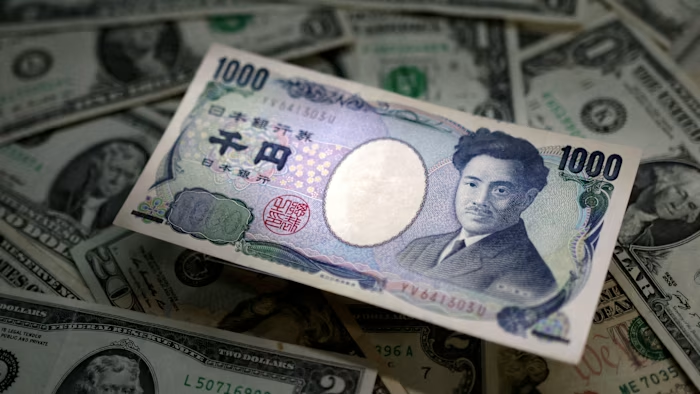
US rate rise jolts yen ahead of Bank of Japan meeting
Stay informed with free updates
Simply sign up to the Currencies myFT Digest — delivered directly to your inbox.
The Japanese yen and other Asian currencies weakened on Thursday after the first US interest rate rise in three years, putting more pressure on the Bank of Japan ahead of its own decision on how far to tighten monetary policy.
The yen fell past ¥156 per dollar in trading on Thursday after the US Federal Reserve raised benchmark rates by a quarter of a percentage point and signalled further steps to curb inflation.
The Japanese currency has weakened more than 1.1 per cent since the Fed’s decision, while the dollar has strengthened 0.7 per cent against a basket of key trading partners and US short-term yields have risen.
Yields on two-year US Treasury notes rose 0.07 percentage points on Wednesday to hit 4.74 per cent, falling slightly on Thursday to 4.71 per cent.
The Korean won weakened 0.3 per cent on Thursday to Won1,380. In India the rupee fell back to Rs96.07, its weakest level since late July.
The currency moves undermine progress in recent weeks by the US and Japan to support the yen, and increase scrutiny of the Bank of Japan’s own interest rate announcement on Friday, when it is widely expected to raise rates by 0.25 percentage points to 1.25 per cent.
The rate would be the highest in three decades. Some hawkish policymakers at the BoJ have called for the bank to raise rates by 0.5 percentage points to act more firmly against rising Japanese inflation.
“The moves now put Asian currencies on the back foot,” said Mitul Kotecha, head of Asian foreign exchange and emerging markets macro strategy at Barclays.
Kotecha said the Fed’s decision made it “almost inevitable” that the BoJ would raise rates.
Higher energy prices have added pressure to Asian currencies. Brent oil broke above $100 this month and is currently trading around $105.8 a barrel.
“We’ve been hit by a double whammy,” said Abbas Keshvani, Asia macro strategist at RBC Capital Markets. “We’re a region of energy importers.”
“On the other hand there is of course the pull of the dollar, which is from a Fed hiking cycle. It’s going to be difficult for a lot of Asian central banks to compete against that.”
An exception to the broad weakness in Asian currencies was the Chinese renminbi, which was stable at around Rmb6.71 a dollar.
US President Donald Trump and Chinese leader Xi Jinping are scheduled to host a summit in Washington next week, with analysts noting that the renminbi tends to strengthen ahead of such meetings.
The New Zealand dollar has weakened by about 1 per cent since the Fed’s cut, while the Australian dollar has fallen 0.6 per cent.