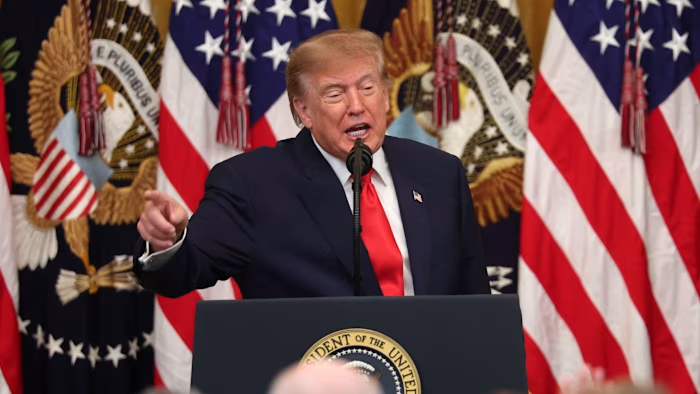
Trump agrees deal with Putin for Russia to release diesel on to global market
Unlock the White House Watch newsletter for free
Your guide to what Trump’s second term means for Washington, business and the world
Donald Trump has struck a deal with Vladimir Putin for Russia to release diesel to the world, sparking a backlash from Ukraine as Washington aims to quell fuel prices ahead of November’s midterm elections.
The US president on Friday said Moscow had agreed to “immediately” release 300,000 tonnes of the fuel “to the American and Global Marketplace” followed by another 500,000 tonnes in November and a further 1mn tonnes “immediately thereafter”.
An additional 3mn tonnes would delivered “based on the condition” of Russia’s refineries, Trump said.
“Between our TOTAL CONTROL of the Strait of Hormuz, and this great announcement on Russian Energy, Diesel Prices for Americans and, indeed, the World, will be COMING DOWN, IN RECORD NUMBERS, AND FAST!” Trump wrote on his Truth Social platform.
The Kremlin confirmed the deal in a statement posted to Telegram that quoted Russia’s president as saying he was “confident that this will have a positive impact on the entire global economy”.
The price of wholesale diesel for delivery in New York harbour fell about 4.5 per cent to $4.67 a gallon following the announcement on Friday even as analysts warned the amount of the fuel Russia agreed to release would be insufficient to halt the global supply crunch.
Ukraine President Volodymyr Zelenskyy criticised Trump’s decision after meeting with a visiting congressional delegation in Kyiv.
“Gifts to Putin will not bring peace or any benefit to the civilised world,” he said. He later called the move “a weak decision” that would help fund the Kremlin’s war against Ukraine and embolden the Russian leader.
The deal between Washington and Moscow comes as the price of diesel — a vital input for industry and agriculture — soars globally as wars in the Middle East and Ukraine knock out infrastructure and strain global supplies.
US diesel prices at the pump hit a record $6.53 in recent weeks, squeezing farmers and truckers and putting Trump under pressure ahead of next month’s midterm elections.
The White House has implemented a host of policy measures to tackle the fuel price crisis, leaning on European allies to release more stocks, pushing Ukraine to halt strikes on Russian refineries and loosening restrictions on the use of tax-exempt red diesel on public roads. But prices have remained elevated.
Friday’s deal will return Russian diesel to the global market after it suspended exports this year as Ukrainian attacks hobbled many of its refineries.
Bob McNally, a former energy adviser to George W Bush and president of Rapidan Energy, said Russia had already “been leaning toward a slight easing of its diesel export ban for logistical reasons”.
“This dovetailed with the Trump administration’s push to respond to soaring diesel prices,” he said.
A senior Ukrainian official said Kyiv would continue its long-range drone strikes on Russia’s energy facilities. “We will burn [Russian] refineries,” the official said.
The US Treasury said its Office of Foreign Foreign Assets Control was “immediately issuing a temporary general licence to allow the supply of Russian diesel to the global market”.
It was not immediately clear how much diesel would be supplied to the US, which has imported minimal volumes of the fuel from Russia over the past decade.
The announcement was met with a lukewarm reception from US allies which have sought to starve Moscow of energy revenues. A UK government spokesperson said Britain would “maintain pressure on Russia through the toughest sanctions regime ever imposed”.
Analysts said Russia — which is running its refineries at about 60 per cent of capacity amid outages caused by Ukrainian strikes — would struggle to provide significant additional volumes to the global market.
“The thing that I’m most curious about is: where is the diesel going to come from?” asked Michelle Brouhard, head of policy and geopolitical risk at Kpler. “Russia doesn’t have an export problem. It’s got a refinery problem.”
Analysts warned the announcement could ultimately remove fuel from the market as it caused diesel prices to slide relative to crude, piling more pressure on refiners that are struggling with soaring freight costs.
“Refinery margins are now negative, which means refinery runs in Asia probably are going to come off . . . which means we’re going to lose some diesel,” said Brouhard.
Additional reporting by James Politi in Washington and David Sheppard in London