The Purpose We Forgot
There is a way of reading the fall of man that has almost nothing to do with fruit. We tend to imagine the first failure as an act of appetite—a reaching hand, a forbidden taste, desire overrunning a command. But when the Quran narrates the moment, it reaches for a different word, and the word is quieter and far more devastating than appetite.
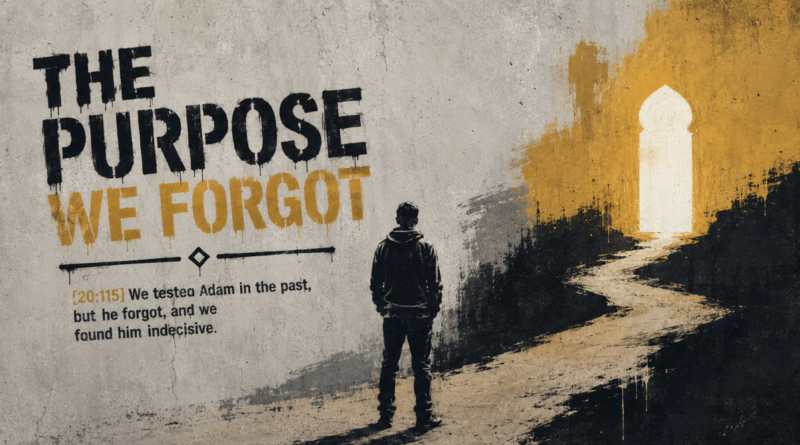
[20:115] We tested Adam in the past, but he forgot, and we found him indecisive.
He forgot. The heading the text places over this verse is blunt about what kind of failure it is: humans fail to make a firm stand. Not that Adam lusted, not that he rebelled in some grand Promethean gesture, but that he lost the thread. He had been told what he was and where he stood, and then, in the moment it mattered, the knowledge slipped. The devil did not have to overpower him. He only had to wait for him to forget.
That is the shape of the human problem in miniature, and everything that follows in these pages is an attempt to trace it out at full scale. Because the story of man since that first forgetting has been, over and over, the story of a creature who cannot seem to hold on to what he is for. We build, we conquer, we theorize, we accumulate—and somewhere in the middle of all that motion the one question that would organize the rest goes dark. What was any of it for? We forget, and we find ourselves indecisive, and the world grows strange and purposeless around us in exact proportion to the forgetting.
When a civilization forgets
In an earlier essay I traced how the modern West arrived at the most radical version of this forgetting. For most of human history, purpose was simply built into the furniture of reality. An acorn was for becoming an oak; a heart was for pumping blood; a human being was for something too. The classical world called this the telos, the end toward which a thing is aimed, and it was not thought of as a pious add-on but as part of the physics of the thing itself. To know what a creature was, you had to know what it was for.
Then came the great subtraction. The scientific revolution learned to describe the world beautifully without ever asking what anything was for, and after a few centuries people mistook the fact that we had stopped asking the question for proof that the question had no answer. Final causes were not disproven; they were quietly declared out of scope. And a strange thing happened once the human telos was declared empty: the whole architecture of meaning that had rested on it began to sag. If there is no end a human life is aimed at, then there is no such thing as a wasted life, no fact about what we ought to be, no ground beneath the word flourishing—which quietly shrinks until it means nothing more than feeling good, a state a contented animal can reach as easily as a saint.
The most honest of the modern thinkers saw the danger clearly. When Nietzsche announced that God was dead, he was not gloating; he was sounding an alarm. He understood that erasing the source of purpose meant erasing the ground of all value, and that the abyss underneath—the sense that in the end nothing matters—had just opened under civilization’s feet. This is forgetting on a historical scale. Adam forgot for a moment in the garden; the modern world forgot on purpose, wrote the forgetting into its textbooks, and called it maturity.
But here is the thing the essay on telos could only gesture at and had to leave open, because it was written for a general audience: the highest form of the question—whether the human telos terminates in God—cannot be answered by the same instrument that lost it. Reason can travel toward a purpose and confirm it. It has a much harder time positing one from nothing, which is why every philosophical attempt to rebuild an ethics on pure logic keeps smuggling a telos back in through the side door and hoping no one notices. What reason struggles to establish, revelation simply declares. And what it declares is the answer to the question the modern world buried.
What we are for
[51:56] I did not create the jinns and the humans except to worship Me alone.
Notice the form of this statement, not only its content. It is not the conclusion of an argument. There are no premises leading up to it, no chain of reasoning the reader is invited to check. It is an axiom—a foundation posited so that everything else can be built on top of it. This is exactly how revelation tends to work. Where philosophy tries to derive the purpose of man and stalls, the Quran states it, plainly, as the first line of the blueprint. The human being is for worship. That is the telos the modern world could not find, sitting in the text the whole time, waiting to be remembered.
And immediately—before we can even misunderstand it—the text closes off the most natural error:
[51:57] I need no provisions from them, nor do I need them to feed Me.
This is the sentence that changes everything about what “worship” can possibly mean. If God needed nothing, then worship cannot be a matter of supplying Him with something—praise He is short on, attention He craves, energy He runs low without. The One who lacks nothing cannot be enriched by our devotion. So whatever worship is, it is not for God’s benefit. Read that carefully, because almost every distortion of religion begins by getting this exact point backward: imagining a needy God who must be flattered, fed, appeased. The Quran demolishes the picture in a single line. He needs no provisions. So the purpose of our existence, though it is aimed at Him, must somehow be for us.
What worship actually is
Here is where the forgetting does its subtlest damage. Even people who remember that we were made to worship have often forgotten what worship is. They picture it as ritual withdrawal—a turning away from the world and toward the ceiling, a private transaction between the soul and the sky that leaves the street outside untouched. And so you get the strange spectacle of the devout man whose devotion has no hands: scrupulous in rite, indifferent to the orphan at his gate.
The Quran will not allow this split. When it speaks of the people it approves, it almost never names belief alone. It names belief and the deed that proves it—those who believe and lead a righteous life, the phrase falling again and again like a hammer on the same nail. Faith that does not become action is, in the Quran’s grammar, barely faith at all. To worship God is to do good. The vertical relation with God discharges itself horizontally, into the world, as righteousness—or it is not real.
And then the text offers the single most astonishing image of what this looks like, an image so bold it should stop us cold every time. It calls our good works a loan. And it makes God the borrower.
[2:245] Who would like to loan GOD a loan of righteousness, to have it repaid to them multiplied manifold? GOD is the One who provides and withholds, and to Him you will be returned.
Sit with the strangeness of it. The One who owns the heavens and the earth, who provides for every creature that crawls, who could fill every empty hand with a word—that One asks to borrow. From us. The Owner of everything positions Himself as debtor to the very people He gave everything to. And He is explicit that the arrangement runs in our favor:
[64:17] If you lend GOD a loan of righteousness, He will multiply the reward for you manifold, and forgive you. GOD is Appreciative, Clement.
Once you connect this to 51:57, the whole logic snaps into focus. God needs no provisions. He is not short of capital. The poor man’s sustenance is already guaranteed by the One who guarantees the sustenance of everything alive—you are the ones who need GOD, while GOD is in no need for anyone (35:15). So when He frames your righteousness as a loan to Him, He is telling you outright that He does not require the loan. The transaction is not for His benefit. It is a device by which He lets you invest in your own transformation, and then, with staggering courtesy, agrees to pay you back for it. To worship God is to lend to God—and the loan enriches only the lender.
This is precisely what the disbelievers in the Quran cannot see:
[36:47] When they are told, “Give from GOD’s provisions to you,” those who disbelieve say to those who believe, “Why should we give to those whom GOD could feed, if He so willed? You are really far astray.”
Their reasoning is flawless and their conclusion is catastrophic. Yes—God could feed them. That was never in question. What they miss is that the whole point of the arrangement was never to solve a logistics problem in the divine economy. It was to give you something to lend, a threshold to step across, an occasion for the righteousness that is the actual purpose of your being here. They stood at the door of the surest investment in existence and mistook it for a trap. They remembered that God is rich, and forgot what they were for.
The measure: God’s attributes, in balance
But if worship is doing good, an obvious and serious question follows. What is the good? By what standard do I know that this act, in this moment, is righteousness and that one is not? Without an answer, “do good works” is a slogan, not a compass.
The Quran’s answer is not that the good is whatever God happens to command, as if goodness were arbitrary and could have been otherwise. That road leads to a tyrant-god whose decrees define morality by fiat. The answer is deeper: the good is grounded in what God is. He is al-Haqq, the Truth, the Real—and morality is woven into the structure of reality because reality is His. To act rightly is not to obey an external rule; it is to move in harmony with the grain of the real, which is to say, in harmony with God’s own nature.
And God’s nature, as the Quran names it, is a set of attributes held in perfect proportion. He is the Most Gracious and the One who holds to account. He is the Forgiving and the Just. He is generous without waste and severe without cruelty. No attribute devours the others; none is missing; each stands in exact relation to the rest. This is the balance—the mizan—that the Quran sees running through the whole of creation, from the orbits of the heavens down to the honesty of a merchant’s scale. Morality, in this vision, is the imitation of that balance. To do good is to reflect the divine attributes in their right proportion: to be merciful where mercy is called for and firm where firmness is, generous without dissolving into waste, just without curdling into cruelty. The moral life is the art of getting the proportions right.
Which is why the Quran describes the community it wants in exactly these terms:
[2:143] Thus, we made you an impartial community, that you may serve as witnesses among the people, and the messenger serves as a witness among you.
The word rendered here as “impartial”—wasat—is the word for the balanced middle, the point that stands between extremes and can therefore judge fairly between them. It is not mediocrity. In Arabic the middle of a thing is often its finest part: the choicest of the flock, the central pearl of the necklace. To be wasat is to occupy the balanced center from which the whole can be seen rightly and weighed justly. A people of the middle is a people who have learned to hold the attributes in proportion, the way their Lord holds them in proportion.
And here is the point that keeps this from collapsing into a rulebook. The balance is not a fixed formula, identical for everyone in every circumstance. It is calibrated—to the person, and to the situation.
[2:286] GOD never burdens a soul beyond its means.
The mean is not arithmetic. What generosity requires of the wealthy is not what it requires of the poor; what courage demands of one temperament is not what it demands of another; the patience owed in one trial is not the patience owed in the next. The Greek philosophers who first mapped the middle path understood this too—the mean, they said, is not the same for all but is fixed “relative to us,” to our capacity and our condition. The Quran grounds the same insight in the mercy of a Lord who knows each soul’s exact measure and asks of it only what it can bear. This is why morality cannot be reduced to a table of fixed quantities and looked up like a tax rate. It is a living act of proportion, the divine attributes refracted through one particular person in one particular moment, tailored by conscience to the situation at hand. Two sincere people, facing different circumstances with different capacities, may strike the balance in different places and both be right—because both are reflecting the same attributes, fitted to different vessels.
All of it is for the Hereafter
So we were made to worship; worship is doing good; the good is God’s attributes held in tailored balance. One question remains, and it is the one that gives the whole structure its weight. Why does any of this finally matter? If a good life and a wasted life end identically in the same silence, the balance we strike is only a private preference dressed up as virtue.
The Quran’s answer is that the deed is the only thing that lasts—the single possession that survives the crossing.
[6:94] You have come back to us as individuals, just as we created you the first time, and you have left behind what we provided for you. We do not see with you the intercessors that you idolized… All ties among you have been severed; the idols you set up have abandoned you.
Everything we spend our lives accumulating is named here precisely as what gets left behind. The wealth, the status, the name, the network of alliances and identities we hid inside—all of it stays on this shore. We arrive as we came: alone, and carrying only what we did. Not what we owned, not what we were called, not the crowd we belonged to. Only the record.
[99:7-8] So whoever does an atom’s weight of good will see it. And whoever does an atom’s weight of evil will see it.
The precision is the point. Nothing is too small to survive; nothing is too well-hidden to appear. The atom of good you did when no one was watching crosses over intact; so does the atom of harm. This is the ledger the loan of righteousness was being written into all along. Every act of good was a deposit in the only account that cannot be seized, devalued, or left behind. The disbelievers of 36:47 thought giving was subtraction—money out of the pocket, gone. They had the direction exactly wrong. It was the one thing they could keep.
And lest any of this be mistaken for a contempt of the world, the Quran blocks that exit as firmly as it blocks the others:
[28:77] Seek, with the wealth GOD has bestowed upon you, the abode of the Hereafter, without neglecting your share in this world.
The point was never to despise the world or flee it. The world is not the enemy of the Hereafter; it is its field. This life is the one place where the only durable harvest can be planted, because it is the only place where the difference between a generous heart and a grasping one can actually show up and be acted on. You do not sow in the barn. You sow in the ground, in the mud, among the seasons and the hardships—and then you carry the harvest home. To neglect your share of the world would be to leave the field unplanted. To live only for the world would be to tend the field and abandon the harvest. The balance—there it is again—is to work the ground precisely because something in it grows toward eternity.
Remembering
Trace the whole line and it closes into a single arc. The fall was a forgetting. The recovery, then, is a remembering—which is why the Quran names its own function so often as a reminder, and why the act at the center of worship is called dhikr, remembrance. We were not asked to discover something new. We were asked to remember something we already knew and lost: that we are creatures with a purpose, that the purpose is to worship, that worship is the doing of good, that the good is the balance of God’s own attributes fitted to our lives, and that the good we do is the only thing we will carry out of this world into the next.
Everything the modern world called sophistication was, at bottom, an elaborate forgetting—a civilization that mistook losing the thread for outgrowing it, and then wondered why the meaning had drained out of everything. And every soul that has ever felt the quiet dread of a comfortable, purposeless life has felt the same forgetting in miniature, the same slippage that took Adam in the garden.
The offer still stands, exactly as it was first made. The Owner of everything is still asking to borrow. The field is still open, and the season is not over. What we send ahead is the only thing we get to keep—and the beginning of sending it ahead is simply to remember, at last, what we were always for.