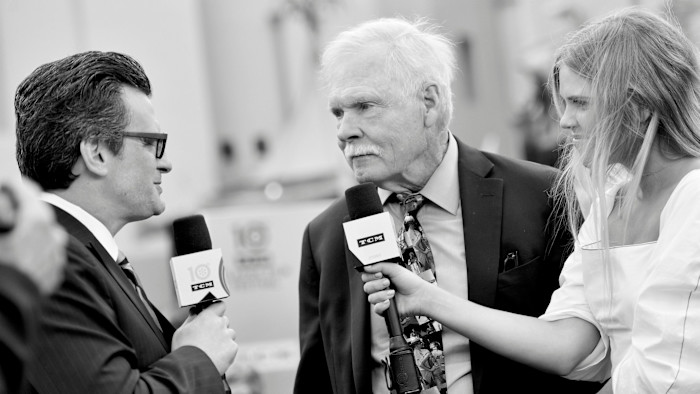
Ted Turner, media mogul, 1938-2026
Ted Turner, the billionaire media owner who has died at age 87, was famous, when not actually notorious, for a range of achievements and characteristics equalled by few humans. Reticence was not one of his virtues and he more than earned his nickname, The Mouth of the South, a sobriquet he loathed.
There were famous public battles with other media moguls such as Rupert Murdoch. Turner called Murdoch a “scumbag” and “Schlockmeister”. Murdoch’s News Corp responded by calling Turner a cultivator of dictators who had “sold out to the establishment in his declining years”. But on the day of his death in 2026, Murdoch said Turner was “a great American and friend”.
For most it would have been achievement enough to create a multibillion-dollar media empire from unpromising origins in the southern US city of Atlanta. Yet Turner also decided to take the risk and endure the inevitable mockery involved in setting up the world’s first 24-hour television news channel, which changed the way news is reported and perceived.
At the same time as developing his business career, Turner became a master yachtsman who successfully defended the America’s Cup in 1977 with an amateur crew and a second-hand boat. He was a womaniser on a colossal scale, taking his girlfriends out publicly while married, and had a reputation for public drunkenness and misconduct. His marriage to his third wife, the actor Jane Fonda, in 1991 brought out a happier side: he was even content to become known as Jane Fonda’s husband. They divorced in 2001.
Turner’s one unfulfilled ambition, although it was unclear how seriously he took it, was to become US president. The closest he came was to be second behind Ross Perot on a private list of two drawn up by Southern political power brokers to choose an independent candidate to contest the 1992 presidential elections.
Afterwards, Turner realistically admitted to any journalist who asked that it was unlikely the American people would choose someone like him, who suffered from a form of manic depression and who regularly took lithium for his condition. It was, however, that enormous life force, an unwillingness to be put off by the barriers that would have deterred the ordinary, that explains his achievements. He was one of the creators of the TV revolution that changed the nature of entertainment, culture and communication around the world.
Just as Turner looked as if he had achieved more of his ambitions than seemed possible, he took on more challenges that would inevitably defeat him or anyone else: to save the environment, tackle overpopulation and end world hunger.
To know Turner you had only to look into his vast office on the 14th floor of the CNN Centre in Atlanta. More trophy room than office, his life was on display, from dozens of silver yachting cups and plates to basketballs and a doll of his favourite admiral, Lord Horatio Nelson.
Robert Edward Turner III was born on November 19 1938 in Cincinnati, Ohio, and the events of his early years go a long way towards explaining his contradictory character and yearning for success, love and approval.
His father Ed, a man of violent mood swings and ruinously heavy drinking habits, left Turner to be raised by his grandmother from the age of three when the family moved. A succession of boarding schools followed, including the stark Georgia Military Academy. The sense of rejection stayed with him all of his life.
There was also family tragedy aplenty in his early years. His sister Mary Jane died in agony when she was 15 after five years suffering from the side effects of a rare form of lupus, an inflammatory disease in which the body makes antibodies against its own tissue.
But the pain of her slow death was as nothing to the shock when Turner’s abusive father died by shooting himself in the head in 1963.
The father had been about to sell his advertising billboard business, and following his death Ted Turner, a 24-year-old incipient playboy, would have received about $1mn. Instead the young Turner blocked the sale and set about building the business.
A key move came in 1970 when Turner took over a heavily lossmaking television station WJRJ in Atlanta. It was fifth in a market of five and he slowly built it up with a wholesome diet of cartoons, old movies and extensive coverage of the Atlanta Braves baseball team. In 1976 to protect the television franchise, he bought the Braves. Eventually the combination of sport and movies drove the ratings through the roof.
Turner’s working methods remained unorthodox. He would disappear for weeks sailing, and then return and work around the clock, even sleeping in the office. An executive who knew him at the time said: “At first, nobody took him seriously. Big mistake. He is eccentric. Maybe even crazy. But Turner is bright and he is driven. And he never gives up.”
In 1976, Turner was one of the first to realise the potential of satellites for television. He escaped from the confines of Atlanta by beaming his TV station up to a communications satellite which transmitted it to cable networks all over the nation. He was to claim his “superstation” saved the struggling cable industry by providing popular programming.
The turning point of his career came in May 1979 when he announced that he planned to launch Cable News Network, the first round-the-clock TV news network even though, typically, he had no idea how he was going to do it. There were no plans, no office and no staff. But launch it he did in 1980 to widespread scepticism and predictions that it would “crash in flames”.
In fact, wrote Porter Bibb, Turner’s biographer, CNN redefined news from “from something that has happened to something that is happening”. Soon after the launch of CNN, Turner, worth more than $100mn, was addressing a group of students in Washington. He held up a copy of Success magazine with his picture on the cover and asked: “Is this enough? Is this enough for you, dad?”
Much more success and recognition was to follow. Using more than 15 satellites, CNN and its regional variants spanned the globe and at times of crisis were watched attentively by presidents and generals.
Impact and controversy soared during the Gulf war of 1990-1991 when CNN was the only western TV organisation allowed to stay in Baghdad. The live pictures were riveting, but questions were asked about whether the station was being used to broadcast Iraqi propaganda and whether undigested events devoid of analysis and context were an unmitigated blessing.
CNN turned Turner, the maverick Atlanta television owner and perpetual outsider, into a player on the world stage who could get the ear of statesmen. There were other satellite television channels, for cartoons for children and old movies for everyone and megadeals.
Turner always said he was happy to overpay for properties as long as they had long-term value. In 1986 he paid $1.5bn for MGM and then had to sell everything apart from the film library because he overstretched himself.
Behind the bluster and eccentricity lurked a sharp business brain, and by 1996 Turner realised that in the new international world of the media, not even Turner Broadcasting was large enough to prosper on its own. In a surprising move, given his personality, he voluntarily sold his interests to Time Warner, creating one of the largest media groups in the world.
After the merger Turner remained an active member of the Time Warner board. But there was more time for other passions, such as breeding buffalo on an enormous ranch in Montana where he liked to spend time with his wife Jane Fonda — when he was not fighting for world peace and the environment. The campaigning, Turner once explained, was like a religious fervour. “I’m not going to rest until all the world’s problems have been solved. I’m in great shape. I mean, the problems will survive me no question about it.”
But his adventures, both business and personal, took a turn in the years afterward. He and Fonda divorced. It was a relationship he later said he never got over. He did not remarry.
That same year, in 2001, Time Warner sold to AOL. After the internet bubble burst, the deal would be taught in business school courses as among the worst in the history of mergers. It was also personally disastrous for Turner, the largest shareholder, costing him most of his fortune. He stepped down from Time Warner’s board in 2003.
Well into his 60s and starting over, Turner shifted his focus to philanthropy and environmental causes.
He dived in with signature vigour.
Turner in 1997 had pledged $1bn to the UN, and made good on that by 2015. He bought millions of acres of wilderness, making him one of America’s largest private landowners — setting them aside as nature preserves. He is credited with helping save US bison from extinction. He created an ecotourism business from his ranches in New Mexico, telling reporters that it gave him “something to live for besides cable television”.
In 2018, shortly before he turned 80, Turner disclosed that he had been diagnosed with Lewy body dementia, a brain disorder that affects memory — a disease that had also afflicted comedian Robin Williams.
He had largely withdrawn from public life, living on his Montana ranch, where he enjoyed fishing, according to his daughter, one of five surviving children.
Turner told Piers Morgan in 2012 of his latest reinvention: “I lost Jane. I lost my job here. I lost my fortune, most of it, got a billion or two left . . . they all broke my heart.”
The AOL merger and what he described as “the subsequent basically destruction of my wealth” had hurt, he said. “But I just toughed it out. You have to keep, you have to keep going. You can’t give up in life.”