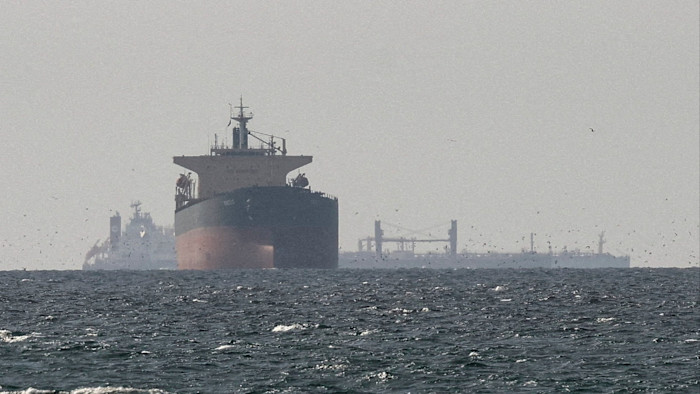
Tankers transiting Strait of Hormuz stop or turn around amid US blockade, data shows
Unlock the White House Watch newsletter for free
Your guide to what Trump’s second term means for Washington, business and the world
The US blockade of Iranian ports appeared to be impacting the movement of ships in the Gulf on Tuesday, with tracking data showing that several tankers transiting the Strait of Hormuz had either stopped or turned around.
Several cargo ships that had come from Iranian ports, including at least two sanctioned tankers, attempted to cross the narrow waterway in the hours after the embargo came into effect on Monday, but none have gone further than the mouth of the Gulf of Oman.
The US military said on Monday that no ships had passed through its blockade of Iranian ports in its first 24 hours, and that six vessels had turned around when ordered to do so.
US President Donald Trump’s decision to impose the naval blockade came after negotiators failed to reach a peace deal with Iranian officials in lengthy talks in Pakistan at the weekend.
The Strait of Hormuz has emerged as a key obstacle in peace negotiations, with Iran already having sought to seize control over the waterway and imposed fees on vessels transiting through it.
Washington issued a notice to seafarers on Monday saying that any vessel that had entered or departed the Iranian ports and coastal areas “without authorisation” would be “subject to interception, diversion or capture”.
The US has said the blockade would be enforced in the Gulf of Oman and Arabian Sea, east of the strait.
The Rich Starry, a tanker sanctioned by the US that appeared to have come from a United Arab Emirates port, turned around late on Tuesday morning and started sailing back into the strait, having transited through on Monday night.
The ship was likely to have loaded with Iranian oil without its GPS on, according to analysts, or done a ship-to-ship transfer in the Gulf.
Another sanctioned tanker, the Elpis, which had signalled that it had come from the Iranian port of Bushehr, showed that it had stopped outside the strait having also passed through on Monday afternoon.
Gregory Brew, an analyst at Eurasia Group, said: “I think this is definitely the blockade’s first test. Iran needs to gauge how seriously the US intends to enforce it, and Elpis is the guinea pig.”
At least 11 ships had passed through the strait going into and out of the Gulf in the first 24 hours after the blockade was imposed at 10am eastern time on Monday.
Several ships appeared to have been allowed to pass into the Gulf, tracking data showed.
US Central Command, which oversees American military operations in the region, said on Monday that more than a dozen warships, over 100 fighter jets and surveillance aircraft, and more than 10,000 troops are enforcing the blockade.
Tanker industry executives described the situation in the Gulf as a “double blockade” as vessels are forced to comply with a mandate from the Iranian Revolutionary Guard Corps to take a route through the strait that hugs the Iranian coastline, as well as the US naval control.
Iran, which has also requested that ships transiting the strait pay fees of up to $2mn, said the blockade was a “violation” of its sovereignty, while Asian countries hit out at the US action as they face increasingly tight energy supplies.
Beijing’s foreign ministry said on Tuesday that the blockade was “irresponsible and dangerous”.
Brett Erickson, a sanctions and security analyst, said that Washington was in “an impossible spot as a result of poor planning and poor execution”.
“What do you do? Do you let Iran continue to ship a few million barrels of oil a day through the strait and benefit? Or do you cut it off and hurt our allies in Asia who are suffering increasingly intense energy shocks?” he said.