Taiwan Tests How It Would Resist a Chinese Siege at Sea
As armed Chinese ships expand patrols around Taiwan, officials in Taipei are more urgently testing how they would keep fuel and other vital supplies flowing if Beijing tried to choke off the island.
China, which claims Taiwan as its territory, has in recent years rehearsed a blockade, using naval ships and military planes to practice sealing off access to Taiwan.
Taiwan relies on imports of fossil fuels for about 95 percent of its energy, and natural gas fuels half of its power generation. And the global shocks caused by the blocking of the Strait of Hormuz during the U.S.-Israeli war with Iran have highlighted the importance of securing energy supplies.
Officials in Taiwan are exploring whether floating gas storage and processing terminals, emergency stockpiles, or even reviving nuclear power could help keep the island running in a crisis.
They have held so-called tabletop, or wargaming, exercises to address a siege scenario, and are planning to conduct drills to escort and reroute ships to port and to store and distribute supplies on Taiwan, four officials said. They spoke on the condition of anonymity to discuss internal government deliberations.
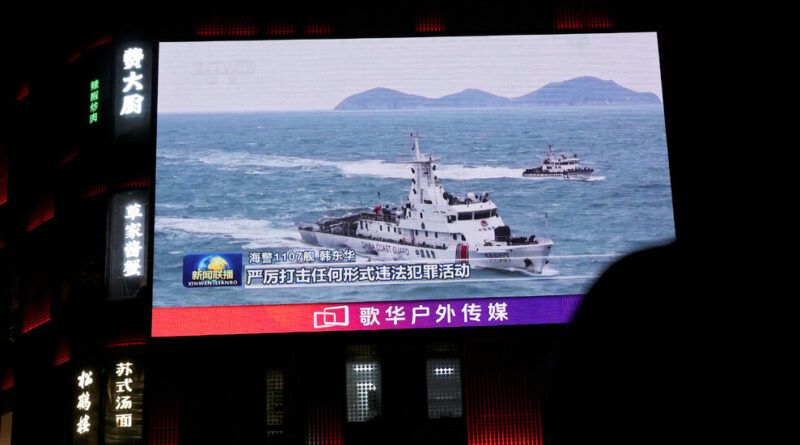
Worries about the threats posed by China have sharpened since last month, when Beijing announced its coast guard ships would conduct “routine law-enforcement patrols” in the waters east of Taiwan. That expanse of ocean matters because it is where Taiwan would most likely look for the United States and its allies to bring military and economic relief if China attacked.
Preparing for an Energy Squeeze
Keeping power plants supplied during a Chinese blockade would be daunting. Taiwan maintains at least 11 days’ worth of natural gas reserves, and has the capacity to store enough for up to 20 days.
“We’ve constantly conducted exercises on these national security topics, figuring out how to handle different scenarios,” Chen Chung-hsiena deputy director-general of Taiwan’s Energy Administration, said in an interview. “We certainly view matters using worst-case scenarios.”
Taiwan is exploring acquiring ships for storing and processing natural gas off shore, to provide additional capacity and for emergencies, Mr. Chen said.
Chen Kuan-tinga lawmaker from Taiwan’s governing Democratic Progressive Party who focuses on national security issues, said such ships could give Taiwan “more flexibility for how natural gas is received and dispatched” if China tries to seal off the island and threaten its infrastructure.
But finding safer gas reception sites remains a big challenge.
Taiwan’s three terminals for receiving and storing liquefied natural gas are on the island’s west, where they would be highly exposed to attack or harassment from China during a crisis. The east coast is forbiddingly mountainous, with relatively narrow roads and small ports with no infrastructure for taking delivery from hulking natural gas tankers, or generating and distributing power from the gas.
“The eastern region wouldn’t necessarily be the best solution,” said Mr. Chen, the energy official. “A floating pier on the west coast is more plausible, closer to existing power plants anyway.”
Taiwan’s government is also weighing whether to reverse its closure of nuclear power plants, which could be one source of stable power.
Craig Singleton, the China program senior director at the Foundation for Defense of Democracies in Washington, said his group held a tabletop exercise about a Chinese “energy siege” of Taiwan last year with senior Taiwanese officials and company leaders. It was clear that “Taiwan urgently needed to diversify both its energy suppliers and the means by which those supplies reach the island before a crisis,” he said.
China’s Threat to Taiwan’s East
Even as they grapple with the threat of invasion, Taiwan’s officials are preparing for a murkier kind of coercion, in which Chinese government ships warn, restrict or even board cargo vessels approaching Taiwan.
The ships China has positioned on Taiwan’s east coast are part of what officials call “gray zone” tactics — hardball actions that fall short of outright warfare. Such muscle-flexing is hard for Taiwan to counter without risking retaliation from China.
Beijing has declared its jurisdiction over the waters in that area, a claim Taiwan rejects. In an early sign of how China could use its presence to assert its claims, a Chinese government ship stationed east of Taiwan radioed three passing cargo ships to request information, including about the crew members onboard.
“What they did east of Taiwan was partly a very initial exercise to model a quarantine, meaning an operation to inspect and possibly turn back ships at sea,” said Lai I-chungthe president of the Prospect Foundation, a foreign policy institute in Taipei.
China’s navy regularly places about seven or eight naval ships around Taiwan, including off the island’s east coast, according to Taiwanese security officials.
“But now we’re also seeing more and more of the China Coast Guard,” Mr. Lai said, noting he was speaking in a personal capacity. The increased presence of the coast guard — a paramilitary force with large, heavily armed ships — would increase Beijing’s choices to put pressure on Taiwan.
During a tabletop simulation late last month, President Lai Ching-te of Taiwan and his senior officials worked through a scenario in which Beijing demanded that cargo ships seek its approval before approaching Taiwan and sent coast guard ships to board, inspect and seize vessels. (In 2024, a Chinese coast guard patrol briefly boarded a Taiwanese ferry.)
Lii Wen, a Taiwanese national security official who described the exercise in a speech afterward, said that it “helped to pinpoint shortcomings in current response measures” and heightened attention on improving coordination between agencies on issues such as ensuring energy supplies. He declined a request for an interview.
The Ministry of the Interior, which helped organize the June simulation, announced this year that it was planning disaster response drills on the east coast of Taiwan in September that would test receiving international medical teams and supplies.
Other exercises will most likely train officials from the ministries for the interior, economic affairs and agriculture to work together on distributing supplies within Taiwan. Escorting of ships approaching Taiwan would fall under its Navy and Coast Guard.
China Is Ramping Up Tactics Short of War
The Chinese coast guard ships currently off Taiwan’s east seem to be serving a mostly symbolic role for now. But that could change, Ryan D. Martinsonan associate professor at the U.S. Naval War College, said in emailed comments, also speaking in his personal capacity.
“Once the ships are out there on a consistent basis, Beijing is in a better position to take more forceful actions against Taiwan,” he wrote.
The two coast guard ships China sent to Taiwan’s east this month weigh 3,000 and 4,000 metric tonsfar larger than the coast guard boats Taiwan sent to shadow them. Ships from the Chinese Maritime Safety Administration, which regulates civilian shipping, also took part in recent actions in the same area.
Chinese government ships sailed near Taiwan’s main island 85 times during May and June, compared with 45 times in the same period last year, the Taiwan Coast Guard has estimated.
Coast guard ships come under Chinese military command and have been increasingly integrated in military exercises near Taiwan, said Julia Famularoa lecturer at the University of Hawaii at Manoa who studies China’s maritime operations.
The pressure from Beijing could increase before and after 2028, when Taiwan holds its next presidential election, said Taiwanese officials and experts.
“I think these gray zone measures will definitely become more and more intense,” said Jing Yuan-chouan adjunct professor at Tamkang University in Taiwan, who studies China’s military strategy toward Taiwan.
“For now, they prefer nibbling away at us, piece by piece,” Mr. Jing said. “But the nibbling lays the way for if they ever want to try to devour us.”