
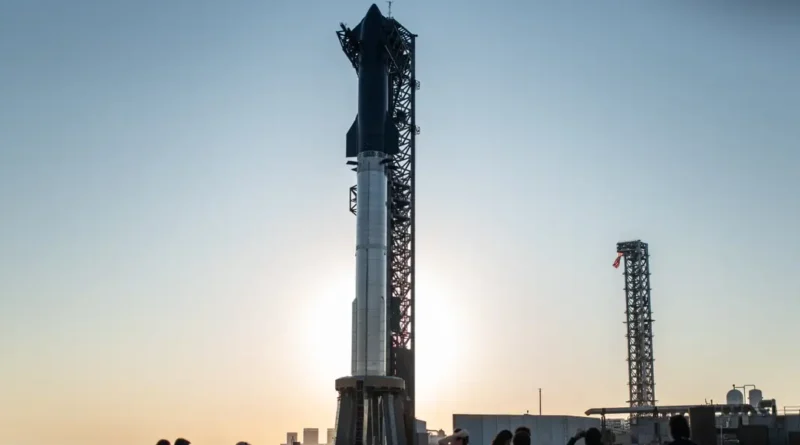
SpaceX's Starship rocket just hit a key milestone on its riskiest launch yet
SpaceX’s Starship rocket just completed a key milestone in its riskiest launch yet.
The 400-foot-tall rocket lifted off from SpaceX’s Texas launch site at around 7:46 am Central Time on Monday, in a landmark launch that saw Starship reach Earth’s orbit for the first time.
The launch went smoothly, with Starship’s massive booster stage returning to Earth in an apparent soft splashdown. The rocket’s upper stage faced a more dramatic ascent, with an engine failure briefly putting Starship’s push for orbit at risk.
After SpaceX’s team decided to continue the mission, Starship reached orbit at around 8:15am Central Time.
Beyond reaching orbit for the first time, Starship’s 14th launch also marks the first time that the megarocket has launched with real, revenue-generating cargo.
Starship is carrying 26 Starlink V3 satellites, the latest version of the low-earth orbit satellites that SpaceX uses to beam its Starlink internet service around the globe.
Starship’s 14th flight is set to launch on Monday, Sept 28. The 75-minute launch window opens at 7:15 a.m. CT. Live coverage of the mission starts ~35 minutes before launch → https://t.co/uQKQvgaTmJ
— SpaceX (@SpaceX) September 27, 2026
The successful deployment of these satellites is a key focus of today’s launch.
Unlike previous flights, SpaceX didn’t catch Starship’s giant booster in the chopstick arms of its launch tower when the rocket returns to Earth. Instead, both the booster and Starship’s upper stage are set to splash down in the Gulf of Mexico and the Pacific Ocean.
While that approach reduces the risk of things going wrong on landing, there are more potential failure points than in previous Starship missions. Starship must enter a stable orbit, deploy satellites, keep its systems working for nearly 10 hours, then reignite an engine to deorbit and survive a controlled reentry.
Why Starship is so important for SpaceX
Reaching orbit and deploying Starlink satellites is a critical step in Elon Musk’s ambitious plans for Starship, which the billionaire has said could launch as often as once a day within the next year.
Launching larger V3 satellites on Starship, which has far greater capacity than SpaceX’s Falcon 9, will allow the company to supersize its Starlink constellation.
The satellite internet service has become one of the most lucrative parts of SpaceX’s business, and was the source of the majority of the company’s revenue last year.
SpaceX has submitted plans to launch 100,000 Starlink satellites in the coming years, up from around 11,000, and Musk has said the satellite internet service could supply the majority of the world’s internet in less than a decade.
Meeting those ambitious goals, which underpin the $2 trillion market cap SpaceX secured after a record-breaking public listing in June, hinges on Starship flying regularly.
RONALDO SCHEMIDT/AFP via Getty Images
SpaceX executives have estimated that Starship, which, unlike the company’s Falcon 9 rocket, will be fully reusable, could reduce the cost of launching cargo into space by up to 10 times compared to the Falcon 9.
That will be critical in enabling SpaceX to build and service massive satellite constellations while still turning a profit, and opens the door for some of Musk’s science fiction-inspired plans.
SpaceX has indicated it aims to launch as many as 1 million satellites functioning as orbital data centers, with Musk betting that training large language models in space will give the company an edge in the AI race.
The company has also made Starship a central part of its long-term plans to build a human (and robot) presence on the moon, and eventually settle on Mars.