SpaceX’s AI Wing Casts Cloud Over Future Earnings, Leading Experts Say
While SpaceX is now a world superpower in crafting reusable rockets, its high-priced takeover of the AI start-up xAI should be factored into calculating the value of the combined outfit and its IPO share price (Photo by CHANDAN KHANNA/AFP via Getty Images)
AFP via Getty Images
While SpaceX is now a world superpower in crafting reusable rockets, its high-priced takeover of the artificial intelligence start-up xAI, with its speculative future, should be factored into calculating the value of the combined outfit and its IPO share price, say leading aerospace equity analysts across North America.
As SpaceX counts down toward the launch of its initial public offering of shares, just after acquiring xAI in an astonishing $250 billion transaction, these space economics experts say potential investors should break down the post-merger outfit into its component parts to project its future earnings.
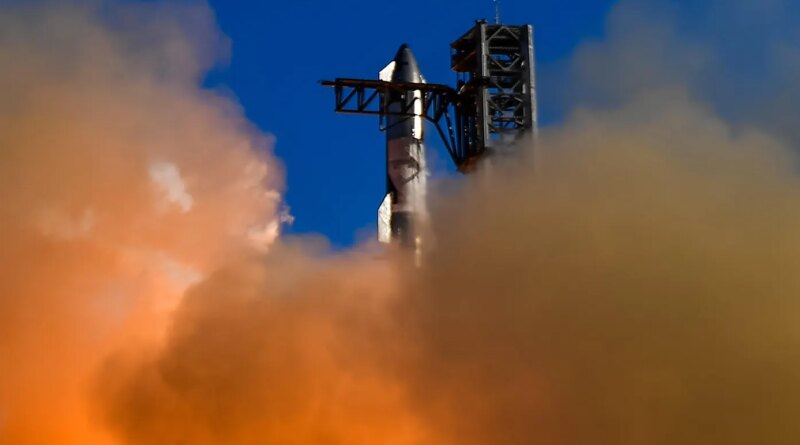
SpaceX the rocket maker leads the globe in lofting boosters into orbit, they say, and could ignite the next phase of the rocket revolution with its prototype Starship super-capsule, which is coursing through a series of spectacular flight tests.
But the ultimate trajectory of its new AI division is “highly uncertain,” and could even lead to more than $80 billion in “capital destruction,” say space securities researchers at the international firm Morningstar.
“The newly acquired AI business,” Morningstar analysts Nicolas Owens and Suryansh Sharma say in a fascinating research note“poses a material threat of value destruction to the company.”
Since Elon Musk took over Twitter, and rebranded it as X, the messaging platform has seen its profits nosedive as many advertisers flee the site. Shown here is the Twitter banner displayed outside the New York Stock Exchange when it first went public a dozen years ago. (Photo by Andrew Burton/Getty Images)
Getty Images
Because both SpaceX and xAI were founded and controlled by Elon Musk, their merger and the valuation assigned to each outfit merit close scrutiny.
While the expanded SpaceX is targeting an IPO valuation of $1.5 trillion, the Chicago-based Morningstar experts said that after closely scanning the operations and earnings of each SpaceX division, they independently determined the “cash flow valuation of SpaceX is $780 billion.”
Potential investors in SpaceX stock, they advise, should take a close look at the dynamics of the merger of the spacecraft inventor SpaceX and the three-year-old xAI lab, and at Musk’s simultaneous governance of the dual outfits.
That merger “was not conducted at arm’s length, given Musk’s ownership and control of xAI, creating a clear related-party conflict,” they point out. A similar cloud surrounds the earlier combination of Musk’s messaging platform Twitter/X and xAI, they add.
“xAI could have been overvalued” in its takeover by SpaceX, with both companies controlled by Elon Musk (Photo by RICCARDO MILANI/Hans Lucas/AFP via Getty Images)
Hans Lucas/AFP via Getty Images
When Elon Musk unveiled SpaceX’s acquisition of the fledgling AI lab in February, via a post on the SpaceX website, he gushed: “SpaceX has acquired xAI to form the most ambitious, vertically-integrated innovation engine on (and off) Earth, with AI, rockets, space-based internet, direct-to-mobile device communications and the world’s foremost real-time information and free speech platform.”
“This marks not just the next chapter, but the next book in SpaceX and xAI’s mission.”
Musk vowed to continue SpaceX’s expansion across the realm of artificial intelligence by “launching a constellation of a million satellites that operate as orbital [AI] data centers.”
“SpaceX is one of the most impressive industrial technology companies in the world, but investors should not value the proven launch and Starlink businesses the same way they value the still-unproven AI and orbital data center story,” says Brian Hurley, a world-leading expert on the rising powers in the NewSpace sector, and their strategic maneuverings, across the globe.
Founder of the highly influential think tank New Space EconomyCanada-based Hurley told me in an interview that with its bombshell new research note on SpaceX, “Morningstar is separating two very different SpaceX stories that are now being bundled together in the IPO narrative.”
“The launch business and Starlink business are real, operating, strategically important businesses with demonstrated technical execution, measurable revenue, and significant competitive advantages,” says Hurley, who also chronicles lightning-speed changes across the space sector via a digital magazine.
“The AI layer is different. xAI, X, and the proposed orbital data center strategy,” he adds, are “much more speculative.”
“The practical investor question is how much value should be assigned to what SpaceX has already proven, and how much should be assigned to what SpaceX may be able to prove later.”
SpaceX’s payment of a quarter-trillion dollars for xAI in many ways resembles the exorbitant sums exuberant investors paid out for shooting stars of the dot-com bubble of a generation ago, he says.
“Investors in the dot-com boom often paid very high prices for companies with fast-growing narratives, large market claims, and heavy operating losses.”
The Nasdaq exchange in New York City, onetime showcase for the dot-com boom, is counting down to hosting the biggest IPO of all time for SpaceX shares. (Photo by John Moore/Getty Images)
Getty Images
Hurley says SpaceX’s IPO prospectus sets out, for the first time, the financial performance of its AI arm: SpaceX’s AI segment generated $3.201 billion in revenue in 2025 while losing $6.355 billion from operations.
In the first quarter of 2026, its AI wing generated $818 million in revenue while losing $2.469 billion from operations.
“It is a business whose operating losses substantially exceed its revenue. xAI/X resembles some dot-com-era companies in the sense that the valuation appears to depend heavily on future dominance rather than current operating performance.”
“It does call into question the $250 billion SpaceX paid for xAI.”
“A $250 billion price against roughly $3.2 billion in annual revenue implies an extremely rich revenue multiple, especially for a business with very large operating losses,” Hurley says. “That price is hard to justify on financial performance alone.”
“xAI could have been overvalued in the SpaceX transaction,” he says. “The related-party nature of the transaction makes independent review and transparent disclosure very important.”
Yet because Elon Musk holds the overwhelming majority of SpaceX’s super-voting class B shares, and controls more than 80 percent of the outfit’s overall voting power, Hurley says, any new shareholders who buy into the IPO would have little recourse to prevent overpayments for acquisition targets in the future.
With the predicted upcoming SpaceX takeover of Tesla, he says, “A hypothetical Tesla transaction could also raise related-party conflict concerns if Musk influenced both sides.”
With its predicted upcoming takeover of Tesla, SpaceX would be further diluting its status as a pure space stock. (Photo Illustration by Daniel Fung/SOPA Images/LightRocket via Getty Images)
LightRocket via Getty Images
“Tesla’s public listing would make the valuation easier to scrutinize because there is a market price, public reporting, analyst coverage, and a public shareholder base.”
“But it would not eliminate the risk of overpayment through a large acquisition premium,” he predicts.
Shareholders who opposed a sky-high payment by SpaceX to acquire Tesla, he says, would be powerless to stop the takeover.
“Minority shareholders would have very limited ability to block future acquisitions, related-party transactions, or strategic pivots.”
Their most likely course of action, he says, would be to offload their SpaceX shares before the contested transaction.
The Morningstar experts previewing SpaceX’s imminent share offering agree.
They add that the future of SpaceX’s AI division is in many ways unpredictable.
xAI took over Elon Musk’s social media platform X, once known as Twitter, and “has invested the equivalent of $50 billion to build a large language AI model named Grok and a gigawatt-scale [terrestrial] data center called Colossus.”
“We don’t think X is material or particularly relevant to the overall business case,” they say. “We don’t see Grok as one of the leading AI labs today.”
“Grok has not demonstrated significant performance advantages over leading peers, and we believe this has prevented its products from gaining meaningful market share.”
Grok trails far behind the series of increasingly sophisticated ChatGPT models created by the AI superpower OpenAI, and behind Google’s ever-advancing, leading-edge Gemini.
xAI’s Grok trails far behind the increasingly sophisticated series of ChatGPT models crafted by AI superpower OpenAI and behind Google’s ever-advancing, leading-edge Gemini (Photo by Jonathan Raa/NurPhoto via Getty Images)
NurPhoto via Getty Images
At the same time, Twitter/X has seen its profits nosedive since its takeover by Musk, and less than one percent of its users are paid subscribers.
“Advertisers have been reluctant to remain on the platform,” Morningstar’s Owens and Sharma write, “as X has historically faced criticism for tolerating extreme political views, resulting in high-profile advertiser boycotts that eroded shareholder value.”
They forecast that SpaceX’s super-constellation of 10,000 Starlink broadband beaming satellites will remain the outfit’s primary generator of profits for the foreseeable future, and point out that more than 2 billion global citizens remain on the other side of the “digital divide,” cut off from access to the World Wide Web’s online universities, global markets and telemedicine services.
But most of these outliers live in low-income sectors of the planet, beyond the target demographic groups that Starlink is aimed at.
SpaceX now operates the world-leading super-constellation of broadband-beaming Starlink satellites (Photo by: Alan Dyer/VW Pics/Universal Images Group via Getty Images)
VW Pics/Universal Images Group via Getty Images
They also modeled a spectrum of potential futures based on Elon Musk’s vow to launch one million AI data centers into orbit.
They say that in their best-case scenario, SpaceX succeeds in overcoming an intricate obstacle course of technological hurdles and manages to capture 4 percent of the global market for these celestial compute centers.
But in a worst-case prediction they call “No Go,” SpaceX’s orbiting data centers cannot economically compete with their terrestrial counterparts despite a massive influx of shareholder funding into the scheme.
“We assign the No Go scenario a 43% chance of happening,” they say, “worth more than $81 billion of capital destruction on its own.”
Meanwhile, space economics scholar Brian Hurley predicts that with the sensational whirlwinds of hype surrounding the globe’s biggest-ever IPO, the price of the SpaceX shares is likely to rise, at least for an interim period, with the launch of the stock on the NASDAQ exchange.
He counsels would-be investors to wait out the volatile early days of trading and instead consider purchasing stock when SpaceX insider shareholders begin selling their equity in the weeks and months following the IPO.
“The [SpaceX] share price could decline when employee and private-investor shares become available after the IPO,” he predicts.
“A small initial float can support a high early price, but later selling windows may create downward pressure as more supply reaches the market.”