Sniper Safaris & the Purge of Bosniak Muslims
“Justice for Bosnia.”
These words, after so long, have re-emerged on protest signs and in newspaper headlines. But why, decades later, has the Bosnian genocide, which took place during the 1990s, returned to public attention?
What stones could the international community have possibly left unturned? Did the pursuit of justice, despite the proceedings before the International Court of Justice (ICJ) and the prosecutions carried out by the International Criminal Tribunal for the former Yugoslavia (ICTY), really go far enough to deliver justice for the people of Bosnia? [1]
The reason this subject has resurfaced lies with the Public Prosecutor’s Office in Milan, which has opened an investigation into allegations that Italian citizens, along with other Western nationals, travelled during the Bosnian War to take part in so-called “sniper safaris”. [2] These alleged “tourist snipers” are believed to have travelled to Sarajevo, a city that endured the longest siege in modern history between 1992 and 1996.
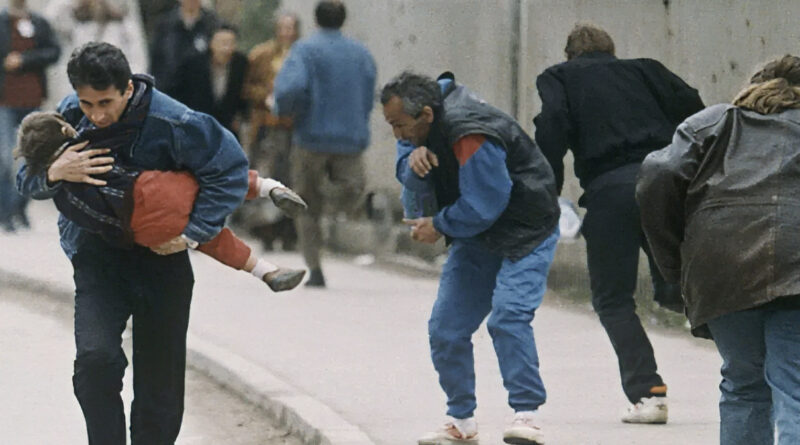
During those four years in Sarajevo, more than 11,000 people, including over 1,600 children, were killed as Serb forces subjected the city to relentless shelling and sniper fire. According to the allegations, these foreign individuals positioned themselves alongside Serb forces. There, positioned high up in Sarajevo’s surrounding mountains, they would hunt Bosnian civilians.
Brief history of the Bosnian genocide
- Over 100,000 Bosnians were killed in three years (1992-95), the vast majority Muslim.
- No food, water, electricity, or humanitarian aid was allowed in during the four-year siege of Sarajevo (1992-96); many faced starvation.
- From 11-16 July 1995, 8,372 Muslim men and boys were killed in Srebrenica. They were taken to various holding locations such as warehouses, schools, and farms before being executed by firing squads or beheaded. Their bodies were then pushed into mass graves using bulldozers.
- The systematic rape of Bosniak women was used as a “cleansing” war tactic; Serbs also aimed to further “cleanse” Bosniak culture by destroying major institutions including 614 mosques, as well as numerous libraries, books, rare manuscripts, and historical archives.
- Families were separated: men were forced to remain in Serb-controlled areas while women and children were boarded on buses and deported. More than two million people were displaced and became refugees.
What are these “sniper safaris”?
Wealthy people are said to have paid large sums to shoot at civilians in Sarajevo, a city then besieged by Serb forces.
The money would go to the army of Radovan Karadžić, the former Bosnian Serb leader, who in 2016 was found guilty of genocide and other war crimes and crimes against humanity. [3] These sniper tourists would then be transported to the hills surrounding Sarajevo so they could shoot at civilians for pleasure.
Ezio Gavazzeni, a Milan-based writer who gathered evidence on the allegations, claimed “many, many, many Italians” were alleged to have partaken in the crimes, without providing a figure.
There were Germans, French, English … people from all Western countries who paid large sums of money to be taken there to shoot civilians.”
Edin Subasic, a 62-year-old Bosnian intelligence retiree, claimed,
…the snipers on the safari chose whether they wanted to kill an adult civilian, a woman, a child, a pregnant woman, a soldier … and everything had its price.”
These accounts support several claims made by witnesses who said Serb forces would charge tourist snipers various prices depending on their desired victim. For instance, the snipers would be charged a hefty price to kill children and pregnant women, while shooting men would cost them less.
Testimonies at the Hague
During the 2007 trial in the Hague which saw Dragomir Milošević convicted of war crimes and sniper attacks on civilians in Sarajevo, more than 130 witnesses were called to testify. [4] One such witness was John Jordan, an American volunteer firefighter who went to Sarajevo to help rescue civilians from rubble and burning buildings.
John’s testimony stretched across two days, where he recounted the horrors he witnessed. One part of his testimony which particularly stood out was his account of a different kind of sniper, unique from the rest, he claimed. [5]
First, Jordan recalled, these foreign snipers wore different clothing, which he described as a civilian-military combination. Secondly, they carried different weapons.
Their guns, Jordan claimed, were enormous and unusual, better suited for:
…hunting boar in the Black Forest than in urban combat in the Balkans.”
He also noticed that they looked unfamiliar with the streets and had to be led and directed by other Serb snipers. And that they were given advantageous positions uphill so that their victims downhill would make for easier targets.
Human hunters
Despite the testimonies of Jordan and others, who claimed that the existence of said foreign killers were acknowledged by all civilians under siege, the rumours of Sarajevo’s mysterious “human hunters” lay dormant for a long time.
It wasn’t until 2022 that these allegations gained real public attention for the first time. This was due to the release of an explosive documentary (four years in the making) called Sarajevo Safari by Al Jazeera Balkans and ARS Media. [5]
The documentary features extraordinary accounts and testimonies from two people who claimed they saw the foreign snipers with their own eyes. One of these witnesses was a Slovenian intelligence officer who served the US during the war, he remains anonymous and explains that he was told by the Serbs to never speak of the things he saw.
He claims that Serb snipers took him on a tour of their vantage points across the city, the tops of roofs and high up on the surrounding hills. This, he says, is where he met a group of tourist snipers.
Though he never spoke to them directly, he said they didn’t seem like average people. Their hunting skills, for one, were remarkable.
He says,
…for certain sums of money, strangers would come in to shoot at the surrounded citizens of Sarajevo.”
He says he could feel their excitement and adrenaline. The witness also alleged that their stage was also always readily set up for them: advantageous locations, binoculars, guns. All they had to do was show up.
He says he watched through binoculars as one tourist shooter aimed his rifle at a child, walking along the street, holding their mother’s hand.
Edin’s testimony
The other man featured in the documentary is called Edin Subasic, also an intelligence officer, but for the Bosnian Army.
He says that one day, in late 1993, the intelligence services had captured someone who had been fighting in Sarajevo. The captive claimed they had stories about foreigners on the battlefield which might be of interest to the Bosnians.
According to this captive, the foreign snipers came from places like the US, Canada, Russia, and Italy. They arrived in Bosnia mostly by bus, to a place called Pale. From there, they would make the half-hour drive to Sarajevo, where they would hunt men, women, and children for sport.
Serbia has denied any involvement in the killings, but investigators strongly believe that Serbian intelligence services were not only aware of, but heavily involved in the “sniper safaris”.
The investigation remains open.
Persistence through faith
In their attempt to erase Islam and exterminate Muslims, the Serbs rekindled a long-dormant faith within the persecuted Bosnians. A people who had, for so long, lost all knowledge and practices of Islam, the identity of their faith displayed only within their names, had now become steadfast. Devout. Guided by belief.
Just as the Bosnians were pushed to the edge of existence, stripped of their safety and dignity, and found themselves closer to Allah and the truth, so too have the people of Gaza found themselves walking the same path. Because when worldly structures collapse, mosques and schools destroyed, when injustice becomes the norm and death a daily occurrence, faith no longer remains theoretical. It becomes an anecdote to grief. It becomes the only means of survival. It is lived and breathed.
And like the Palestinians, the Bosnian people grew ever more steadfast in their faith, not in spite of, but because of the persecution they endured.
In the shadow of genocide, remembrance has become resistance. And Bosnian proverbs bear witness to this:
There is no misery that could not be overcome.
There is no sorrow that cannot be overcome.”
Source: Islam21c
Notes
[1] https://www.icj-cij.org/case/122