Merz Criticizes Terrorism Laws After Deadly Berlin Pride Attack
Chancellor Friedrich Merz of Germany on Monday called for tougher monitoring of individuals who are security threats, a day after prosecutors said the suspect in Saturday’s terrorist attack near a gay Pride event in Berlin was released from detention in May.
“If we cannot detain such potential offenders, we must do everything we can to restrict their freedom of movement as much as possible,” Mr. Merz said at a news conference.
On Sunday, the German authorities had also revealed that the suspect had tried to join the Islamic State terrorist group, and had previously been sentenced to prison for preparing a serious act of violence.
The suspect was shot and killed by the police on Sunday.
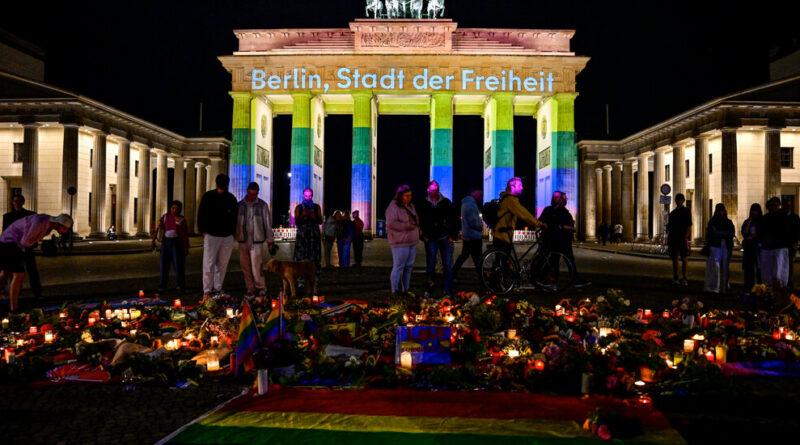
“It was an attack on our free society,” Mr. Merz said. “We will do everything to protect and defend this freedom, this openness and the liberal values of our society.”
The revelations about the suspect have intensified debates over religious extremism and public safety in Germany, with the authorities calling the attack an act of Islamist terrorism. Mr. Merz said the authorities needed to address how the suspect could have gone “unhindered” to the Pride event.
A woman was killed and 29 other people were injured in the attack. The woman was a Polish citizen, the spokesman for the Polish Foreign Ministry, Maciej Wewior, said on Monday.
On Sunday, prosecutors in Berlin identified the suspect as a 21-year-old German citizen named Abdul B., withholding the surname in keeping with German privacy laws. His full name is Abdul Rahman Toufiq Ballout, according to two people familiar with the investigation who spoke on the condition of anonymity to discuss details about the case.
The prosecutors said that the suspect tried to join ISIS in May 2025 after traveling to Lebanon, where he had family ties. From there, they said, he had wanted to cross the border into Syria but was arrested in Lebanon and sentenced to three months in prison for offenses including incitement to religious and sectarian conflict.
The suspect returned to Germany in November and was arrested at the airport in Berlin. He was held in pretrial detention until May, when he was sentenced by a juvenile court to a year and 10 months in prison for offenses that included “preparing a serious act of violence endangering the state.”
He had also posted ISIS propaganda on a social media account in 2024, the prosecutors said.
The sentence, however, was suspended and Mr. Ballout was released and placed under the supervision of a probation officer.
The prosecutors said the court had considered several factors, including that he had served nine months in detention in Germany and Lebanon, that he had largely confessed and had distanced himself from ISIS, and that no real threat had materialized.
The prosecutors said they had filed an appeal and requested a longer sentence.
The attacks and the disclosure that the suspect was known to the authorities and released just over two months ago have added to calls from some politicians and analysts for Germany to take a tougher approach to terrorism. Those demands have intensified months before important regional elections, with polls showing that far-right parties were poised to make gains, in part over anxieties about rising violence.
The far-right Alternative for Germany party said the Berlin attack demonstrated the government’s failure on security policy because it was overly focused on the wrong targets. “The one-sided fixation on right-wing extremism must finally be ended and adjusted to the actual facts,” Martin Hess, the home affairs spokesman for the party, said on social media.
Peter Neumann, a professor of security studies at King’s College London, said Germany had lighter sentences for terrorism-related offenses than other European countries, such as France and Britain, as well as the United States.
The goal is for the person to be re-educated, giving them a better chance of becoming a contributing member to society. But in this case, he said, that was a mistake, considering how aggressively the suspect had tried to join ISIS.
“In terrorism cases, even when suspects are quite young, the protection of the public should be more important than the educational aspect,” Professor Neumann said, noting that the suspect had tried to join the Islamist terrorist group just a year before he was released from detention.
But Frieder Dünkel, a professor emeritus of criminology at the University of Greifswald, defended the system as a largely effective way of dealing with young offenders.
“We see no need to reconsider the system as a whole,” he wrote in an email, and that officials instead should consider “what went wrong in the individual case.”
Mr. Merz said that it was too early to determine the political fallout of the attacks but he was incredulous that Mr. Ballout had not been monitored more carefully.
“I cannot understand how it is that I can track my cellphone anywhere in the world — and even use my cellphone to determine, for example, where my iPad is — yet it is allegedly impossible, or technically impossible, for the security authorities in Germany to determine at any time where individuals posing such a significant threat are located,” he said.
Jim Tankersley contributed reporting from Berlin.