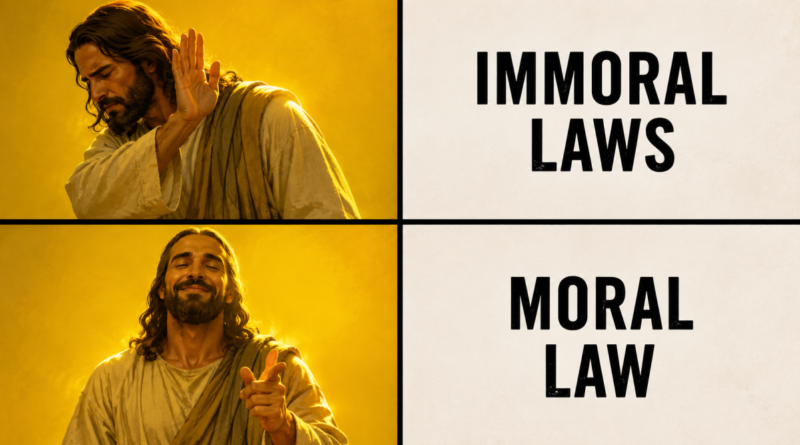
Jesus’ Universal Operating System for Living Under Any Legal System
When Jesus told his followers to sit at the feet of the scribes and Pharisees, to observe everything they taught but not to follow their example (Matthew 23:2–3), he was issuing an instruction of remarkable subtlety. He was not critiquing the content of Jewish law, nor was he calling for its reform or abolition. He was teaching something far more radical and portable: how to live consciously under God, regardless of the legal system. The Jewish legal framework of first-century Judea was not the subject of his teaching but its circumstantial backdrop—the particular theater in which a universal drama was being enacted.
What if the revolutionary core of Jesus’ message has been obscured by two thousand years of retrospective framing? First, by disciples who cast him as the fulfillment of Jewish prophecy, weaving his teachings into the fabric of messianic expectation and covenant theology. Then, by Gentile converts who transformed him into a cosmic savior within Roman metaphysical categories, building an institutional apparatus that would have been foreign to the Galilean teacher himself. What remains when we strip away these layers of interpretive sediment is a universal methodology for living under any legal system, which is equally applicable under Jewish law, Roman occupation, the Persian Empire, or modern secular democracy.
The Operating System Metaphor
The most productive way to understand Jesus’ teaching is as an operating system for God-conscious living, compatible with any particular legal code or political structure. An operating system does not replace the applications it runs; it provides the fundamental logic by which those applications function. Jesus was teaching a way of being that could run on top of Mosaic law, Roman civil administration, or any other system of external authority. The specific commands of those systems were less important than the interior posture one adopted while following them.
This becomes evident when we examine the structure of his ethical instruction. He does not engage in the kind of detailed legal casuistry that characterized much of rabbinic Judaism. While the Mishnah would later devote entire tractates to questions of Sabbath observance, ritual purity, and agricultural tithes—working out the precise application of Torah to every conceivable circumstance—Jesus offers something entirely different. His teaching focuses on principles of consciousness and intention that sit at a level of abstraction above any particular legal code.
Consider the twin commandments he identifies as greatest: to love God with all one’s heart, mind, and soul, and to love one’s neighbor as oneself. These are not legal reforms. They do not modify, clarify, or extend existing Jewish law in the manner of halakhic reasoning. They function instead as meta-principles, establishing the consciousness from which one approaches any law. A person operating from this consciousness could follow Roman law, Babylonian law, or modern tax code with equal integrity, because the law itself is not the locus of spiritual life. The locus is the heart that apprehends God and extends love to the neighbor, regardless of what the external legal framework demands.
“The first of all the commandments is: ‘Hear, O Israel: The Lord our God, the Lord is one. And you shall love the Lord your God with all your heart, with all your soul, with all your mind, and with all your strength.’
And the second is like it: ‘You shall love your neighbor as yourself.’
There is no other commandment greater than these.” (Mark 12:28–34)
“You shall love the Lord your God with all your heart, with all your soul, and with all your mind…
And the second is like it: ‘You shall love your neighbor as yourself.’
On these two commandments hang all the Law and the Prophets.” (Matthew 22:34–40)
“You shall love the Lord your God with all your heart… and your neighbor as yourself.”
Jesus said: “You have answered rightly; do this and you will live.” (Luke 10:25–28)
This is why Jesus can tell his followers to obey the scribes and Pharisees who sit in Moses’ seat, while simultaneously warning them against becoming like these teachers. The content of the law is legitimate; the problem is the consciousness with which it is administered and followed. In Jesus’ diagnosis, the scribes and Pharisees have allowed the law to deform their souls. They have become spiritually misshapen by treating legal correctness as an end in itself rather than as a context for loving God and neighbor. Jesus is teaching his followers to inhabit the same legal space while maintaining an entirely different interior orientation—one that remains spiritually sovereign even while externally compliant.
The Roman Mile and Inner Sovereignty
The instruction to go two miles (Matthew 5:41) when compelled to go one provides perhaps the clearest evidence that Jesus was teaching a universal method rather than a Jewish legal position. This saying directly addresses a Roman practice: the angaria, the legal right of Roman soldiers to compel civilians in occupied territories to carry their packs for one mile. This was not a provision of Jewish law. It was an imposition of imperial power, a daily reminder of subjugation.
The conventional interpretation treats this as teaching about non-retaliation or turning the other cheek, which is true enough but misses the deeper logic. Jesus is instructing his followers in how to maintain inner sovereignty while living under coercive external authority. The person who goes exactly one mile under compulsion remains psychologically enslaved; his action is entirely determined by the external power that compels him. The person who refuses to go even one mile engages in overt rebellion and suffers the consequences. But the person who voluntarily goes two miles has reclaimed agency. He transforms a moment of subjugation into an occasion for free choice. He is no longer being moved by external force but by an interior principle.
This is not passive submission. It is a sophisticated psychological maneuver that preserves human dignity under conditions of domination. More importantly, it is completely transferable. The same principle works whether the coercive authority is Roman, Jewish, Persian, or modern bureaucratic. The specific legal context is irrelevant. What matters is the consciousness that refuses to be spiritually colonized even when physically compelled.
The same logic operates in the famous “render unto Caesar” episode (Matthew 22:15–22; Mark 12:13–17; Luke 20:20–26). When Jesus examines the coin and declares that one should give to Caesar what is Caesar’s and to God what is God’s, he is not making a statement about Jewish taxation law or the legitimacy of Roman rule. He is establishing a principle of dual citizenship that allows one to function within worldly authority structures while maintaining ultimate allegiance elsewhere. The question posed to him was a trap designed to force him to choose between the Roman Empire as a representation of the worldly state and his obligations to God’s Kingdom in the Hereafter. His answer transcends the binary entirely by locating true sovereignty in a dimension orthogonal to both options.
This teaching works identically whether the empire in question is Rome, Babylon, Britain, or the modern administrative state. Pay your taxes, follow the traffic laws, submit the proper paperwork—give to Caesar what bears Caesar’s image. But do not let Caesar colonize your soul. Reserve for God what bears God’s image: your consciousness itself, your capacity for love, your interior freedom. This is portable wisdom that makes sense without a specific legal framework.
The Absence of Legal Specificity
What is striking about Jesus’ teaching, when compared to both the Hebrew prophets and the rabbinic tradition, is how little attention he pays to the specific content of Jewish law. The prophets are deeply concerned with particular violations: idolatry, injustice in the courts, exploitation of widows and orphans, ritual hypocrisy. They call Israel back to covenant faithfulness by pointing to concrete failures to observe Torah. The rabbinic tradition extends Torah by reasoning about its application to new situations, building a massive superstructure of legal interpretation.
Jesus does neither. When he addresses legal questions, he typically moves immediately to the principle behind the law rather than engaging with its specific application. The Sabbath is made for man, not man for the Sabbath (Mark 2:27–28). What defiles a person is not what goes into the mouth but what comes out of the heart (Matthew 15:11). The law and the prophets hang on the twin commandments of love. Even when he appears to be intensifying Torah—teaching that anger is like murder, lust like adultery—he is shifting attention from external compliance to interior consciousness.
This is the pedagogy of someone teaching a method of consciousness rather than a legal system. A legal reformer would need to specify exactly which laws to follow, how to interpret ambiguous cases, which traditions to retain and which to discard. Jesus shows remarkably little interest in these questions. His concern is the posture of the soul before God, a posture that can manifest under any legal regime.
The Sermon on the Mount, often treated as the core of Jesus’ ethical teaching, contains almost nothing that requires specifically Jewish law to make sense. The Beatitudes describe interior states (poverty of spirit, mourning, meekness, hunger for righteousness) that have no necessary connection to the Mosaic covenant. The instructions on prayer, fasting, and almsgiving assume these practices but do not interpret them through halakhic categories. The prohibition on anxiety, the call to seek first God’s kingdom, the warning about serving two masters—all of this could be taught by a Buddhist master or a Stoic philosopher with minimal modification. The few elements that are culturally specific (references to synagogues, phylacteries, Gentiles) function as local examples of universal principles.
The Art of Turning Law Against Itself
Perhaps the most sophisticated aspect of Jesus’ method—and the strongest evidence for his universalism—is his consistent practice of using any given legal system against itself to expose the gap between legal correctness and spiritual integrity. This is not the approach of someone trying to reform Jewish law from within. It is the technique of someone teaching a meta-skill: how to operate within any code by applying it against its own internal contradictions and misapplications.
When Jesus heals on the Sabbath, he does not simply defy the law. He uses the law’s own logic to justify his action. “Which of you, if your son or your ox falls into a well on the Sabbath, will not immediately pull him out?” (Luke 14:1–6) The Sabbath law itself permits emergency action to save life. If you save an animal, how much more should you save a human being? He takes the principle embedded in the exceptions already recognized within the legal system and extends it to expose the absurdity of prioritizing ritual observance over human flourishing. This is not uniquely applicable to Sabbath law; it is a transferable technique for dealing with any legal system that has lost sight of its own foundational purposes.
The same pattern appears in his encounter with those who would stone the adulteress. “Let him who is without sin among you be the first to throw a stone at her” (John 8:7). Jesus does not argue that adultery is good, nor does he directly dispute that the Torah prescribes punishment for sexual offenses. Instead, he turns the moral scrutiny of the law back upon those attempting to enforce it.
The Torah does not require judges or witnesses to be sinless, but it does insist that those administering justice be righteous, impartial, and incorruptible:
- 2 Chronicles 19:6–7 — Judges are warned to judge carefully because with God “there is no injustice or partiality or bribery.”
- Exodus 18:21 — Judges should be capable, God-fearing, trustworthy, and opposed to dishonest gain.
- Deuteronomy 1:16–17 — Judges must judge fairly, show no partiality, and not fear anyone.
- Deuteronomy 16:18–20 — “Judge the people with righteous judgment”; do not distort justice, show partiality, or accept bribes.
- Leviticus 19:15 — Do not pervert justice or favor either the poor or the powerful.
But Jesus’ challenge can be understood at an even deeper level. Consider how many offenses in the Old Testament could result in death by stoning:
- Worshiping or serving other gods — Deuteronomy 17:2–5
- Enticing others to worship other gods — Deuteronomy 13:6–10
- Sacrificing a child to Molech — Leviticus 20:2
- Blaspheming the name of the LORD — Leviticus 24:10–16, 23
- Practicing as a medium or spiritist — Leviticus 20:27
- Breaking the Sabbath by gathering wood — Numbers 15:32–36
- A persistently rebellious and disobedient son — Deuteronomy 21:18–21
- A betrothed virgin having consensual sex with a man other than her betrothed — Deuteronomy 22:23–24
- The man who has consensual sex with another man’s betrothed virgin — Deuteronomy 22:23–24
- A newly married woman found not to have been a virgin when the marriage was contracted — Deuteronomy 22:13–21
- An ox that gores a person to death — Exodus 21:28
This gives Jesus’ challenge extraordinary force. If his accusers insist upon the strict application of the law to the woman before them, they must be prepared to submit themselves to the same standard. They cannot isolate one commandment, apply it mercilessly to someone else, and quietly exempt themselves from the rest of the legal and moral system they claim to defend.
Taken to its logical extreme, such uncompromising enforcement becomes self-defeating. A community in which every capital provision were pursued with maximal severity would eventually find the law turning upon the very people attempting to enforce it. Jesus therefore exposes something deeper than individual hypocrisy: the danger of treating law as an instrument of condemnation rather than as a means toward justice.
By holding up the mirror of the law to those wielding it, Jesus exposes selective enforcement and self-righteous judgment. The principle extends far beyond the Torah. In any legal system, those who invoke the law against others must be willing to stand beneath the same law themselves.
In his disputes about ritual purity, Jesus employs a similar maneuver. When criticized for his disciples eating with unwashed hands, he quotes Isaiah back at his critics: “This people honors me with their lips, but their heart is far from me; in vain do they worship me, teaching as doctrines the commandments of men.” He uses Jewish Scripture to critique Jewish practice, showing that the prophetic tradition itself already contained the principle that external ritual observance without interior devotion is worthless. He is not importing a foreign critique but excavating a truth already present within the tradition, buried under layers of later interpretation.
The famous “Sabbath was made for man, not man for the Sabbath” encapsulates this method perfectly. He does not reject Sabbath observance. He points to its purpose: the Sabbath exists to serve human flourishing, not the other way around. Any law that becomes harmful to the very people it was designed to protect has been misunderstood or misapplied. This principle applies to Roman road laws, medieval guild regulations, modern labor codes, or any system where the letter of the law is used to defeat its spirit.
Jesus’ challenge to “give to Caesar what is Caesar’s and to God what is God’s” operates by the same logic. The question is a trap: answer that tribute should be paid and you alienate the Jewish nationalists; answer that it should not be paid and you commit treason against Rome. Jesus escapes by pointing to the coin itself. It bears Caesar’s image and inscription. Caesar has already claimed it as his by marking it. But human beings bear God’s image, so they belong ultimately to God. He uses the evidence his questioners themselves provide—the coin in their own possession—to demonstrate a principle that transcends the specific question. This technique would work identically in a debate about any political authority’s legitimate claims.
What makes this approach universal is that it is not content-specific. Jesus is demonstrating a method: find the highest principle already recognized within the system, identify where current practice violates that principle, and use the contradiction to expose spiritual truth. Any legal system contains such contradictions because any codified law is an attempt to capture in rules what is ultimately a matter of wisdom and judgment. The gap between the rule and its purpose, between the letter and the spirit, exists in every legal framework.
This is why Jesus can operate so effectively within Jewish legal debate while teaching something applicable far beyond it. He is using the Jewish legal system as a training ground for a skill that works anywhere. Just as a chess master learns principles of strategy that apply to other strategic domains, someone who learns to navigate the tensions in Jewish law by appeal to its own highest principles has learned something transferable to Roman law, corporate policy, or any other rule-governed system.
The technique is particularly evident in Jesus’ expansions of the law to interior states. “You have heard it said, ‘Do not murder,’ but I say to you that anyone who is angry with his brother is liable to judgment” (Matthew 5:21–22). This is not legal reform; murder was already prohibited. He is showing that the law against murder presupposes a principle about the sanctity and dignity of human life, and that principle logically extends to the interior hatred that precedes and enables murder. He takes the law’s implicit logic and makes it explicit, showing that anyone who keeps the letter while violating the spirit has missed the point entirely.
This move is devastating to legalism of any kind because it shows that no system of external rules can ever fully capture what the rules are reaching toward. There will always be a gap between the codified law and the deeper principle it attempts to embody. Someone who understands this can operate within any legal system while recognizing its limitations, following its requirements while maintaining allegiance to the higher truth the system imperfectly expresses.
The brilliance of this method is that it requires no external authority. Jesus does not need to say, “I am establishing a new law.” He simply asks, “What does your own law require if you follow its logic honestly?” He positions himself not as a revolutionary legislator but as someone who understands the law more deeply than its official interpreters. This is precisely how one would teach a universal method using a particular legal system as the case study. The specific content is Jewish law, but the skill being taught is how to think about law as such.
This also explains why his teaching translated so well into Gentile contexts. Early Christians faced Roman law, Greek philosophical traditions, and various local customs. They did not have Jewish Torah to appeal to, but they had learned the method: identify the highest principles, expose contradictions between practice and principle, maintain interior sovereignty while navigating external requirements. The technique Jesus demonstrated with Jewish law worked equally well with any other system.
Moreover, this approach explains why Jesus attracted such hostility from religious authorities while confounding their attempts to trap him legally. He was not breaking the law in ways they could prosecute, but he was exposing the gap between their legal expertise and their spiritual blindness. This is threatening precisely because it is unanswerable within purely legal categories. When someone shows that you are keeping all the rules while missing their entire point, there is no legal response available. The only options are to acknowledge the truth or to eliminate the critic.
The modern reader can employ exactly the same method. When a corporate policy produces absurd or unjust results, one can often point to the stated values or mission of the organization to show the contradiction. When a law is enforced in ways that defeat its purpose, one can appeal to legislative intent or constitutional principles. When social norms become oppressive, one can invoke the community’s own highest ideals to critique current practice. This is Jesus’ method: use the system against itself by holding it accountable to its own professed standards.
The Dual Strategy: Subversion and Transcendence
The technique of turning law against itself addresses one category of legal obligation: laws that conflict with the higher principles of love and human flourishing. But Jesus’ teaching contains a complementary strategy for laws that are already morally aligned with these principles. Here the method is not subversion but voluntary overflow—going beyond what the law requires as a demonstration of interior freedom and spiritual excellence.
This dual strategy reveals the completeness of Jesus’ operating system. When external law contradicts the spirit of love, use the law’s own logic to expose and navigate around the contradiction while maintaining outer compliance. When external law aligns with the spirit of love, exceed its requirements voluntarily to demonstrate that your obedience comes from interior principle rather than external compulsion. In both cases, the goal is the same: preserve spiritual sovereignty while operating within the system.
The “go two miles” instruction exemplifies the second strategy. The Roman practice of angaria—compelling civilians to carry military equipment for one mile—was an imposition, but it was also a legitimate exercise of imperial authority within the Roman legal framework. The soldier had a legal right to compel service. Jesus does not teach his followers to refuse or to subvert this law. Instead, he teaches them to exceed it voluntarily. Go the second mile of your own accord.
This is not submission but transformation. The person who goes exactly one mile remains psychologically in the position of the compelled, his action dictated entirely by external force. The person who chooses to go two miles reclaims agency. He demonstrates that while his body may be subject to Roman law, his will remains sovereign. The first mile is obedience; the second mile is freedom. The first mile acknowledges Caesar’s legitimate authority; the second mile reserves something beyond Caesar’s reach.
Critically, this strategy only works when the underlying law or demand has some degree of moral legitimacy or at least neutrality. Jesus is not teaching people to voluntarily exceed unjust or immoral laws. He is teaching them to transform morally acceptable but burdensome external requirements into occasions for demonstrating interior freedom. This is why the technique is transferable: any legal system will contain requirements that are legitimate within that system’s own framework, even if burdensome. The voluntary overflow transforms burden into opportunity.
The same principle operates in Jesus’ intensive ethical demands, though here the hyperbole makes the teaching even more striking. “If your right eye causes you to sin, tear it out and throw it away. If your right hand causes you to sin, cut it off and throw it away” (Matthew 5:29–30)” These statements are obviously not literal prescriptions—no one seriously believes Jesus advocated self-mutilation. They are hyperbolic intensifications of already-valid moral principles.
The law says “do not commit adultery.” Jesus says the principle behind this law—respect for covenant relationship, protection of human dignity, purity of heart—extends to the lustful look that precedes and enables adultery. And if you take this principle seriously, you should be willing to go to extreme lengths to protect your integrity. Better to lose an eye than to lose your soul. Better to lose a hand than to become enslaved to destructive desire.
This is the voluntary overflow applied to interior moral life. The external law prohibits the action; Jesus teaches that someone truly committed to the principle behind the law will voluntarily exceed the requirement, policing not just behavior but thought and desire. This is not legalism but its opposite: the recognition that no external law can ever fully capture what it means to love God and neighbor with your whole being. Someone who understands the spirit behind the law will always go beyond the letter.
The pattern appears throughout Jesus’ teaching. The law requires certain acts of righteousness—prayer, fasting, almsgiving. Jesus teaches that these should be done in secret, without public recognition, voluntarily forgoing the social rewards that might motivate external compliance. The law prohibits murder; Jesus teaches voluntary mastery of anger. The law prohibits false witness; Jesus teaches that your yes should mean yes, and your no should mean no, making oaths unnecessary because your word is already completely reliable.
In each case, the movement is the same: take a valid external requirement and show what it would look like to fulfill not just the letter but the spirit, not under compulsion but from interior commitment. This demonstrates that your compliance comes from love of God and neighbor rather than fear of punishment or desire for reputation. It transforms law-following from external constraint to internal excellence.
What makes this a universal method is that it provides a clear decision rule for any legal system. First, discern whether a given law or requirement aligns with the fundamental principles of love, justice, and human flourishing. If it does not—if it violates these principles or has been applied in ways that defeat them—use the law’s own logic against itself to expose the contradiction while maintaining whatever compliance is prudent. If it does align with these principles, exceed the requirement voluntarily to demonstrate that your heart is already committed to what the law can only externally mandate.
This two-part strategy allows one to maintain integrity under any legal regime. In a just system, you exceed requirements and demonstrate excellence. In an unjust system, you navigate the contradictions while preserving spiritual sovereignty. In a mixed system—which is to say, in any actual historical system—you apply discernment case by case, subverting where necessary and overflowing where possible.
The strategy also explains why Jesus can simultaneously tell his followers to obey the scribes and Pharisees while warning them not to be like them. Obey the legitimate requirements—these are the “first miles,” the external compliance that acknowledges the authority structure. But do not let your spiritual life be defined by that compliance. Go beyond, overflow, demonstrate that your righteousness exceeds that of the scribes and Pharisees not by being more legally scrupulous but by being more interiorly transformed. Follow the law from love rather than legalism, and that love will naturally exceed what mere law-following can achieve.
This teaching is psychologically sophisticated because it recognizes that human beings need to distinguish between what is demanded of them and what they freely choose. External compliance, even to just laws, can create resentment and a sense of constraint. The voluntary overflow transforms this psychology. When you choose to go the second mile, you are no longer being coerced. When you choose radical self-discipline beyond what any law requires, you are demonstrating mastery over yourself rather than submission to external authority.
The dual strategy also has the effect of relativizing all legal systems while still taking them seriously. No external law is ultimate—not even good law—because what matters finally is the heart that loves God and neighbor. But external law is not irrelevant either. It provides the structure within which interior freedom can be demonstrated. The righteous law gives you the opportunity to show voluntary overflow. The unrighteous law gives you the opportunity to maintain sovereignty under pressure. In both cases, the law becomes the occasion for spiritual exercise rather than the definition of spiritual life.
This is why the method works under any legal system. Roman law, Jewish law, Islamic law, secular law—each will contain some requirements that align with love and justice and others that do not, some applications that serve human flourishing and others that defeat it. The discerning person, operating from God-consciousness, can navigate all of them using the same dual strategy: subvert what contradicts love, exceed what embodies it, and in both cases remain spiritually free.
Sitting in Moses’ Seat
Nowhere is this dual strategy compressed more tightly than in the instruction with which we began. When Jesus tells the crowds and his disciples that the scribes and Pharisees sit in Moses’ seat, and that they should therefore do whatever these teachers tell them while refusing to imitate their works, he is not offering a throwaway concession to established authority. He is stating the entire method in a single breath. Receive everything they teach, and then apply it more faithfully than they do themselves.
The instruction depends on a distinction that is easy to miss because Jesus makes it so quickly. Much of what the scribes and Pharisees transmit is legitimate; they genuinely occupy Moses’ seat, and the law they hand down carries real authority. Jesus does not tell his followers to ignore them, to establish a rival academy, or to abolish the teaching they dispense. He tells them to receive it. But in the same breath he drives a wedge between the teaching and the teachers, between the content of the law and the consciousness of those who administer it. The law is to be kept; the example of its keepers is to be refused. This is the very distinction on which the entire operating system depends, and here it is stated as a direct command.
Once the wedge is in place, the dual strategy follows naturally from it. Where the law the scribes transmit is genuinely righteous, the follower does not merely comply at the minimum level modeled by its official interpreters. He carries it further, fulfilling not just the letter they enforce but the spirit they have neglected. In the same discourse, Jesus faults these teachers for tithing scrupulously down to the garden herbs while abandoning the weightier matters of justice, mercy, and faithfulness (Matthew 23:23). To apply their teaching better is not to tithe less but to tithe and also to attend to what they have left undone—to overflow the requirement, to carry it the second mile its own logic was always pointing toward. This is the transcendence strategy stated as a rule of discipleship: whatever righteousness the tradition prescribes, exceed it.
But where the teaching, or more often its application, betrays the spirit of the law, the same principle demands the opposite maneuver. Here applying the law better means using its own foundation against its corrupt expression. When Jesus confronts the practice by which a man could declare his wealth “corban,” dedicated to God, and thereby excuse himself from supporting his aging parents, he charges his opponents with nullifying the commandment of God through their tradition (Mark 7:9–13). A technically valid legal ruling had been turned into an instrument for violating the commandment to honor one’s father and mother. Faithfulness to the law, in such a case, requires subverting the ruling that has been weaponized against it. And Jesus’ justification for this is not that the law is dispensable but that it binds more deeply than its official interpreters realize. It is more righteous to preserve the foundation of the law—the love of God and neighbor from which every commandment descends—than to preserve its surface while violating its purpose. To break the letter in order to honor the spirit is, in these cases, the higher obedience, because keeping the letter would produce the very injustice the law exists to prevent.
Seen this way, the instruction to sit at the feet of the scribes is not a counsel of passivity or deference. It is a training exercise. Receive the whole tradition, master it more thoroughly than those who teach it, and then apply it with a discernment they lack—overflowing it where it is righteous, subverting it where it has been turned against its own ends, and in both cases answering to the foundation rather than the surface. The follower who learns to do this within the Jewish legal system has learned to do it anywhere. The seat of Moses becomes a school for a skill that will outlast the seat of Moses entirely.
The Judaization and Romanization Hypotheses
If we take seriously the possibility that Jesus was teaching a universal method rather than a Jewish reform program, we must account for why Christianity came to be framed so heavily in both Jewish messianic categories and Roman institutional forms. The answer lies in the sociological and political pressures faced by the early movement.
The first followers of Jesus were Jews living in a culture saturated with messianic expectation and covenant theology. They had experienced Jesus as profoundly significant and needed categories adequate to that significance. The available theological vocabulary was Jewish: messiah, son of David, fulfillment of prophecy, new covenant. The Gospel writers, particularly Matthew, strain to connect Jesus to Hebrew Scripture through quotation and typology. Paul develops an elaborate theology of how Jesus relates to Torah, Abraham, and Israel. This is not necessarily fabrication, but it is interpretation—a process of fitting Jesus into available categories of meaning.
The process was both natural and problematic. Natural because any new teaching must be communicated in existing language and concepts. Problematic because these categories may obscure as much as they illuminate. By framing Jesus primarily as the Jewish messiah, the early movement made him comprehensible to a Jewish audience but potentially obscured his universal applicability. The message became: Jesus is the fulfillment of specifically Jewish hopes, rather than: Jesus taught a method of God-consciousness that works for anyone, anywhere.
The Romanization of Christianity involved a different set of transformations. As the movement spread into the Gentile world, it encountered Greek philosophical categories and Roman institutional forms. Jesus became the Logos, participating in elaborate metaphysical schemes about substance and hypostases. His death became a cosmic transaction satisfying divine justice. His resurrection became proof of individual immortality rather than vindication of God’s faithfulness. And perhaps most significantly, the movement became institutionalized in forms borrowed from Roman administration: hierarchy, orthodoxy enforced by councils, partnership with state power.
This process culminated in the Constantinian settlement, when Christianity became the official religion of the empire. At this point, a teaching about maintaining inner sovereignty under worldly authority became itself a form of worldly authority. The irony is almost too perfect: the teacher who said his kingdom was not of this world became the ideological foundation for European Christendom, with popes crowning emperors and bishops wielding temporal power.
These transformations are understandable given the social and political dynamics involved, but they progressively buried the original teaching under layers of theological and institutional scaffolding. To recover Jesus as a universal teacher requires archaeological work: carefully removing these layers to see what remains.
The Evidence of the Parables
The parables provide crucial evidence for reading Jesus as a teacher of consciousness rather than Jewish legal reform. These stories are his characteristic teaching method, and they are remarkable for their universality. The good Samaritan, the prodigal son, the sower and the seeds, the workers in the vineyard, the persistent widow, the Pharisee and the tax collector—none of these require specifically Jewish law or theology to understand. They are stories about human psychology, social dynamics, and divine-human relationship that could be told in any culture.
Consider the parable of the prodigal son. This is a story about forgiveness, restoration, resentment, and the nature of divine love. It requires no knowledge of Torah to grasp. A Buddhist could tell an analogous story about compassion and non-attachment. A Confucian could use it to illustrate filial relationships and the virtue of magnanimity. The story’s power lies in its psychological insight, its recognition of how human hearts actually work. The same is true of the good Samaritan, which teaches about the difference between authentic compassion and religious performance through a narrative that actually subverts ethnic and religious boundaries.
The parables consistently redirect attention from external religious identity to interior spiritual reality. Who inherits eternal life? The one who shows mercy, regardless of their ethnic or religious status. Who is justified before God? The tax collector who acknowledges his need for mercy, not the Pharisee who catalogs his legal compliance. Who is greatest in the kingdom? The one who becomes like a child, not the one who achieves religious status. These stories undermine any reading of Jesus that makes him primarily concerned with Jewish legal observance or ethnic particularity.
The Problem of the Temple
One of the strongest counterarguments to the universal reading comes from Jesus’ relationship to the Jerusalem Temple. His dramatic action in the Temple courts, his prediction of its destruction, his claim to supersede it—all of this seems to place him squarely within Jewish prophetic tradition, critiquing Israel’s unfaithfulness to covenant. If Jesus were truly teaching a universal method indifferent to specific religious frameworks, why would he care so deeply about the Temple?
This objection deserves serious consideration, but it ultimately strengthens rather than weakens the universal reading. Jesus’ concern with the Temple appears to be less about reforming Jewish practice than about exposing the limits of any religious system that locates God primarily in external institutions rather than interior consciousness. The Temple represented the pinnacle of the idea that specific places, rituals, and mediating structures were necessary for encountering God. Jesus consistently taught the opposite: God is greater than any temple, and true worship must be reflected through our daily practice, not in this mountain or that temple.
His statement to the Samaritan woman is particularly revealing. When she raises the question of where proper worship should occur—the traditional site of division between Jews and Samaritans—Jesus dismisses the question entirely. The location doesn’t matter. What matters is the spirit in which worship is offered. This is not a Jewish answer to a Jewish question; it is a universal principle that relativizes all particular religious locations and institutions.
The Temple action itself, driving out the money changers, can be read as a protest against the commercialization of religion, a problem hardly unique to Judaism. Any system that turns access to God into a transaction, that measures spiritual standing by external offerings rather than interior devotion, falls under the same critique. Jesus was using the Temple as a local instance of a universal problem.
Similarly, his prediction of the Temple’s destruction need not be read as specifically anti-Jewish polemic. It can be understood as recognition that any external religious structure that becomes an end in itself, rather than a means to encountering God, is ultimately dispensable. God does not need buildings. What matters is the consciousness that apprehends God directly, without mediation by stone and ritual. This is a principle that applies to cathedrals, mosques, and monasteries as much as to the Jerusalem Temple.
Conclusion: The Portable Kingdom
Whether one ultimately accepts this reading of Jesus or not, it explains a remarkable feature of his teaching that has often gone unnoticed: its extraordinary portability. Unlike legal codes, it does not depend on a particular nation. Unlike temple worship, it does not depend on a particular place. Unlike ethnic covenants, it does not depend on belonging to a particular people. It can be lived by as a Jew under Rabbinic law, a subject under Caesar, a merchant in medieval Baghdad, or a citizen of a modern liberal democracy.
This portability is precisely what one would expect if Jesus were not primarily constructing a new legal order but teaching an operating system for the human soul under any system. Laws change. Empires rise and fall. Religious institutions flourish and decay. Political constitutions are amended, courts reverse precedent, and customs evolve. Yet the fundamental question remains unchanged: How does one live consciously before God while inhabiting whatever system history has placed one under?
The answer Jesus repeatedly gives is not another legal code but a way of operating. Distinguish the spirit from the letter. Recognize the purpose behind the rule. Preserve your inner sovereignty under external authority. Where the law embodies love and justice, exceed it freely. Where it has lost sight of its own purpose, expose the contradiction by appealing to the higher principle already latent within it. In every case, refuse to let external compliance become a substitute for interior transformation.
Read in this light, the sayings that have often appeared disconnected reveal themselves as variations on a single theme. Go the second mile. Render to Caesar what belongs to Caesar, and to God what belongs to God. The Sabbath exists for humanity, not humanity for the Sabbath. Anger is the seed of murder; lust the seed of adultery. Not what enters the mouth but what proceeds from the heart defiles a person. The eye that causes one to stumble should be torn out—not because self-mutilation is virtuous, but because the integrity of the soul is worth more than anything external. Each saying redirects attention from the visible structure to the invisible principle, from the rule to the consciousness that gives the rule its meaning.
If this is correct, then Jesus belongs in a broader company than is usually imagined. He stands not only among the prophets of Israel but among the world’s great teachers of human consciousness—those who sought to cultivate the kind of person capable of living wisely under any circumstances rather than merely prescribing the correct set of external behaviors. His Jewish context was not incidental, but neither was it the endpoint of his teaching. It was the laboratory in which he demonstrated a method intended to outlive every legal system in which it was first expressed.
Perhaps this is why his words have survived the disappearance of the world that produced them. The Temple is gone. Roman law is gone. The debates between Pharisees and Sadducees are historical curiosities. Yet the questions Jesus posed remain as immediate as ever. How do we obey without becoming legalists? How do we resist without becoming consumed by hatred? How do we live under power without surrendering our souls to it? How do we remain free in circumstances we did not choose?
These are not first-century Jewish questions. They are perennial human questions.
And that may be the strongest evidence that Jesus was not merely interpreting a law, reforming a religion, or founding an institution. He was teaching something far more durable: the art of remaining fully human before God, no matter who sits on Caesar’s throne.