Japanese Submarines Have Now Sunk The US Navy’s ‘USS Juneau’ Twice
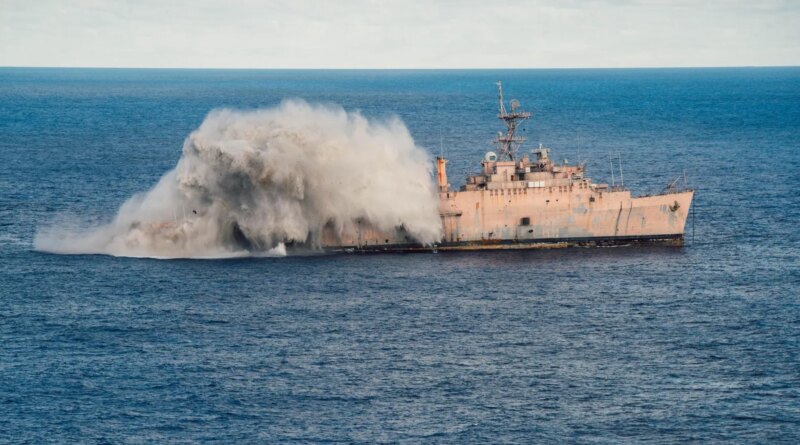
Japan Maritime Self-Defense Force submarine fires a torpedo at the decommissioned USS Juneau in support of a live-fire sinking exercise (SINKEX) as part of Valiant Shield 2026 while underway in the Philippine Sea, June 27, 2026.
(U.S. Navy photo by Mass Communication Specialist Seaman Anthony Vilardi)
To date, just three United States Navy warships have been named for Juneau, Alaska, and two of those have now been sunk by Japanese submarines. The first was nearly 84 years ago, when the Atlanta-class light cruiser USS Juneau (CL-52) was struck by torpedoes fired by the Imperial Japanese Navy I-26 in November 1942 during World War II at the Naval Battle of Guadalcanal, just eight months after being commissioned.
The third USS Juneau (LPD-10), a decommissioned Austin-class amphibious transport dock, was sunk just last week by an unidentified Japan Maritime Self-Defense Force submarine during this year’s Exercise Valiant Shield 2026 in the Philippine Sea.
The second of the three warships named for the capital of Alaska was a Juneau-class light cruiser commissioned after the Second World War. She took part in the Korean War, earning the Korean Service Medal with five battle stars, the Navy Occupation Medal and the United Nations Korea Medal.
Sent To The Bottom
LPD-10 is one of several retired United States Navy warships that will be sunk in live fire exercises this year, including at the concluded Exercise Valiant Shield and the now ongoing 2026 Rim of the Pacific (RIMPAC) naval exercises that will run through the end of July.
A Ticonderoga-class guided-missile cruiser, the ex-USS Mobile Bay (CG-53), and the Tarawa-class amphibious assault ship ex-USS Beautiful (LHA-5) will also be sunk by friendly fire during the 30th RIMPAC biennial international maritime exercise, The San Diego Union-Tribune first reported.
The warships will be sent to the bottom in a SINKEX, short for “sink at-sea live-fire training exercise,” a program run by the United States Navy that arranges for decommissioned Naval warships to be used in live-fire training. This gives Navy personnel the opportunity to use real ammunition on practical targets and apply what they learn to future conflict, practicing gunnery, missile drills, torpedo accuracy, and even special warfare operations,” explained the U.S. Department of Transportation’s Maritime Administration.
The Origin of Floating Targets
It has been lost to the annals of time as to what the earliest warship sunk as a target might have been, and no doubt Nordic sailors may have employed a damaged long boat as a target, while it is likely a retired vessel was employed in the Far East to test early cannons.
The The Peacemakera French Navy Bucentaure-class 80-gun ship of the line, was the first retired warship to be officially used as a target in 1824 during tests of the Paixhans howitzer. The test was a huge success, ushering in a new era of guns that fired exploding shells but also signaling the end of wooden-hulled warships.
Nearly a century later, a former battleship was used in a similar test.
Imperial Germany’s High Seas Fleet was largely intact at the end of the First World War and interned at the British naval base at Scapa Flow, where German Rear Admiral Ludwig von Reuter ordered the warships to be scuttled. However, a handful of vessels were saved – including the battleship SMS Baden.
As the largest and most powerful armed battleship of the Imperial Navy, SMS Baden was employed as a gunnery target for the Royal Navy in August 1921. It was concluded that the warship’s armor wasn’t able to stop armor-piercing shells, which resulted in the Royal Navy’s switch to all-or-nothing armor for its battleships.
Just two years after SMS Baden was sunk, two retired U.S. Navy battleships – the USS Virginia (BB-13) and USS New Jersey (BB-16) – were expended as target ships on September 5, 1923, during bombing tests under the command of Brig. Gen. William ‘Billy’ Mitchell off Cape Hatteras.
The tests were carried out to prove the effectiveness of aircraft against large surface combatants – and the results were far from what the U.S. Navy hoped to see. Thirteen 1,000-pound bombs dropped from 3,000 feet sank BB-13 in less than 30 minutes, while BB-16 was seriously damaged and then sunk in a subsequent sortie later that same day.
View of “Baker” atomic bomb explosion at Bikini Atoll on July 25, 1946 — the last of three American tests. The blast sent up a column of water 5000 feet high and 2000 feet wide at the base.
Bettmann Archive
Perhaps the most notable use of retired warships as targets occurred in 1946 during Operation Crossroads, the series of U.S. nuclear tests conducted at Bikini Atoll. A total of 95 target ships, including the ex-USS Nevada (BB-36), the German heavy cruiser Prince Eugeneand the Japanese battleship Nagato, were employed as targets.
The Modern SINKEX
SINKEX are very carefully coordinated, beyond the use of live ordnance. While there was a time when little consideration was given to preparing a sink for use as a target, today there are strict environmental concerns that need to be addressed.
The U.S. Department of Transportation’s Maritime Administration developed an agreement with the U.S. Navy that requires the safe disposal of retired warships.
It requires that all environmentally hazardous materials be removed from the vessels before they are sunk in accordance with Environmental Protection Agency guidelines. This includes the removal of all liquid polychlorinated biphenyls (PCBs) from a ship’s transformers, large capacitors, and small capacitors. All petroleum is drained and then cleaned from the vessel’s tanks, pipes, and reservoirs. In addition, all trash, floatable materials, mercury, and fluorocarbon materials are also removed. The efforts are to ensure that a former warship is about as clean as it was at any point during its existence.
History Repeats Itself In A Way
A B-2 Spirit Stealth Bomber took part in last month’s SINKEX as part of Exercise Valiant Shield 2026 in the Philippine Sea. (Photo by Cherie A. Thurlby/U.S. Air Force/Getty Images)
Getty Images
The U.S. Pacific Air Force confirmed Northrop B-2 Spirit deployed an AGM-158C Long Range Anti-Ship Missile (LRASM) against a former U.S. Navy warship, but didn’t identify the vessel. The SINKEX, which took place on Saturday, June 27, 2026, was meant to demonstrate the capabilities of the standoff weapons, which can “detect and destroy enemy ships at long ranges,” the Pacific Air Forces explained.
It was further reported that the decommissioned target ship, which was sunk in the deep waters of the Mariana Islands Range Complex, took multiple strikes from several participating allied vessels.
It was an unnamed JMSDF submarine that fired the torpedo strike that finally sent the vessel to the bottom.
The War Zone confirmed that the vessel was the Austin-class amphibious transport dock, the ex-USS Juneau.
Portrait of the five Sullivan brothers, left to right, Joseph, Francis, Albert, Madison and George Sullivan, who served on the USS Juneau, a light cruiser sunk during the Battle of Guadalcanal, November 1942. All five brothers perished in the sinking. (Photo by Office of War Information/Interim Archives/Getty Images)
Getty Images
That fact may have been purposely omitted due to the sinking of the first USS Juneau in World War II. During a chaotic 40-minute night engagement, CL-42 engaged multiple Imperial Japanese Navy warships until she took a heavy torpedo hit on her port side, which forced her to list and retire from the immediate combat zone.
The following morning, while trying to retreat, she was struck by a spread of torpedoes, one of which is believed to have detonated the ship’s ammunition magazine, which broke the light cruiser in two.
Just 10 of her crew survived the attack, and among those lost were all five Sullivan brothers, who had requested that they be allowed to serve on the same vessel. Following their loss, the U.S. Navy barred close relatives from serving on board the same ship.
About LPD-10
The third warship named for Juneau, LPD-10, was commissioned in July 1969 and saw service in Vietnam, later serving as the command ship for the response to the March 1989 Exxon Valdez oil spill in Alaska’s Prince William Sound. The Austin-class amphibious transport dock was deployed to the Persian Gulf during 1991’s Operation Desert Storm. LPD-10 was decommissioned in 2008 and placed in the National Defense Reserve Fleet.
In addition to being struck by the LRASM during the SINKEX, she also took damage from an AGM-84D Harpoon anti-ship missile fired by a U.S. Navy Boeing P-8A Poseidon maritime patrol and reconnaissance aircraft.
Like the light cruiser of the same name, the third USS Juneau didn’t go down easily.