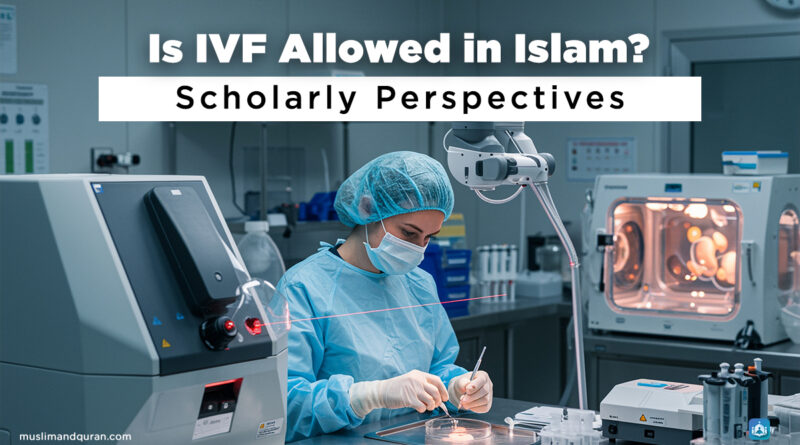
Is IVF Allowed in Islam? Scholarly Perspectives – Muslim and Quran

Last updated on May 29th, 2026 at 04:48 am
Having children is a natural desire for all men and women. This is a natural and lawful way of having children across all civilizations and religions, to get married. One of the major purposes of marriage is to have children. In Islam, marriage and having children are emphasized. Many Quranic verses particularly describe children as Allah’s سُبْحَانَهُ وَتَعَالَى blessings. Islam calls children the adornment of worldly life.
Likewise, the Prophet Muhammad, may God bless him and grant him peace, had also emphasized the importance of getting children. Some of the references from the Qur’an and Hadith, emphasizing the importance of having children, are quoted here:
Translation of relevant part
Wealth and children are an adornment of the life of the world…..
Translation of relevant part
And Allah has given you spouses from your kind, and has granted you through your spouses, sons and grandsons …..
- Hadith 3227 of Sunan An-Nasai describes marriage as a means of increasing the Muslim population, which will be a source of pride for the Prophet. The same subject is also mentioned in other Hadiths, as well.
Translation –
…. Marry the one who is fertile and loving, for I will boast of your great numbers.
So, there is no second thought in this regard that Islam not only allows but also emphasizes Muslims to marry and produce children in good numbers. But unfortunately, many couples are unable to have children, due to some medical conditions, or by the Will of Allah سُبْحَانَهُ وَتَعَالَى. Many such couples often wonder if getting children with the latest medical techniques and treatments, like “In Vitro Fertilization”, commonly known as IVF, is permissible in Islam?
In this blog, we will be exploring the scholarly view on the permissibility of IVF in Islam.
In Vitro Fertilization (IVF)
Before exploring scholarly perspectives on the permissibility of IVF in Islam, let’s first look at what IVF is.
In simple words, IVF (In Vitro Fertilization) is a medical treatment through which couples can have babies when they are unable to get them naturally. In this medical procedure, if someone is unable to conceive naturally, a baby can be created outside the human body in a laboratory. That’s why babies produced through this medical procedure were often called “test tube babies”.
IVF is a complex medical process, comprising various steps. Generally, it involves four steps as follows:
- The first step is Collection. Doctors collect eggs from the wife and sperm from the husband, which are the two basic things for the production of a child.
- The next step is known as Mixing or Fertilization. The collected eggs and sperm are combined in a special dish in a controlled laboratory environment. Putting eggs and sperm together in a dish facilitates fertilization. This is one of the critical steps in this whole procedure.
- The third step is called Growth or Development of the Embryo. After successful fertilization, the fertilized egg develops into a small cluster of cells called an “embryo” in medical terminology.
- The fourth and final step in this procedure is the transfer of the embryo. Again, this is a critical step. The healthy embryo is carefully selected and directly placed into the wife’s womb, allowing the baby to grow.
Once the embryo is placed in the mother’s womb and begins growing naturally, the rest of the process of a child’s birth is the same as a normal birth cycle.
When This Medical Technique Is Used?
In simple terms, this special medical treatment is recommended and used by doctors when a couple is unable to have children through natural means.
Technically, this treatment is used if the couple is facing infertility due to any of the following reasons:
- If the wife’s fallopian tubes are blocked or damaged.
- If the husband’s sperm count is below the desired level.
- If the wife has ovulation disorders.
- If the couple is experiencing unexplained infertility.
- If the couple is unable to produce children due to some genetic reasons
Permissibility of IVF in Islam
The majority of modern Islamic scholars and experts in Islamic jurisprudence, including renowned international Islamic Fiqh authorities, hold that IVF is permissible in Islam, but only under strict conditions. It implies that IVF can be used by a Muslim couple when the entire procedure is conducted within the Islamic guidelines, without violation of any of the clear Islamic teachings.
The conditions that make the treatment under IVF technology permissible in Islam mainly include the following:
· Preserving the Lineage – the Sperm Must be from the Husband
The preservation of the biological lineage of children is highly emphasized in Islam. A guiding principle in this context often takes reference from the 5th verse of Surah Al-Ahzabwhere the basic concept is clarified with reference to adopted children.
Translation of relevant part
Call your adopted sons after their true fathers; that is more equitable in the sight of Allah.
The above verse clearly emphasizes the preservation of a child’s lineage. The same principle is applicable in the event of getting treatment through IVF for having a child. It implies that the sperm, used in this procedure, must be taken from the husband. Taking a third person’s sperm or a donor is strictly prohibited and would make the whole procedure unethical and a clear violation of Islamic teachings. If this condition is not met, the birth of a child will not be lawful.
· Preservation of Lineage – the Egg Must be from the Wife
The next condition is that the egg taken for this treatment must be from the wife. If an egg is taken from some other woman or a donor, it will also make the whole process un-Islamic. Islam puts a high emphasis on the preservation of genetic and biological lineage. Hence, taking an egg from any woman other than the wife is strictly prohibited in Islamic jurisprudence.
· Placement of Embryo only in the Wife’s Womb (Uterus)
The next condition that makes IVF permissible in Islam is that the fertilized embryo must be implanted in the uterus of the wife. This cannot be placed in the womb of a volunteer or surrogate, as Islam strictly prohibits surrogacy. Some scholars are particularly strict on this issue, with the view that implanting the embryo in a woman other than the wife is like involving a third-party woman in the production of a child, which creates confusion about the biological parentage of the baby.
· The Couple Must be Lawfully and Islamically Married at the Time of Implanting the Embryo
This is yet another very sensitive condition while getting treatment under IVF. The husband and wife must be in the state of marriage at the time of implantation of the embryo in the wife’s womb. It means that if the husband has died, this process cannot be performed. Similarly, if the marriage has already ended through a divorce, this procedure cannot be adopted for getting a child. In both these cases, implantation of the womb must not be conducted, even if the sperm and eggs were collected before death or divorce, because the marriage contract ends under both these situations.
· Mixing or Misuse of Eggs and Sperms Must be Prevented
The process of collection of eggs and sperm and fertilization involves a team of doctors and medical technicians. It also involves a special laboratory. During this entire process, there is every likelihood that the genetic material (either egg or sperm) of a third person might be mixed. This needs special attention and extreme care while handling the genetic material, fertilizing it, and implanting the embryo in the womb of the correct and genuine woman. Any mixing or mishandling at any stage, either accidentally or intentionally, will make this treatment unlawful from an Islamic perspective. Hence, scholars stress that the IVF treatment must only be conducted through a well-trusted and well-equipped medical facility. The couple should also keep a strict eye on the entire process to avoid any unethical behavior.
· The Islamic Concept of Haya (Modesty) Must be Observed
The exposure of private parts, especially those of women, must be avoided to the maximum extent. The procedure under IVF involves unhiding of private parts of women; hence, it is extremely important to ensure that male staff, including doctors, are prohibited, especially when female staff for conducting this procedure is available or can be arranged. If female staff are not available, male staff can be allowed. But in both cases, exposure of the private parts of the wife must only be allowed to the minimum possible extent, depending on medical necessity.
· IVF Should only be Used When Extremely Necessary
Although having children is a natural desire and highly emphasized in Islamic teachings, one must observe patience and keep complete trust in Allah’s سُبْحَانَهُ وَتَعَالَى Will and Blessings. The Islamic history tells us that the Prophets Ibrahim and Zakarriyah عَلَيْهِمَا ٱلسَّلَامُ were blessed with children at a very old age. Hence, it is important for Muslims to keep on making Duas for Allah’s سُبْحَانَهُ وَتَعَالَى blessings for getting children. However, relying on treatment is equally emphasized in Islam. Hadith 5678 of Sahih Al-Bukhari narrates it as follows:
Translation
There is no disease that Allah has created, except that He also has created its treatment.
So, getting available medical treatment is also permissible in Islam. This principle also applies to the medical condition of infertility, for which the technique of IVF can be used. However, this method must be adopted in the event of extreme necessity, backed by medical investigation.
FAQs
Is IVF completely halal in Islam?
The scholarly opinion on IVF is that it is halal (permissible) in Islam but with strict conditions, such as taking sperm and eggs only from a lawful wife and husband, and placing the embryo in the wife’s womb, instead of a surrogate.
Is it allowed in Islam to donate sperm or take a donor’s sperm for IVF?
No, it is strictly prohibited in Islam. Sperms and eggs can only be taken from a lawfully and Islamically married husband and wife.
Is surrogacy permissible in Islam?
No, surrogacy is strictly prohibitedas it is against the basic principle of family lineage. Surrogacy involves a third-party woman in the process of childbirth, which is not allowed as it causes confusion about the real mother of the newborn.
Is taking treatment under IVF a matter of lack of trust in Allah Glory be to Him?
No, going for treatment under IVF or any other medical treatment is not a violation of the basic Islamic concept of complete reliance on Allah سُبْحَانَهُ وَتَعَالَى. In fact, Islam emphasizes getting medical treatment, as is evident from many Hadiths, such as Hadith 5678 of Sahih Al-Bukhari.
Should we consult a scholar before getting IVF treatment?
Yes, it is a highly recommended practice to consult an authentic Islamic scholar before opting for IVF. It is necessary for you to tell them everything that necessitates you to go for this treatment. They would also guide you on how you can comply with the strict conditions that make this procedure permissible under Islamic teachings.