Iran’s Loyalists Promote a Wider Nationalism, Unveiled Women Included
Dressed in a pink top and acid-washed jeans, the young woman in the video hardly looked the part of a pious loyalist to Iran’s clerical rulers, standing alongside a crowd of women draped in black from head to toe. That was exactly the point.
Letting her curls spill onto her shoulders, the woman offered an on-camera testimony.
“I was not a supporter of the Islamic Republic, nor the supreme leader,” she told a pro-government filmmaker, Hossein Shamaghdari, who posted their exchange online. After the United States and Israel attacked in February, she said, she began to admire Iran’s hard-line forces, as they battled two of the world’s most powerful militaries.
“If the Revolutionary Guards and Basijis were not fighting, we would not still be here,” she said, holding back tears, and praising the very forces that had once cracked down on unveiled women and protesters. “I am remembering the start of the war, and rethinking my views about the Islamic Republic.”
The woman is never identified in the video, and it is unclear who she is — let alone whether she has indeed changed her mind on Iran’s autocratic government. What is unmistakable about the video, though, is a new kind of nationalism that Iran’s government and its supporters are formulating — one that embraces those who once rebelled against it.
By not only surviving the war, but emerging with a strong hand in ongoing peace talks, Iran’s government feels emboldened. Still, a national reckoning lies ahead, as the country sinks deeper into economic crisis and its population remains deeply divided after antigovernment protests that swept the country shortly before the war.
To head off those challenges, Iran’s government is tapping into popular outrage about the attack on the country by outside powers. The state and its supporters are projecting a sense of unity they believe can reach constituencies far beyond a hard-core base.
Their message is that loyalists and dissenters can find common ground in a fight against foreign aggression. And they aim to present a friendlier, more inclusive face of the regime — even as that regime continues to crack down on critics, seizing their properties and executing people at the highest rate in decades, according to human rights activists.
For weeks, supporters of the government have been posting videos online that claim to show former protesters arguing that, after the war, there is “no alternative” to the Islamic Republic. Others show hipsters with piercings — once disparaged by Iran’s theocratic government — expressing their admiration for the new supreme leader, Ayatollah Mojtaba Khamenei.
It is impossible to know how genuine those sentiments are but there is little sign in the videos that their appearances are coerced, and many liberal Iranians have voiced staunch opposition to the U.S.-Israeli war on Iran.
Perhaps most surprising among this genre of videos are those made by Mr. Shamaghdari that feature unveiled women, often portrayed as the epitome of defiance against the regime.
The hijab is still a legal requirement for women in Iran, and women can be arrested or whipped for shirking it. Last week, an Iranian singer, Parastoo Ahmadi, was sentenced to 74 lashes for performing unveiled at a concert in 2024, according to a human rights group.
Many now openly flout the rule, however, and unveiled women have become a common sight on the streets of Tehran and rural towns. But never in state-backed media, until now.
“For decades, mandatory hijab has been one of the deepest fault lines between supporters of the Islamic Republic and its opponents,” said Omid Memarian, an Iran analyst at DAWN, a Washington-based think tank focused on the Middle East.
In the past, Iranians’ stance on compulsory hijab often reflected their views on social freedoms, he said, but now loyalists are willing to look past such differences among those standing with them against the war.
“After the war, the country’s main political and social fault line changed,” Mr. Memarian said.
This messaging stands in stark contrast to imagery of women that was prevalent during the eight-year Iran-Iraq War in the 1980s, Mr. Memarian said, when veiled women were meant to idealize piety and revolutionary sacrifice.
During the most recent war, state television has shown women’s military parades, featuring pink guns and pink jeeps.
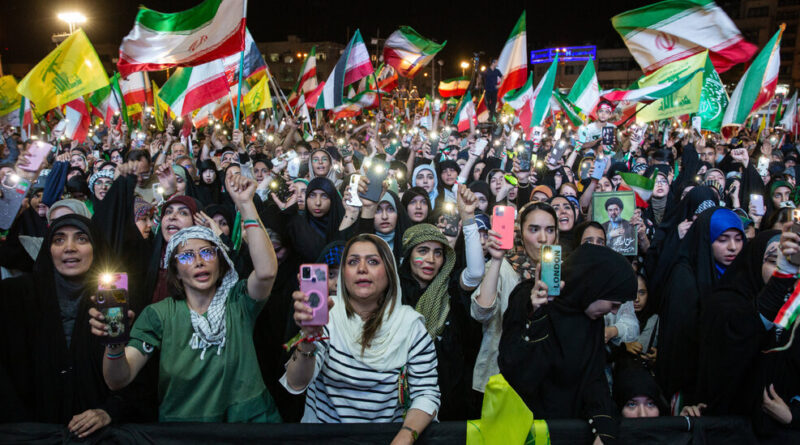
Even more ubiquitous have been the images of unveiled women at pro-government rallies. Some loyalists have highlighted their presence as a sign of national reconciliation after the bloody crackdown on January’s protests that left thousands dead.
“We have been unfair to these very people,” Amir Taha Hussein Khan, a pro-government commentator, wrote in a social media post alongside images of unveiled women at pro-government rallies. “Today, these same people, with all their being, selflessly stand against the enemy.”
Some Iranians interviewed by The Times were skeptical that everyone going to the rallies was there out of genuine conviction, arguing that free meals and money were sometimes offered in exchange for attendance. Those claims could not be independently verified.
Either way, critics say the images smack of government hypocrisy.
“They want to use the lack of hijab to their advantage,” said Maryam, a Tehran resident who asked not to be identified by her full name for fear of retribution. “All of a sudden, in the face of war, the regime says we are all Iranians.”
Some critics have posted images online showing unveiled women at recent rallies alongside photographs of a partly-veiled Mahsa Amini, the young woman who died in police custody in 2022 over charges of improper dress. Her death kindled the “Women, Life, Freedom” movement, when women ripped off their veils and took to the streets in mass protest.
The government has occasionally promoted images of unveiled women in the past, usually at state rallies after periods of dissent, said Shima Tadris, who studies Iranian women’s rights movements at the Gerda Henkel Foundation, a research institute in Germany.
That happened after the January protests, she added, and became widespread during the war because it projected an image of broad-based support for the government.
At the same time, Ms. Tadris said, the government wants to demoralize the January protesters who plunged Iran’s leadership into one of its most precarious moments since the revolution that brought them to power in 1979. The Islamic republic, she said, wants to signal to protesters: “‘You are the ones who are alone, more and more people are joining us.’”
The attempts at promoting national unity come as Iranian society feels more fragmented than ever.
Before the war, Iranians were largely split into two camps: pro- and anti-government, said Naghmeh Sohrabi, a Middle East historian at Brandeis University.
The opposition has since splintered into those who support the United States-led war, in the hopes of toppling the government, and those who are against it, fearing the destruction it causes. Government loyalists are split, too, between those who want to continue the war and those who want to negotiate a deal to end it.
“What’s happening on the ground is this fracturing of society on a very deep level,” she said. “The question for them is how do you bring society back together again?”
Roya Khoshnevis, an academic and cultural analyst based in Tehran, said that although those rifts could not be healed with nationalistic fervor, there was collective pride in surviving the war.
“People do not necessarily feel more united,” she said. “Despite the wrong actions the Islamic Republic has taken toward its people for ages, like many Iranians, I am proud of how strong they have appeared.”
Some activists worry the state will no longer be as lenient once the threat of war subsides, Ms. Tadris, the researcher, said.
Last month, Iran’s judiciary summoned the editor of the state news agency, IRNA, over a photo essay that featured images of a woman unveiled in her home. Yet it was Iran’s president, Masoud Pezeshkian, who came out to defend him.
“The same women they say one day should be arrested, you have shown holding up photos of the supreme leader,” Mr. Pezeshkian said during an interview with Iran’s state broadcaster. “We need to accept differences, and not think of these differences as hostile.”
Hakim program contributed reporting.