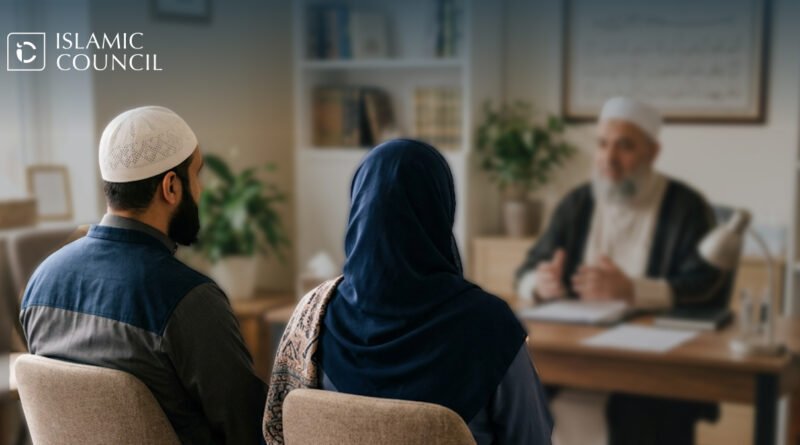
How Imams can help couples navigate marriage
Picture this: a Muslim couple, a marriage breakdown, a desire for faith-based support. This isn’t a new picture. For many Muslims in the West, this was part of their life journey. A journey that began with all intentions to want to solve the problems, to make it work, and to bring about a reconciliation so their marriage would not break down. But now, when they look back, it was only part of the journey, the earlier part. After that, things got worse, and it made more sense to move apart and break away.
Let’s not get the wrong idea here. I’m not taking us back over what went wrong or trying to apportion blame. That ground has been covered many times, and there’s little to be gained from going over it again. No, I want to focus on one thing that could have been done differently, something that might have changed the course of the journey. Of course, for those who have already been through this, it was the qadr of Allah that they had to face those circumstances. But for those who have yet to walk that path, if there is one thing we can do differently to help them avoid the same outcome, why shouldn’t we?
It’s been a full three years now since I joined Islamic Council, a reconciliation, arbitration, and advisory service based in the London Muslim Centre, that provides support for families and couples. What have I learnt in those three years? Our work with couples in crisis doesn’t always work. In fact, it doesn’t work in almost half of the cases, and that’s exactly why I’ve decided to put pen to paper and speak about what needs to change in all of this.
Need for earlier intervention in marriage breakdown
Perhaps, for some of you reading this, this sounds familiar, and I apologise for putting something out that might be triggering. The trauma of that part of the journey is real and neither of the two, nor their children, ever recover from it completely.
Having said that, Islamic Council has always tried to take a two-pronged approach to dealing with marriage breakdown cases.
Reactive approach
We are there when the couple urgently needs us, this is the reactive and responsive approach.
At this point we do what we can do, give guidance as best we can, and try to set things right where possible. But also at this point, it’s often too late and the crisis has become so bad, that all we’re really doing in half of these cases is damage limitation.
Quite often, it is about helping the couple think about their children and trying to enable some form of co-parenting to happen while both are in a state of deep-seated hurt. Also quite often, this is at a point where they don’t trust each other or each other’s families.
Proactive approach
That’s where this second approach comes in.
It was long recognised — not just by the scholars and the good people of Islamic Council, but by so many who saw this same pattern playing out in the lives of many couples they knew — that early intervention was necessary. Doing something earlier on to make sure couples would not have to go down the same path again and again. In effect, educating and empowering couples with the mindset, skillset, and toolset to resolve their differences and minor conflicts before they became too big to sort out. This is the proactive approach.
For years, Islamic Council has held educational workshops, marital primers, marriage mastery courses, and seminars on the art of successful relationships. Over the past few years, we even moved to publishing short self-help guides on how a couple could reconcile matters between themselves. But the figures we’re seeing are still the same. On average, Islamic Council takes on around 30 new marriage breakdown cases a month and almost half are still beyond any meaningful reconciliation.
So what could we have done differently?
In many of the cases, we note that the couple have already seen another faith-based service. The vast majority that we work with have either already been seen by their local Imam or had a conversation with him regarding their family matter. We see that people hope he has what they need to solve their issues, and that’s the thing: perhaps we need to upskill our Imams in order to curb the crisis affecting so many of our families.
The present reality of our Imams in general is not a good one. With so many Muslims turning to their Imam, you may have assumed that these men were amongst the most educated and resourceful among us. Well, you may assume that if you are naïve. Sadly, the Imam’s role continues to be one of the lowest paid in our communities, and there is such a limited amount of training for the true breadth of what this role entails, beyond graduation from a seminary you may find a training on end-of-life care or a chaplaincy course. But when it comes to structured, long-term, and meaningful continued professional development (CPD), well, sadly there’s hardly anything out there.
And when it comes to helping couples in crisis, without structured training, even the most well-intentioned Imam can find themselves acting as fixer rather than facilitator. E.g. falling into taking sides, absorbing cases that should have been referred elsewhere, or missing warning signs that specialist intervention is required. For the couple, the consequences can be huge. For the wider community, the impact of not having skilled Imams who know when to help is even greater.
Strengthening their role in supporting Muslim families
If we can formally upskill our Imams to prepare for these scenarios, we may well be able to save many couples and avoid letting the damage get to the point where reconciliation is no longer possible.
The Prophet ﷺ identified the separation of a husband and wife as amongst one of the greatest achievements of Shaytān. [1] This makes the Imam’s role in those moments one of the most critical and consequential they will ever play.
So this is precisely what we’ve decided to fix. For the first time, for Imams across the UK, Islamic Council has created a professional development workshop designed to give them the skills and support to work with couples experiencing marital difficulties. [2] How Imams Can Help Couples Navigate Marriage will equip them with practical frameworks, therapeutic knowledge, and Islamically grounded tools to better support couples. It will enable Imams to know when they need to step away from trying to “fix” a situation and know when they should be the facilitator for the couple in crisis.
The event will take the form of a full day of professional development, delivered across four sessions. It will be primarily aimed at Imams, but male Islamic scholars and community practitioners are also welcome. As for attendee numbers, we’ll have a cap of 50 as we anticipate that a small, high-quality cohort of Imams will register and benefit in line with the nature of the training, and to get the maximum benefit of the trainer-student ratio.
The sessions (on Thursday 26 November) will cover topics including communication and conflict resolution, emotional support and active listening, understanding domestic abuse and safeguarding responsibilities, and the integration of Islamic principles with contemporary counselling approaches. Most importantly, they will give Imams the clarity to understand when specialist intervention is required and who they can make referrals to.
Perhaps we needed to have done this a long time ago. Perhaps this was the part of the journey that if we, as a Muslim community had paid attention to, would have resolved the crisis for so many of those families that are now broken. Well, let’s not look back and throw blame, we have it now, and we all know an Imam who would benefit from this, and benefit his community by being better skilled for them.
For all Imams — and for all of you who are in touch with your Imam, send them here — visit the workshop page and get signed up for this CPD. Lets change the journey for our future generations.
Source: Islam21c
[1] Sahīh Muslim, 2,813; https://sunnah.com/muslim:2813b