'Ghost particles' from space telescope wins 2026 Nobel Prize in Physics
Neutrinos are elusive subatomic particles. The Sun produces vast numbers of them: every second, billions pass harmlessly through an area the size of your fingernail.
But IceCube is searching for much higher-energy neutrinos, those produced by violent processes far beyond our Solar System — in distant galaxies.
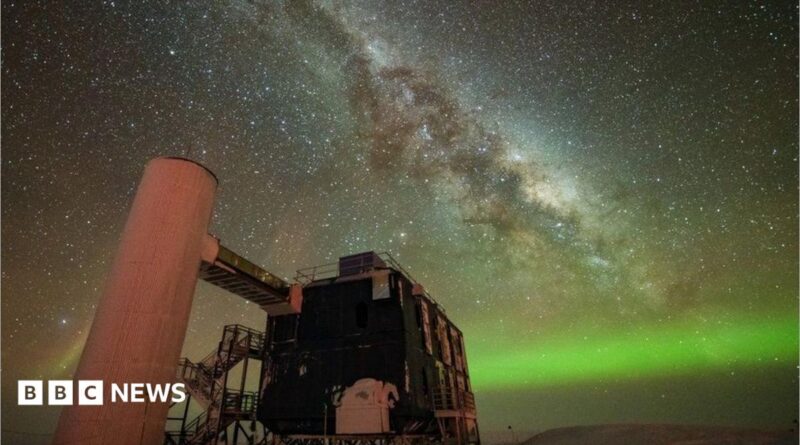
It is composed of thousands of sensors on long cables that are drilled and frozen into a 1km cubic block of ice.
Neutrinos can be thought of as astronomical messengers that point to those fundamental events.
At the observatory, most neutrinos pass straight through the ice, but occasionally one interacts with it, producing particles that give off a telltale flash of light.
These rare signals carry clues to where the neutrinos came from and the extreme conditions that produced them — allowing scientists to investigate places that ordinary telescopes cannot easily see.
“Francis Halzen has led an international team of researchers and engineers who have provided us with a fantastic instrument,” said Prof Mark Pearce, Chair of the Nobel Committee for Physics.
“His tenacity and scientific vision has paved the way for a new kind of astronomy.”