Ghassan Salame says Lebanon-Israel talks ‘not negotiations,’ Hezbollah disarmament by force ‘illusion’
Lebanese and Israeli officials are due to hold talks in Washington on Tuesday under the auspices of the Trump administration to lay the groundwork for a ceasefire and eventual negotiations. Israeli airstrikes and Hezbollah rocket attacks have intensified over the weekend in southern Lebanon and northern Israel, even as the sides prepare to meet. Lebanon’s Health Ministry said that 2,055 people were killed in Israeli attacks since renewed fighting began on March 2, triggered by a Hezbollah attack on Israel in support of Iran. Twelve Israeli soldiers and two civilians have been killed by the Iran-backed Shiite militia group over the same period, Israeli officials say.
Israel says the ceasefire reached between the United States and Iran does not include Lebanon, and it has been pounding towns and villages in southern Lebanon for weeks, leading to mass displacement of civilians who now have no homes left to return to. Many believe Israel’s effective depopulation campaign is aimed at ensuring Hezbollah cannot reconstitute itself. Some argue that Israel intends to occupy southern Lebanon, as it did in 1982.
Workers clear rubble from the site of an Israeli airstrike the day before that targeted the Bir Hassan neighborhood in Beirut’s southern suburbs on April 9, 2026. (Photo by AFP via Getty Images)
Lebanon’s prime minister, Nawaf Salam, said over the weekend that efforts to end the conflict and to secure an Israeli withdrawal from southern Lebanon were continuing. However, there are few signs, if any, that Israel intends to end its operations against Hezbollah anytime soon.
An estimated 1.2 million displaced civilians are adding pressure on the country’s already frail finances and infrastructure amid rising popular anger at Israel and Hezbollah alike.
Both Israel and the United States have been pressuring Salam’s government to disarm Hezbollah, arguing that with its chief sponsor, Iran, so badly weakened, the circumstances are ripe.
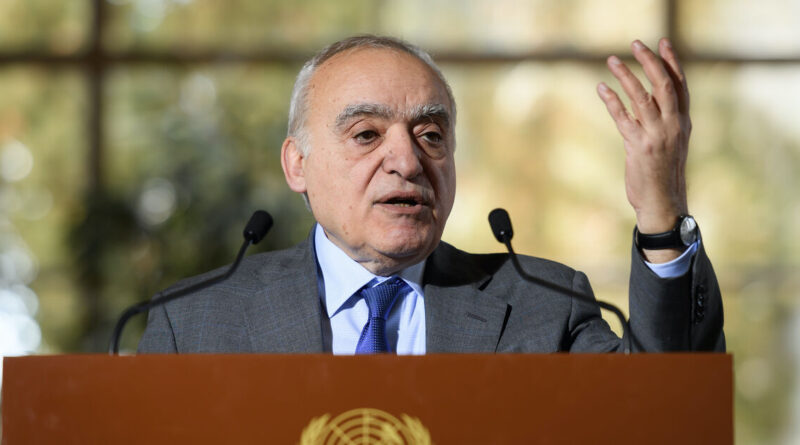
Al-Monitor sat down with Lebanese Culture Minister Ghassan Salame on April 13, which marked the 51st anniversary of the start of Lebanon’s bloody 15-year-long civil war, to discuss the challenges facing his beleaguered nation.
A transcript of the interview, lightly edited for clarity, follows:
Al-Monitor: This is a very big week for your country. You have peace talks with Israel that are about to kick off tomorrow in Washington. Will you be taking part, Mr. Minister, because we do know that you have had some experience in this regard, though a long time ago?
Salame: Well, this is not really a negotiation. The [process of] negotiations will take some time before they start. This is a preliminary meeting on an ambassadorial level. Our ambassador to Washington, [Nada Hamadeh;, Israel’s ambassador to Washington, [Yechiel Leiter]; and the American ambassador to Beirut, [Michel Issa], will be coming together tomorrow at 3:00 p.m. Washington time at Foggy Bottom.
Our intent is to press during that meeting tomorrow for a pause in violence. We believe that there should be some further deescalation to what has taken place since Thursday. There has been some deescalation of Israeli bombing of Lebanon. It has been concentrated on the capital city and the suburbs. We want it to extend to the whole of the territory, and we want it open and not related in particular to that meeting. We want at least a 15-day pause in order to start looking at a possible negotiation with some kind of serenity rather than the kind of panic and feeling of disaster that was predominant in Lebanese minds on Wednesday, that black Wednesday of last week when more than 20 different neighborhoods of the capital had been bombed at the same time, leading to hundreds of deaths, including among women and children.
Al-Monitor: Well, it’s a very complex situation because on the one hand, Israel is beginning these preparatory talks with you, but on the other hand, it says that there won’t be a ceasefire with Hezbollah. And so one can assume that on some level, black Wednesday was part of an effort to perhaps put further pressure on your government to pursue disarmament of Hezbollah, to get the Lebanese army involved. But also we do know that there is quite a bit of opposition to Hezbollah in your country and anger with Hezbollah for drawing Lebanon into this conflict, as some view the situation. Can your government speak with one voice on all of this, given the complexity?
Salame: The government is speaking in one voice. We have taken a number of decisions on August 5 and 7, and of late 10 days ago, concerning the military and security activities of Hezbollah, and the government has been united on these issues.
I think that there are a lot of illusions concerning disarmament of Hezbollah due to the laziness of people who are dealing with these issues.
It so happens that I have been dealing with the question of disarmament in many areas of the world where I have been sent as a mediator, and one thing I can tell you is that disarmament cannot be done by decree or in a matter of weeks. This is a long process. Lebanon has done a lot in terms of trying to close its borders, the airport, the ports, the land crossing points in order to stop new weapons from coming to any armed group in the country that is not part of the Lebanese official armed forces. But the idea that you can disarm just by making two phone calls or two check points here and there is just an illusion.
Al-Monitor: Mr. Minister, would you say that this illusion is not just subscribed to by Israel, but perhaps by the Trump administration as well, because Ambassador Tom Barrack, the US envoy to Syria, seemed to believe that this could happen fast as well?
Salame: Mr. Barrack came in last August with an agenda for disarmament. That was basically concentrated on three months. I think it was not an illusion but probably too much squeezing into a trimester, in three months. He probably didn’t appreciate enough the fact that although Hezbollah has been weakened substantially during the war it had led against Israel in 2023 and 2024, this is a party that has been arming itself, training three generations of fighters and getting help, notably for 44 years, and becoming by so doing probably the most formidable nonstate military actor in the world and not only in the Middle East, according to many of my former colleagues in academia.
Al-Monitor: Well, we also have to consider the history of why Hezbollah came into being in the first place — the Israeli occupation. Do you believe that Israel wants to occupy southern Lebanon again?
Salame: The year 1978 was the first large invasion of our territory by the Israeli army. It led to the creation of a security zone that was occupied by Israel for 22 years. With the passage of time, the Israelis understood two things: First, any occupation of any territory usually leads to resistance opposed to that occupation. And second, the names could change, but the momentum remains the same. In 1978, those who resisted were mostly the Palestinians and their allies in the Lebanese left. But they were defeated in 1982, and instead of this resistance disappearing, it was taken over by somebody else — that’s Hezbollah and pro-Iranian groups.
That is why in 2000 they came to the conclusion that this kind of security zone is not the kind of thing they need. So they withdrew. However, much later, with Oct. 7, 2023, in Gaza, something new happened. Some people were able to cross the border and attack Israeli targets and Israeli settlements beyond that border. So the idea of a security zone came back not only to Lebanon but to Gaza, where the Israelis are trying to cut Gaza into two, with one part entirely controlled by them and one less controlled.
They also did that in Syria, when they came down from the Golan Heights and occupied quite a large chunk of Syrian territory. That’s exactly what they are doing now in south Lebanon.
Smoke rises from the site of an Israeli airstrike that targeted an area in the southern Lebanese city of Sidon on April 8, 2026. (Photo by Mahmoud ZAYYAT / AFP via Getty Images)
There is a big change with the old model of the security zone. In the old model, most of the civilian population were allowed to remain in their homes. The new kind is an occupation, with a complete destruction of civilian facilities and homes in the villages they occupy. Right now we are witnessing the destruction of a large city in south Lebanon, Bint Jbeil, which would be number 53 in the list of villages already entirely destroyed. This kind of occupation can be construed as a war crime.
Al-Monitor: When you have such a huge percentage of the population displaced, the finances being what they are and the violence continuing and people feeling conflicted about all of this, are you concerned about there being renewed civil war?
Salame: To say that I’m not concerned would be lying to you. I’m of course concerned, and it so happens that the day we are talking to each other it is exactly the 51st anniversary of the explosion of the civil war in 1975 on April 13, 1975. We have endured civil war, and those of my generation have come to the conclusion that there is no cause that is more important than maintaining civil peace. There are tensions because we are in a depleted economy: 2025 and 2026 are years where foreign aid in most countries, especially European countries and the United States, has gone down dramatically — around 40% less than what foreign aid used to be. You are not only pushing hundreds of thousands of new displaced persons into Beirut and to the north, but you are depriving them of the hope they used to have after every conflict of going back to their homes.
Al-Monitor: How much more difficult has this whole task of disarming Hezbollah, which you say will take a very long time, become as a result of Feb. 28, of the war launched against Iran by Israel and the United States, which, of course, placed Hezbollah in a defensive position on some level?
Salame: We had arrangements with the Israelis in November 2024 in order to end the latest war between Lebanon and Israel. What happened for 15 successive months was a daily bombing of Lebanon, assassinations left and right of members of Hezbollah. We relied on the Americans and the French to produce the kind of ceasefire that was mentioned in the arrangements of Nov. 27, 2024. But nothing of that happened. Quite to the contrary, more than 15,000 sorties by Israeli aviation took place during that time. A number of hills in south Lebanon had been occupied before Feb. 28. Dozens of Lebanese had been taken prisoner before Feb. 28. The line of the Lebanese government has been and still remains: If the Israelis really want us to disarm Hezbollah, they should stop bombing our country. Because by bombing our country, they are giving Hezbollah an argument not to be disarmed. We are going to push tomorrow in Washington for a ceasefire. As long as the bombing continues, it’s very hard for us to sell the idea of sitting with Israel.
Al-Monitor: Do you believe that there has to be a pause in the fighting with Iran? Iran was saying that for them Lebanon was part of the ceasefire. Does Lebanon feel that Iran has to be part of the ceasefire?
Salame: Iran and Pakistan both confirmed to us that Lebanon was part of the ceasefire.
We believe that if the Islamabad process is derailed, it will have an extremely negative impact on our situation.
Al-Monitor: There’s been speculation for some time that the United States would like to involve Syria in a conflict with Hezbollah, that they want Syria’s president, Ahmed al-Sharaa, to fight Hezbollah. Do you believe those rumors?
Salame: Look, I have been hearing this for now three months or so, and we keep talking to the Syrian government. The president has talked to Sharaa. The prime minister has talked to Sharaa. We keep sending emissaries to Damascus, and they sometimes send emissaries here.
There is no reason so far not to believe the Syrian government that says that “whoever wants us to intervene in Lebanon doesn’t know that we are in a defensive posture.” And they give details of that defensive posture — that they have deployed a few hundred fighters along the Lebanese border in a defensive posture, and they have deployed many more on the Iraqi border in a defensive force. So far there is no evidence whatsoever to believe that the Syrian government, the new Syrian government, is intent on intervening or interfering in Lebanese affairs.
Al-Monitor: Turning to culture, you are the minister of culture. You recently approached UNESCO and sought their help in trying to protect heritage sites in Lebanon. Can you tell us a little bit about that and how much of Lebanese heritage is currently under threat?
Salame: It’s a real headache. The country is full of archaeological sites. Whenever you want to build a building in most of Lebanon, you bump into Ottoman or Roman or Phoenician ruins. The country is made of millennia of civilizations, leaving their signature at that level or at the lower level or at the Bronze Age level, but it is full. So a minister of culture is someone who has headaches all the time because wherever he looks he finds sites.
We estimate there are open archaeological sites across the country at more than 10,000 — for a country of 10,400 square kilometers. That tells you something. Now, there are of course jewels of the crown — Baalbek, Byblos, Beiteddine, you name it. Most of them are on the UNESCO list, but not all of them. In fact, five of our sites are listed as World Heritage Sites. But the other sites are extremely important. My own office as minister of culture is in a walled building, an extremely elegant building built by the Ottomans in 1907. So I don’t want to lose it either. That is why we pushed UNESCO to implement the 1954 treaty of which Lebanon is a signatory on the protection of heritage in times of war.
Nader Saqlawi, director of archaeological excavations in southern Lebanon, places an Enhanced Protection Emblem, a special symbol used under international humanitarian law to protect critical sites during armed conflict, at the archaeological site of the Roman hippodrome in the southern Lebanese city of Tyre, on March 23, 2026. (Photo by Dimitar DILKOFF / AFP via Getty Images)
And there is, in addition to that, what is called “enhanced protection.”
And this enhanced protection consists of considering certain particular sites as especially important for the whole world and needing to be protected, and that is why you are allowed by UNESCO to put a huge blue shield on them so that the pilots cannot say, “We didn’t know what we were bombing.” So we went and asked for a meeting of that particular committee in UNESCO. Seventy-nine sites we wanted enhanced protection for were accepted. It’s not a guarantee that they won’t be attacked. I’m particularly worried about Tyre, where there was an attack not very far, like 20 meters from the museum, where unfortunately 10 people were killed.
My archaeologists keep running from one side to the other to make sure that nothing has been destroyed by this bombing, and in the various museums we do have across the country, including at the National Museum, we had to transfer most of the very precious glass or fragile artifacts to some places where they can be better protected from not only bombing but also the waves of pressure that come after bombing takes place.