Gazans nourish dreams at twice-bombed culinary school
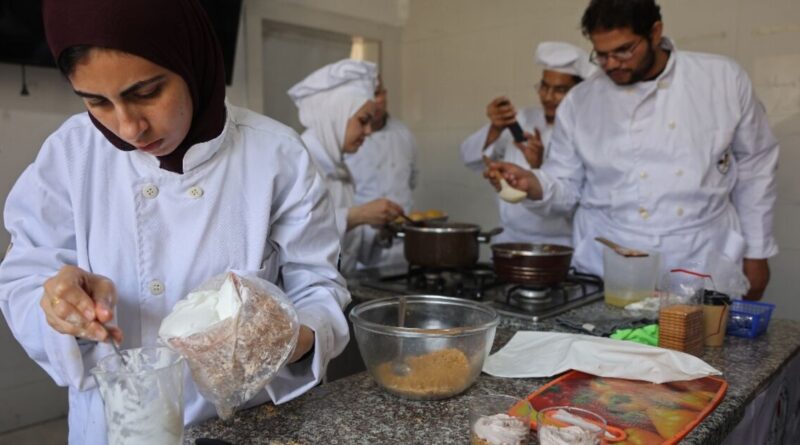
Inside a Gaza City culinary academy that has been bombed and rebuilt twice during the war, students chop, whisk, and plate dishes with quiet determination, committed to mastering their craft despite the hardships that surround them.
At Smile Kitchen Culinary Academy, men and women receive training that brings a semblance of normal life in the otherwise devastated Palestinian territory, as well as valuable skills in an economy battered by years of war.
Huda Zamo, 34, told AFP she owned an online clothing business before the war, but decided to launch her own food services after being displaced by the war and seeing people’s need for food.
“When the war came, everything was destroyed. We went through famine and displacement,” she said, adding she learned about the academy via Facebook and figured the classes would be good for her to develop her new business.
According to the UN, at least 1.6 million of Gaza’s 2.1 million residents are facing high levels of acute food insecurity mainly due to Israeli restrictions on goods entering the territory.
Ahmed Abu Taha, the school’s director, said keeping the school open in Gaza required a lot of logistics one would not expect elsewhere.
“Smile Kitchen Academy was established in 2016 and was bombed twice (by Israel) in 2021 and 2023,” Abu Taha told AFP.
After the latest bombing at the beginning of the war between Israel and Hamas in Gaza, the academy closed for three years, until it finally reopened earlier this year, with new equipment.
“There is strong engagement from students in the Gaza Strip under these difficult circumstances,” Abu Taha said, adding that some students hope to use their new skillsets in more promising markets.
“Students also aim to obtain an international certificate from the World Chefs organisation in Paris, which qualifies them to work in tourism establishments outside Gaza.”
In the kitchen, students wearing white chef’s toques and jackets emblazoned with a Palestinian flag on the sleeves labour under the supervision of teacher Nabil al-Shawaf.
– Shortages –
Shawaf, a towering man whose jacket is lined with the traditional checkered black-and-white pattern of the Palestinian keffiyeh scarf, said he had to improvise a lot of aspects of his course due to shortages in the Gaza Strip.
“We are facing difficulties due to the political and economic situation in Gaza and the brutal aggression on the Gaza Strip. There is a shortage of raw materials, and the cost for electricity and fuel is very high,” Shawaf said.
Trucks of aid and private sector goods have entered Gaza more easily since an October 2025 ceasefire, but international NGOs and the UN warn the situation remains volatile, with regular goods still too expensive for Gazans to purchase.
Israel controls all entry points into Gaza, and denies entry to certain goods, including those it says could be repurposed by Palestinian Islamist group Hamas to make weapons.
Gaza does not produce enough food to sustain its population, with 75 percent of fields once used to grow crops either destroyed or damaged since the start of the war in October 2023, according to the UN’s food agency, FAO.
Despite the ceasefire, Israeli attacks have killed people almost daily in Gaza, leaving the students’ professional future uncertain.
But with her new skills, student Zamo feels confident she will be able to bring her new business forward.
“I want to expand it, introduce new dishes, and offer styles that are different from local restaurants,” she said.