
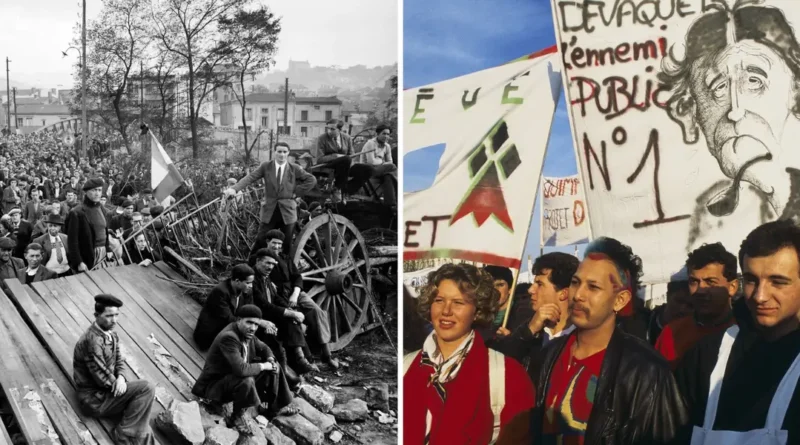
France is facing widespread unrest. Photos show its protests and riots over the past 100 years.
France is experiencing one of its largest riots and protests in years.
What began as peaceful demonstrations over school conditions culminated in nationwide cost-of-living protests and, subsequently, riots.
French Prime Minister Sébastien Lecornu said Tuesday that curfews imposed on Monday contributed to a calm night, though more protests are planned, according to Reuters.
The riots and protests echo many in France’s long history of mass demonstrations. From nationwide strikes to student demonstrations, several have brought the country to a standstill, in some cases prompting France’s leaders to announce a state of emergency.
Take a look at some of France’s biggest and most impactful protests and riots over the past 100 years.
1934 — February 6 riots
Keystone-France/Gamma-Keystone via Getty Images
Veterans and right-wing demonstrators took to the streets following a government corruption scandal. At least 15 people were killed.
The French Prime Minister at the time resigned the following day, stoking fears of a fascist coup.
1936 — Popular Front strikes
AFP via Getty Images
Alongside an economic crisis, fears of a fascist coup after the 1934 riots helped unite left-wing parties and trade unions. Mass strikes and factory occupations in May and June 1936 led to major labor reforms, according to France’s National Assembly.
1948 — Miners’ strike
-/AFP via Getty Images
In 1948, 300,000 French coal miners went on strike to protest economic conditions, per The New York Times. There was a heavy government crackdown, where some striking miners were killed, and another 3,000 were fired, according to AFP.
1961 — Paris Algerian demonstration and massacre
AFP via Getty Images
About 30,000 Algerians peacefully demonstrated against a curfew and in support of Algeria’s independence, according to the BBC.
French police brutally cracked down. Historians estimate that at least 120 Algerians were killed, though some estimates put that number closer to 300, Al Jazeera reported.
1968 — May 1968
Keystone/Hulton Archive/Getty Images
What started as a student movement demanding university reforms turned into millions of people striking after trade unions joined the uprising.
Between the protests and rioting, the demonstrations brought the nation to a standstill. To restore order, then-president Charles de Gaulle dissolved the National Assembly and called early elections, which his party won in June.
In this year’s student protests, many banners referenced “May 1968,” Time reported.
1986 — Anti-Devaquet student protests
Michel SETBOUN/Gamma-Rapho via Getty Images
Hundreds of thousands of students protested proposed university reforms they feared would restrict access to higher education.
Three weeks of violent clashes with police left hundreds injured and 22-year-old Malik Oussekine dead, forcing Prime Minister Jacques Chirac to withdraw the reforms, Time reported.
1995 — Strikes against pension reforms
Anne-Christine POUJOULAT / AFP via Getty Images
Between October and December 1995, public-sector workers went on strike against proposed austerity measures and pension reforms, bringing the country to a standstill, per the Global Nonviolent Action Database.
Then-prime minister Alain Juppé withdrew the proposed changes to public-sector pension plans, though other parts of his reform package went ahead.
2005 — French riots
Pascal Le Segretain/Getty Images
After two teenagers died while hiding from the police, riots began in Clichy-sous-Bois, a Parisian suburb, which then spread to other cities, the BBC reported at the time.
The government declared a state of emergency as unrest spread. The riots lasted about three weeks, while the state of emergency ended after about two months.
2018 — Gilets Jaunes
MEHDI FEDOUACH/AFP via Getty Images
“Les Gilets Jaunes,” or ‘the yellow vests’ in English, was a 2018 protest movement against a planned increase in fuel taxes that evolved into broader anti-government demonstrations, leading to deaths.
The French Prime Minister, Édouard Philippe, froze the tax hike in December that year and then fully canceled it days later.
2023 — Pension reform protests
SAMEER AL-DOUMY/AFP via Getty Images
Hundreds of thousands of people protested and went on strike against President Emmanuel Macron’s pension reforms, which raised the retirement age from 62 to 64, according to Le Monde.
Macron’s government enacted the reform despite the protests; the retirement age began rising in September 2023 and is scheduled to reach 64 by 2030.
