Does Quran 9:29 Command Muslims to Impose Jizya on Jews and Christians?
In a recent debate on the morality of the Quran, the Christian Apologist, GodLogic (Avery), built his case on one verse: 9:29. His argument ran as follows. Sura 9 begins with declaring war on the pagan Arabs, then at verse 29 turns on the Jews and Christians. They are fought for disbelief alone, with no treaty broken and no war started, and made to pay a tax (jizya) to humiliate them. The argument has several weak points, and his opponent missed most of them.
[9:29] You shall fight back against those who do not believe in GOD, nor in the Last Day, nor do they prohibit what GOD and His messenger have prohibited, nor do they abide by the religion of truth among those who received the scripture, until they pay the jizya, willingly or unwillingly.
قَٰتِلُوا۟ ٱلَّذِينَ لَا يُؤْمِنُونَ بِٱللَّهِ وَلَا بِٱلْيَوْمِ ٱلْءَاخِرِ وَلَا يُحَرِّمُونَ مَا حَرَّمَ ٱللَّهُ وَرَسُولُهُۥ وَلَا يَدِينُونَ دِينَ ٱلْحَقِّ مِنَ ٱلَّذِينَ أُوتُوا۟ ٱلْكِتَٰبَ حَتَّىٰ يُعْطُوا۟ ٱلْجِزْيَةَ عَن يَدٍ وَهُمْ صَٰغِرُونَ
The “dhimmi tax” is not in the Quran
The image the Christian reached for was a protection racket: a gang telling a shopkeeper it would be a shame if something happened to his store. That describes a real institution, but not one the Quran created.
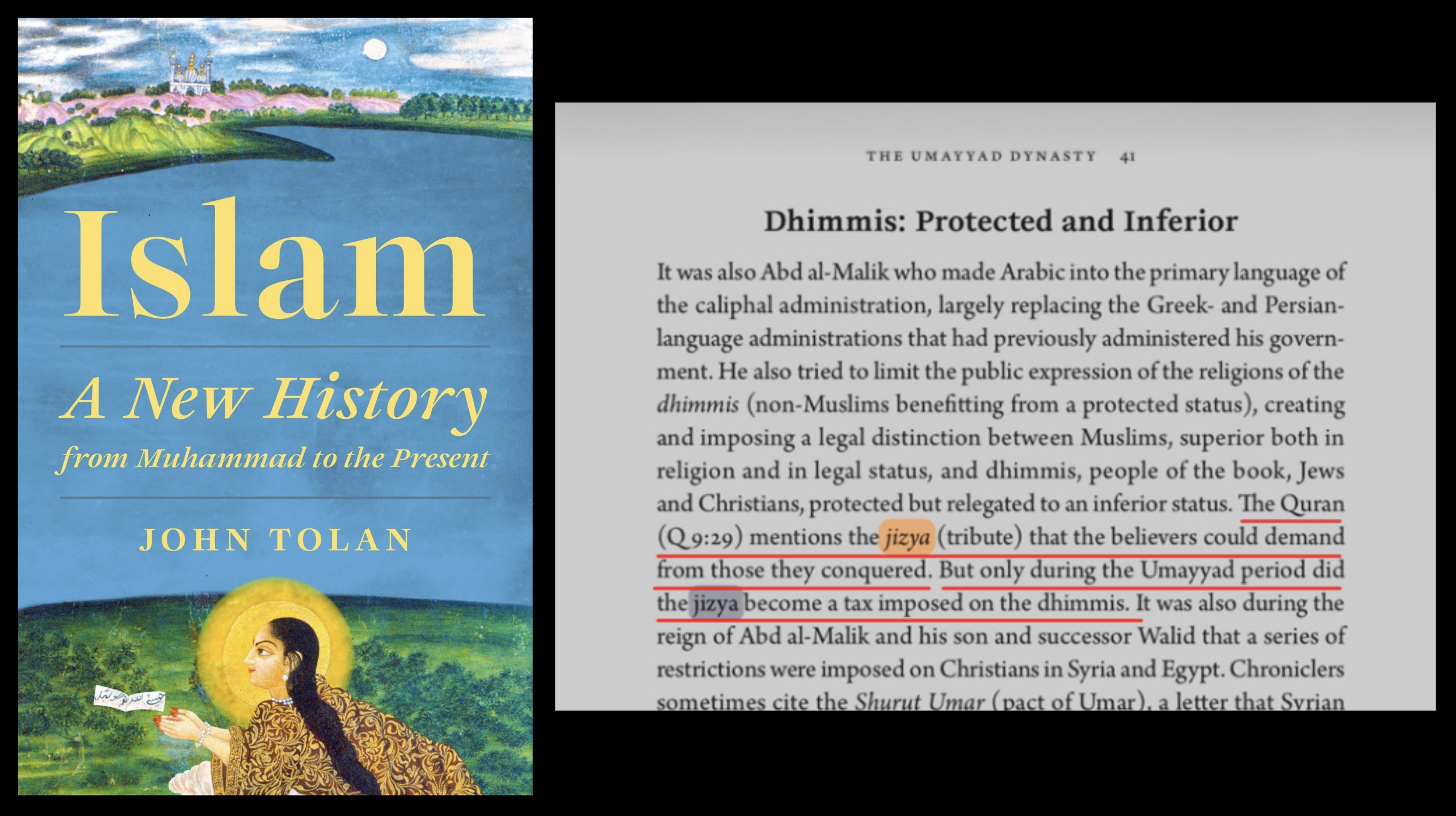
The historian John Tolan, in Islam: A New History from Muhammad to the Present (Princeton University Press, 2025), notes that although the Quran mentions jizya in 9:29, it was only under the Umayyads that it became a tax imposed on the dhimmis, the protected non-Muslim subjects (p. 41). This development occurred decades after the conquest of Mecca in 630 CE, particularly during the reign of ʿAbd al-Malik (685–705 CE), some 55 to 75 years later. Tolan further explains that the legal status of the dhimmi emerged gradually over the Umayyad and Abbasid periods, was never uniformly defined, and was even less consistently enforced. The famous restrictions attributed to the Pact of Umar were likewise a later development, with its most complete version appearing in the twelfth century, roughly five centuries after Umar’s reign.
So the humiliating, permanent, protection-money arrangement Avery described is a later legal development read back into a verse. Quran-alone reading, which is what he claimed to be arguing against, has no obligation to defend it.
What jizya means in the Quran
If the dhimmi tax is a later institution, the natural question is what the word means in the Quran itself. Al-jizya occurs only once, at 9:29, so its meaning has to be drawn from its root and from its context.
The triliteral root j-z-y occurs 118 times in the Quran, and throughout it carries the sense of paying back what is owed: recompense, requital, compensation. The clearest example is 5:95, which addresses a pilgrim who kills game on purpose. What he owes is a jazāʾ, livestock equivalent to the animal he killed (or else the feeding of the poor or a fast in expiation).
[5:95] O you who believe, do not kill any game during pilgrimage. Anyone who kills any game on purpose, then his fine (fa–jazāʾ) shall be a number of livestock animals that is equivalent to the game animals he killed. The judgment shall be set by two equitable people among you. They shall make sure that the offerings reach the Ka’bah. Otherwise, he may expiate by feeding poor people, or by an equivalent fast to atone for his offense. GOD has pardoned past offenses. But if anyone returns to such an offense, GOD will avenge it. GOD is Almighty, Avenger.
يَٰٓأَيُّهَا ٱلَّذِينَ ءَامَنُوا۟ لَا تَقْتُلُوا۟ ٱلصَّيْدَ وَأَنتُمْ حُرُمٌ وَمَن قَتَلَهُۥ مِنكُم مُّتَعَمِّدًا فَجَزَآءٌ مِّثْلُ مَا قَتَلَ مِنَ ٱلنَّعَمِ يَحْكُمُ بِهِۦ ذَوَا عَدْلٍ مِّنكُمْ هَدْيًۢا بَٰلِغَ ٱلْكَعْبَةِ أَوْ كَفَّٰرَةٌ طَعَامُ مَسَٰكِينَ أَوْ عَدْلُ ذَٰلِكَ صِيَامًا لِّيَذُوقَ وَبَالَ أَمْرِهِۦ عَفَا ٱللَّهُ عَمَّا سَلَفَ وَمَنْ عَادَ فَيَنتَقِمُ ٱللَّهُ مِنْهُ وَٱللَّهُ عَزِيزٌ ذُو ٱنتِقَامٍ
The payment is proportional to a specific harm, and it is owed because of what the person did, not because of what the person is. The verb that governs jizya in 9:29, yuʿṭū, is likewise a word of giving and offering. Together they describe handing over what is owed. They do not describe submitting to a levy on a religious identity.
The Quran also places a rule over every fighting verse. In 2:190 to 193, the believers may fight those who attack them but are forbidden to aggress, and the passage ends by limiting aggression to the aggressors alone, with the fighting to stop once they refrain. Additionally, it calls oppression worse than murder. Therefore, a reading of 9:29 that turns it into a standing order to fight or tax people for what they believe runs straight into such commands.
[2:190] You may fight in the cause of GOD against those who attack you, but do not aggress. GOD does not love the aggressors.
[2:191] You may kill those who wage war against you, and you may evict them whence they evicted you. Oppression is worse than murder. Do not fight them at the Sacred Mosque (Masjid), unless they attack you therein. If they attack you, you may kill them. This is the just retribution for those disbelievers.
[2:192] If they refrain, then GOD is Forgiver, Most Merciful.
[2:193] You may also fight them to eliminate oppression, and to worship GOD freely. If they refrain, you shall not aggress; aggression is permitted only against the aggressors.
Additionally, 60:8-9 explicitly decrees who is permissible to fight against.
[60:8] GOD does not enjoin you from befriending those who do not fight you because of religion, and do not evict you from your homes. You may befriend them and be equitable towards them. GOD loves the equitable.
[60:9] GOD enjoins you only from befriending those who fight you because of religion, evict you from your homes, and band together with others to banish you. You shall not befriend them. Those who befriend them are the transgressors.
On the Quran’s own usage, then, jizya is a payment tied to conduct, the war and the damage it caused, and not to the status of being a Jew or a Christian. The recurring tax on dhimmis that Avery had in mind is something the Umayyads built later.
The context he cut away: 9:1–13
Avery’s reading depends on a story in which the believers finish with the pagans of Mecca and then, with no new provocation, turn their attention to the people of the book and demand money for their disbelief. That story requires cutting verse 29 loose from the verses that open the sura.
Here is what those verses describe. The believers had been driven out of their homes in Mecca and emigrated to Medina. Years later they made a treaty with the Meccans. The Meccans broke it. The believers then marched on Mecca and presented the Meccans with terms: the treaty-breakers were given a window of time to settle their affairs, those who had kept their agreements were explicitly exempted and their treaties honored to term, anyone who sought safe passage to hear the message was to be given it and then escorted back to safety (9:6), and those who stopped fighting and reformed were to be treated as brothers (9:11). The Meccans, ironically, complied, and the city was taken with almost no bloodshed.
The sura then states its own justification for this campaign in plain terms. Verses 12 and 13 name the grounds: the other side violated its oaths, attacked the religion, tried to expel the messenger, and began the hostilities.
[9:12] If they violate their oaths after pledging to keep their covenants, and attack your religion, you may fight the leaders of paganism—you are no longer bound by your covenant with them—that they may refrain.
[9:13] Would you not fight people who violated their treaties, tried to banish the messenger, and they are the ones who started the war in the first place? Are you afraid of them? GOD is the One you are supposed to fear, if you are believers.
This was a defensive war with a stated cause: broken treaties, expulsion, and aggression. It was fought under conditions the sura spells out and ended on terms the other side accepted.
Now read verse 29 in light of that. Avery asked his opponent to produce a verse showing that Jews and Christians attacked the believers, as if the burden sat there. But the sura’s own framing is the burden-bearer. The reasons for fighting are given at the start, and the sura reads as a single discourse about a single conflict and its settlement. Nothing in verse 29 announces a second, unrelated war launched against a new group for belief alone. To get that reading, Avery has to disjoin verse 29 from verses 1 through 13 and treat it as though the sura had started over.
What the verse itself says
Verse 29 describes a fight with a purpose and an end: until “they pay the jizya,” and it is explicitly a payment owed by a party that has been defeated. On the reading that jizya is reparations, a payment for harm done, the verse is describing compensation owed by an aggressor, not a standing levy on a religion.
[9:29] You shall fight back against those who do not believe in GOD, nor in the Last Day, nor do they prohibit what GOD and His messenger have prohibited, nor do they abide by the religion of truth among those who received the scripture, until they pay the jizya, willingly or unwillingly.
قَٰتِلُوا۟ ٱلَّذِينَ لَا يُؤْمِنُونَ بِٱللَّهِ وَلَا بِٱلْيَوْمِ ٱلْءَاخِرِ وَلَا يُحَرِّمُونَ مَا حَرَّمَ ٱللَّهُ وَرَسُولُهُۥ وَلَا يَدِينُونَ دِينَ ٱلْحَقِّ مِنَ ٱلَّذِينَ أُوتُوا۟ ٱلْكِتَٰبَ حَتَّىٰ يُعْطُوا۟ ٱلْجِزْيَةَ عَن يَدٍ وَهُمْ صَٰغِرُونَ
The Arabic also matters. The phrase that identifies the people of the book is min alladhina utu al-kitab, “among those who were given the scripture.” The preposition min is partitive. It marks a subset. The verse does not command action against Jews and Christians as a whole; it singles out some of them, those who fit the preceding description. Avery read it as a blanket sentence on both communities, and the Arabic does not support that.
It is also worth remembering who the “people of the book” were at this point. By the time of sura 9, the Quraysh themselves had received the Quran. The category is not a clean line separating pagans in verses 1 to 28 from Jews and Christians afterward, which was Avery’s central structural claim.
The context he skipped
His whole case rested on the idea that verse 29 introduces a new group, so nothing earlier could implicate them. But the setting of sura 9 is the proclamation given for the conquest of Mecca, when a mixed population was being absorbed into the new order. The Quran itself addresses an audience of Jews, Christians, and Pagans, a point scholars such as Gabriel Said Reynolds have pressed from the historical side.
The idea that the community around Muhammad contained no Jews or Christians whose conduct could be in view is an assumption unsupported by history. Jewish communities were established among the Banū Qaynuqāʿ, Banū Naḍīr, Banū Qurayẓa, and in Khaybar, Fadak, Taymāʾ, and Wādī al-Qurā. Christianity was likewise represented among the people of Najrān, Banū Taghlib, Ghassānids, and Lakhmids. Southern Arabia had also witnessed the Jewish-influenced Himyarite kingdom and the subsequent rule of Christian Abyssinians (Aksumites). Arabia was hardly a religious vacuum devoid of Jews and Christians.
However, the strongest evidence is internal. While Sura 9 describes the events associated with the conquest of Mecca, dated to the year 630 CE. Sura 5 is associated with the Farewell Pilgrimage, after the conquest, and dated to the events of 632 CE. If anyone wanted to know how the Quran treats the people of the book at the end of the story, this is where to look, and the picture is not perpetual war:
- 5:3 announces that the religion has been completed.
- 5:5 permits believers to eat the food of those who received the earlier scripture and to marry their women. That is a description of neighbors, households, and shared tables.
- 5:48 acknowledges that each community has its own law and practice, under one underlying diin.
- 5:66 and 5:68 call on the people of the book to uphold the Torah and the Gospel along with what was revealed to Muhammad.
- 5:69 repeats the promise of 2:62: those who believe in God and the last day and do good have nothing to fear.
[5:5] Today, all good food is made lawful for you. The food of the people of the scripture is lawful for you. Also, you may marry the chaste women among the believers, as well as the chaste women among the followers of previous scripture, provided you pay them their due dowries. You shall maintain chastity, not committing adultery, nor taking secret lovers. Anyone who rejects faith, all his work will be in vain, and in the Hereafter he will be with the losers.
The abrogation argument cuts the other way
The Christian’s framework depends on abrogation: the harsh verse comes later and cancels the gentle one. His opponent rejected abrogation outright, which is a defensible Quran-alone position. But the Christian’s own logic should have worked against him. If later revelation governs earlier, then 5:5 and 5:69, which come after the events of sura 9, are the verses that govern the relationship between believers, Jews, and Christians. The salvation promise of 2:62 is not overturned at the end of the Quran. It is restated.
[5:69] Surely, those who believe, those who are Jewish, the converts, and the Christians; any of them who (1) believe in GOD and (2) believe in the Last Day, and (3) lead a righteous life, have nothing to fear, nor will they grieve.
Conclusion
The claim that the Quran ends by commanding endless war on Jews and Christians for their beliefs requires reading 9:29 as a blanket order, reading jizya as a medieval dhimmi tax, treating the audience as cleanly divided, and ignoring sura 5. Each of those steps fails. The verse speaks of a subset (“from among”), the tax institution is a later Umayyad development, and the Quran’s final word on the people of the book is coexistence, shared meals, intermarriage, and the same salvation promised at the start.
Related Articles: