
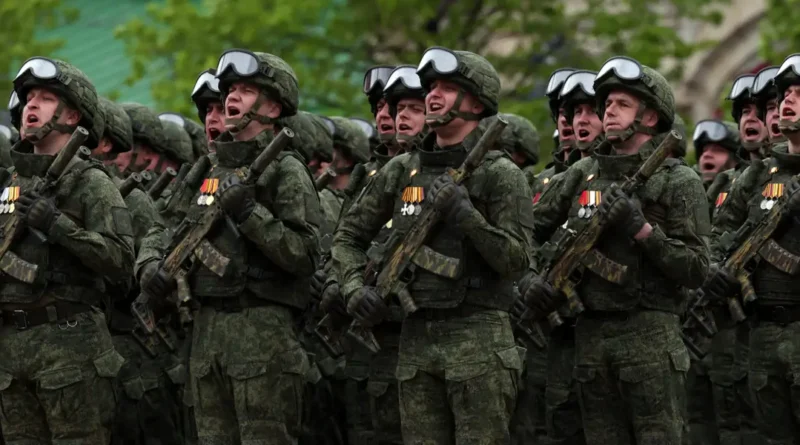
Disrupted Russian supply routes are forcing its troops to walk 18 miles to the front lines, Fedorov says
Russia’s crippled logistics routes on the war’s southern front are forcing its infantry to walk some 18 miles to their combat positions, Ukraine’s defense minister said on Wednesday.
“You’ve already seen, for example, in the south, where Russian infantry, due to logistics being disrupted, are walking 30 kilometers on foot to reach positions,” Mykhailo Fedorov said at a joint press conference in Kyiv with his Swedish counterpart, Pål Jonson.
Russian and Ukrainian troops are typically moved by vehicle to intermediate positions before traveling the last few miles on foot, at night, or in smaller vehicles to avoid detection by light drones.
Marching 30 km, or about 18 miles, in one go would take a soldier in combat gear at least six to eight hours.
Fedorov said Russian forces have had “major problems getting infantry to the front line” and sending them supplies, fuel, and generators used by drone operators.
The logistics disruption comes as Ukraine has increasingly used a newer class of drone capable of striking at depths of 30 to 300 km, targeting Russian supply routes, bombing trucks, bridges, and facilities in the rear.
“There are a lot of problems not obvious at first glance that affect the intensity of enemy actions on our territory,” Fedorov said.
Crimea, a major logistics hub for Russian operations in Kherson and Zaporizhzhia, is also facing a severe energy crisis as Ukrainian mid-range drones bombard oil facilities and key bridges connecting the peninsula to the mainland.
Local officials began rationing fuel for civilians last month before announcing they would cut fuel sales indefinitely.
“A large number of crises are beginning to accumulate, and it is becoming increasingly difficult for Russians to resolve crisis after crisis,” Fedorov said.
The mid-range drone has been key to Ukraine’s renewed war effort, giving Kyiv intermediate-range strike capacity that it can deploy at scale rather than relying on a limited Western supply of missiles.
Some of these fixed-wing drones use AI to help with Russian signal jamming, and are designed to identify and engage targets with some degree of autonomy, George Barros, director of Innovation and Open Source Tradecraft at the Institute for the Study of War, previously told Business Insider.
Fedorov and other Ukrainian commanders have said before that