
At Michelin-starred Matthias, agentic AI helps its head chef source the freshest rare ingredients
Until May 2025, Net Zero Logistics’ vans were running 30 to 40 routes daily across Connecticut. Mark Chiusano, the CEO and owner of Net Zero, which focuses on the last mile of deliveries, said he wanted more efficient routes that would lower costs while meeting client needs.
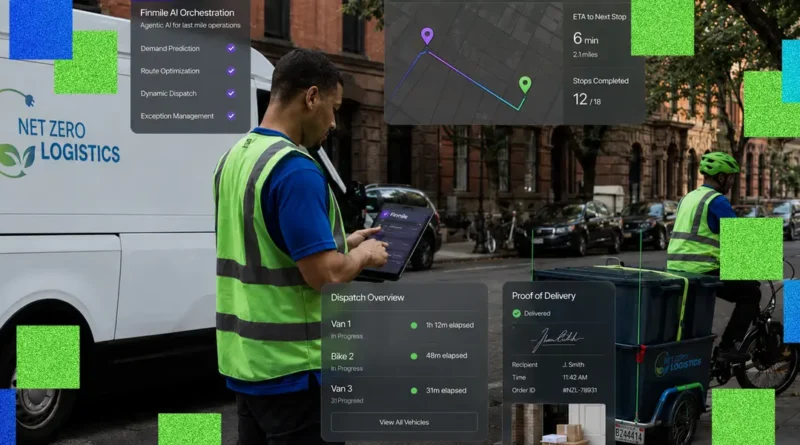
Net Zero’s own transportation management software couldn’t suggest optimized routes, so Chiusano said they decided to try Finmile, an AI-powered transportation routing software that provides dynamic routing based on location, weather, traffic, service-level agreements, vehicle specs, driver behavior, and available drivers. Now, Net Zero averages 16 to 20 routes daily, with each driver delivering more packages in the same amount of time or less, said Chiusano.
Mathematicians and traveling salesmen have been trying to make routes more efficient for centuries, said Willem-Jan van Hoeve, an operations research professor at Carnegie Mellon University’s Tepper School of Business. “Traveling salesmen would go from city to city to sell goods. They wanted to do so in the most cost-effective way,” he said. The goal? Find the shortest distance to all stops. Today, however, the problem is more complex.
“Look at the urban environment, with rush hour, schools dropping off, and events. Even the distance is highly dependent on the time you’re traveling,” van Hoeve said. The classic approach of prioritizing the shortest distance is not well-suited to current deliveries, as customers expect deliveries at specific times, he said.
Rich Pleeth, Finmile’s CEO and cofounder, understood this modern problem firsthand through his experience in physical logistics. His company launched in 2022, delivering packages with e-cargo bikes and electric vans, then pivoted in 2024 to route-optimization software. “I realized that delivery is the broken part of e-commerce,” Pleeth said.
The company uses agentic AI to ingest ordersbuild initial routes, and continuously update them throughout the day to improve efficiency. “AI is not sitting in a dashboard waiting for a human. It is actively making decisions, reassigning stops when a driver is late, inserting returns into live routes, predicting delivery failures before they happen, and triggering customer communications automatically,” Pleeth said.
More efficient routes and package sortation
Legacy software systems often layer AI on top of existing code, which “can become unwieldy,” said Stuart Hyden, Net Zero’s president and COO. But AI was foundational to Finmile, making it easy for Hyden and his team to create customized reports or change routing without any technical expertise, he said.
Routing automation software has also helped Net Zero reduce the time its drivers spend sorting packages, a process that often starts after 3 a.m. when they receive customer delivery information for the day.
Previously, drivers sorted packages by geographic area, which was more time- and labor-intensive. “With dynamic routing, it is very fast and efficient. You scan the package, and it comes up on the device and tells you what route it goes on,” said Hyden. “It helps us reduce the sortation labor cost.”
Once Net Zero’s operations staff accepts the initial AI-generated routes that Finmile’s algorithm proposes each morning, they are available on drivers’ smartphones. Drivers can then scan packages to load into the trucks. The program continues aggregating data and refining the algorithm to further improve routes.
“Our team has the ability to edit routes on the fly,” said Chiusano. “It does seem to be reducing the number of hours on road, making each route more efficient.”
With Finmile, the drivers don’t need to sort parcels into delivery order. Instead, drivers put packages into their assigned totes; at each stop, the software — which drivers access on their devices — specifies the tote number. Hyden said a driver can rummage through a tote with 30 to 40 packages more quickly than they can sort items by stop each morning before hitting the road.
Increased tracking and fewer customer claims
Since implementing Finmile, Net Zero’s routes are increasingly efficient, and drivers are making more deliveries, said Chiusano.
He added that the AI-powered technology has helped reduce the number of deliveries not received because drivers can access the exact drop-off coordinates. In addition to Finmile’s software geotagging deliveries, each driver’s phone barometer tracks steps. The program knows if a driver is going upstairs or delivering at the ground floor, said Pleeth, information that is automatically fed into Finmile’s algorithm.
Similar to Amazon drivers, those who use Finmile can photograph the drop-off, including the location address numbers and door. The software maintains a door-color library, an extra check against future erroneous deliveries. Combined, these AI-enabled proof-of-delivery checks have resulted in fewer delivery claims, Pleeth said.
Dispatchers and drivers can also track performance in real time. The system displays the number of orders the driver delivered, the average drop time, and the driver’s dwell time. Driver access to this information increases the transparency they have into performance-related management discussions, said Hyden.
Companies not using dynamic route optimization need to “get on board,” said Chiusano. “It’s not the same logistics world as 10 years ago or even two years ago.”