A Question Swirling Around Putin’s Big Conference: Could the War End?
Over the past month, President Vladimir V. Putin has said on two separate occasions that Russia’s war against Ukraine is “moving toward its conclusion” and “coming to an end.”
Speculation followed. Was Mr. Putin ready to end his invasion, with Russian troops stalled on the front lines and the economy weighed down by war? Or did he plan to keep pressing toward his sweeping objectives in Ukraine and believe victory to be at hand?
As Mr. Putin’s comments have left Russia’s political and business elite anxiously guessing, it also got them talking at the Russian leader’s flagship annual economic conference in St. Petersburg this week.
Some discussed a possible endgame, as pro-Putin figures have appeared in state media in recent days spinning Russia’s current position in the war as a victory, potentially laying the groundwork for a way out, if Mr. Putin so chose.
Russia, they said on the sidelines of the forum, is at a crossroads more than four years into its invasion. If the war is prolonged and escalated, they said, it would require many more sacrifices from the elite and from society at large, potentially including more intense economic pain and an unpopular military mobilization that reaches deeper into the Russian population.
Ukrainian officials have spoken in similar terms, saying that a primary goal of theirs is to force the Kremlin into a political decision to either negotiate or further mobilize, with a hope that it would choose negotiation.
Such discussions inside Russia reflect a growing schism within the Russian political establishment between generally pro-Western technocrats who see much to gain from ending the war, and conservative hawks who want the country to fight on.
Aside from his two cryptic comments about a conclusion to the war, Mr. Putin has indicated that he is siding with the hawks.
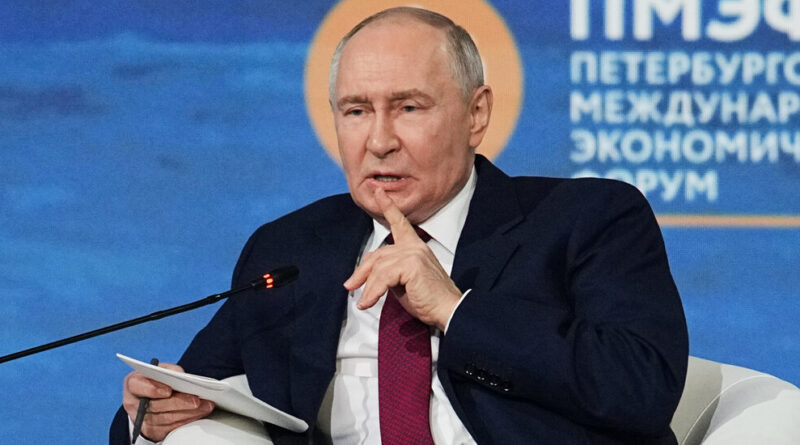
Speaking with heads of international news agencies on Thursday, during the second day of the economic conference, Mr. Putin exuded confidence, saying, “Russian troops are advancing along the entire line of contact.”
That claim was at odds with reality. Last month, for the first time in more than two years, Russia was unable to achieve any meaningful advancement along the front. Some Russian pro-war bloggers called Mr. Putin’s assessment fantastical, and asked whether he really believed what he was saying.
Mr. Putin also said it was up to Ukraine to abide by agreements he said he had made with President Trump last summer during a summit in Alaska. Those are believed to include a Ukrainian withdrawal from the eastern Donbas region, an idea that Kyiv has rejected.
On Friday, Mr. Putin said that an open letter from President Volodymyr Zelensky of Ukraine, offering a cease-fire and direct negotiations, was not a serious bid for peace. Rather, he said, Mr. Zelensky’s missive, which taunted Putin in personal terms, was “creating an environment where it’s impossible to hold any personal meetings at all.”
In all, Mr. Putin’s remarks seemed to indicate that the real difficulties facing Russia, and the hopes among elites that the war could be wound down, had so far left him unswayed.
A leading Russian economist, who runs a major government institution and requested anonymity to speak freely, said that the country faced difficult economic questions whether the war continued or not.
To end it, and the immense government spending that has come with it, would cause a depression, he said. To continue it, he added, would require escalating the war effort, and that would mean resorting to aspects of Soviet-style state planning, as the country has exhausted its ability to spend heavily on the war and maintain a semblance of normal life.
The conflict in Ukraine defines the current and future state of Russia’s economy, society and politics. Yet at the conference it was the elephant in the room. Business leaders and government officials were mostly tight-lipped about the war, even on the sidelines.
Some signaled relief that Russia had begun trying to tighten military expenditures, which had spurred inflation and sent interest rates soaring. But the fact that higher spending on the war was the cause of the ballooning budget deficit was never addressed during the formal economic discussions at the forum.
“A large budget deficit ultimately leads to financial destabilization for the state,” said Anton G. Siluanov, the country’s finance minister. “We are currently going through this period, and thank God we are entering a stage where balanced growth is within reach.”
Others asserted that Moscow and Washington were achieving progress in bringing the war to an end, even as Ukrainian officials have described the Trump administration as so distracted by the war in Iran that talks over Ukraine have become virtually frozen.
“Nothing is stalling. An active dialogue is underway,” Kirill A. Dmitriev, a Russian envoy who frequently handles informal negotiations with the White House, said in an interview. “How do we know the dialogue is successful? Because the enemies of this dialogue — the British — are furious that they failed to turn the U.S. toward heavier sanctions against Russia.”
Mr. Zelensky is working to bring the British, as well as the French and the Germans, more into the negotiating process as the Americans lose interest, including with a meeting scheduled for Sunday in London.
Mr. Dmitriev said he had been in touch with his American counterparts, including several phone calls with Steve Witkoff and Jared Kushner this week.
He said that Mr. Zelensky knew well what it would take to end the war. “There is an understanding, which Zelensky himself voiced, that the U.S. said they would give security guarantees to Ukraine only if Ukraine leaves the Donbas,” Mr. Dmitriev said.
Other speakers at the conference, particularly those representing the more hawkish, ultranationalist factions of the Russian political class, said they saw no chance of an American-brokered peace, offering instead a vision of perpetual war.
Andrei O. Bezrukov, a former Russian spy who lived undercover in the West with his wife for decades, said that Russia should “recognize that in the coming years, perhaps two decades, we will be at war.”
“We must learn how to live with this war,” said Mr. Bezrukov, who now serves as an adviser to the head of Russia’s biggest oil company. “We must build our state system and our economy so that it fulfills not only the goal of development, but the goal of defense too.”
Mr. Bezrukov spoke at a panel titled “Principal Threats Facing Russia in the Second Quarter of the 21st Century.” Two hundred people packed a room designed for half of that capacity, a reflection of the intense interest in the hawks’ perspective.
The moderator of the session, Konstantin V. Malofeev, an ultraconservative Russian media mogul, painted a picture of a Russia that will be colonized by the West unless it wins its war in Ukraine at all costs, even if nuclear weapons must be used.
Georgy Y. Filimonov, the governor of Russia’s Vologda region, said at the panel that one of Russia’s primary tasks should be to rid the government of pro-Western elements. Aleksandr Galushka, a former government minister, said that Russia should adopt elements of a planned economy.
These and other hard-line comments received pushback from Igor I. Shuvalov, a former first deputy prime minister and now the head of the state development bank. Speaking at a separate session, Mr. Shuvalov warned that “a certain shift is occurring that challenges what we have spent 30 years building, and it is a serious matter.”
“Technological leadership is built on freedom, not on total state control,” Mr. Shuvalov said, cautioning against a return to Soviet-style economic planning. “We must not repeat a lesson we have already learned.”
Within Russian politics, he added, “those who want to pick a fight with us have awakened.”