Fed should defy Donald Trump with rate rise, top economists say
Stay informed with free updates
Simply sign up to the US inflation myFT Digest — delivered directly to your inbox.
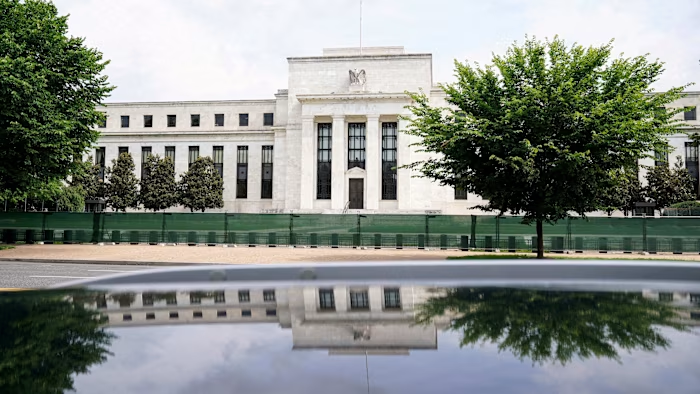
The Federal Reserve should face down Donald Trump and raise rates for the first time in more than three years, leading economists said, as they backed chair Kevin Warsh’s view that the central bank must focus on taming inflation.
Wall Street is widely expecting Fed officials to resist Trump’s calls for low borrowing costs and hoist the benchmark federal funds rate by a quarter point at the conclusion of its two-day meeting on Wednesday.
Top academic economists polled by the University of Chicago’s Booth School of Business on behalf of the FT concurred with the market’s outlook, with 50 of 51 respondents saying that borrowing costs should be raised from the current 3.5-3.75 per cent range.
While most economists backed a quarter-point rise, 14 per cent called for a jumbo half-point increase amid fears that a surge in fuel prices triggered by Trump’s war with Tehran will morph into a broader inflation crisis.
“The Fed is significantly behind the curve in terms of raising rates. Inflation has been well above target for years,” said Olivier Coibion, professor at the University of Texas at Austin.
“Inflation is not trending back to the target; if anything, it’s moving in the wrong direction, so policy should be reacting strongly.”
US rate-setters cut borrowing costs three times last year as inflation eased sharply after reaching multi-decade highs following the Covid-19 pandemic. But the Iran war, Trump’s tariffs and the AI boom have dented progress ever since.
The Fed’s preferred headline PCE price index is running at 3.7 per cent, nearly double the central bank’s 2 per cent target. Costs further up supply chains are increasing at an even more rapid rate.
Almost 90 per cent of respondents to the poll do not expect the Fed to hit its 2 per cent goal until at least 2028 despite expectations of higher interest rates.
Stronger price pressures have not deterred Trump’s calls for aggressive rate cuts, with the president calling current borrowing costs “ridiculous”. While Trump is unlikely to cheer a rise in interest rates, National Economic Council director Kevin Hassett has said in recent days that the White House respects the independence of the Fed chair.
Warsh, who was picked by Trump to lead the Fed earlier this year, paved the way for an increase in a late-August address in Jackson Hole, when he said the central bank would have “work to do” unless inflation swiftly showed signs of slowing down to levels consistent with its target.
“The Fed has a dual mandate for low unemployment and low inflation. It’s getting an A — or in the least an A-minus — on low unemployment, and it’s getting a poor grade on inflation,” said Alan Blinder, a former Fed official, now at Princeton. “The Fed hasn’t hit its inflation target in years — it’s pretty clear where the work needs to be done.”
The Fed last hit its 2 per cent inflation goal in early 2021.
Odds on a rate rise rose dramatically after data published last week showed consumer prices jumped 0.4 per cent between July and August, leaving the annual rate of inflation unchanged at 3.4 per cent.
Traders are now pricing in a 95 per cent chance of a quarter-point rise in US borrowing costs — a move that would mark the first increase in US interest rates since July 2023.

Still, Sebnem Kalemli-Ozcan, of Brown University, said she viewed Wednesday’s decision as a 50-50 call. “Warsh could still say that we should wait to see how the data turn out with so much uncertainty. So in that sense, it is also possible that they are not going to hike and keep having the family fight.”
Despite the extent of their concerns over inflation, economists were more sceptical than markets that the Fed will raise rates again over the course of 2026, with a slim majority anticipating one — or fewer — rises.
More than 90 per cent of respondents said they agreed with Warsh’s remarks in August that progress on PCE inflation — which has fallen from its peak of more than 4 per cent in May — has done little to address concerns that underlying inflation remains stubbornly high.
The Jackson Hole speech came after Warsh sparked concern on Wall Street after the US central bank’s July decision, when the Fed chair failed to set out how he intended to bring inflation back under control.
“He needs to prove himself. He needs to prove that he’s willing to do what it takes,” said Jón Steinsson, of the University of California, Berkeley. “If he tries to not raise rates yet again, markets are going to start turning against him.”