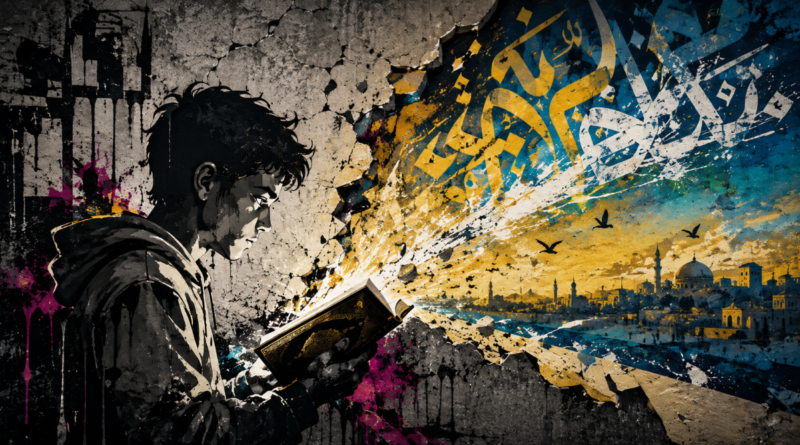
Addressed From Faraway: The World Beneath the Quran’s Words
There is a comfortable illusion buried in the idea of a common language. We assume that if two people hold the same words, they hold the same meanings. Point at a table, say “table,” and the matter is settled. On this view, language is a kind of currency—a fixed set of tokens that anyone holding the same denominations can exchange freely.
This picture is wrong, and nowhere does the mistake cost us more than in the way we approach scripture. We open the Quran, we recognize the words, and we assume that recognition is understanding. But the Quran itself does not share this assumption. It shows, again and again, that its words carry more than their surface—that a verse, a sign, or a story holds depths shaped by the world into which it was first sent. The verses carry more weight than the meanings of their individual words. And if we do not reckon with that depth, we may spend our lives reading a book whose deeper registers we have not yet heard.
The word is a handle, not the thing
Begin with a simple observation. When you hear a word, you do not receive a definition. You receive a flood—associations, images, feelings, a whole history stored inside you. The dictionary entry is the smallest part of what the word does. The rest was loaded there by your life.
A word, then, is a handle: a short, convenient grip attached to a vast and mostly invisible object made of experience. When I say a word, and you understand me, what actually happens is that my handle reaches for an object already sitting in your mind. Communication works not because we exchanged the word, but because we already had similar objects for the word to point at.
The Quran’s own vocabulary shows this vividly. Consider the word translated as “disbeliever”—the root k-f-r (كفر). Its underlying image is not intellectual denial; it is covering, concealment. The farmer who buries a seed under soil is, in classical Arabic, performing kufr—which is why the Quran can use the same root for tillers of the land (57:20). To disbelieve, in the Quran’s picture, is to cover over a truth one has already glimpsed. An English reader who receives only the flat word “disbeliever” has taken hold of the handle and left the entire object behind. The word carries a buried world, and the translation delivers the sound without the freight.
The Quran knows that meaning rides on a shared world
The Quran is remarkably explicit that words only work when they land in a prepared world. It insists that revelation came in Arabic precisely so that its first audience could understand it:
We have revealed it an Arabic Quran, that you may understand. (12:2)
And it states the principle as a rule that held for every messenger:
We did not send any messenger except (to preach) in the tongue of his people (li-yubayyina lahum), in order to clarify things for them. GOD then sends astray whomever He wills, and guides whomever He wills. He is the Almighty, the Most Wise. (14:4)
Notice what this means. Revelation did not descend as pure meaning to be poured into any mind. It came clothed in a specific language, addressed to people who already held the shared references, images, and experiences that would let those words point at the right objects. God accommodated the shared world of the audience, because without that shared world the words would have been sounds and nothing more.
The diversity of tongues is itself presented as a sign, not an accident: among God’s proofs are “the variations in your languages and your colors” (30:22). Language is bound to a people, and a people to a world. This is the same insight that makes translation so much harder than swapping words. The easy part is finding the equivalent term. The impossible part is transferring the cloud of association, history, and emotional temperature the word carried in its native world—and that cloud is exactly where the meaning lived.
Even the proof was fitted to the world
This lesson is not only for the Arabic of the Quran but also for the histories of past communities the Quran preserves. No case shows it more clearly than the she-camel of Thamud, the people of the messenger Saleh. The Quran presents her as their proof and their test: “This is God’s camel; let her serve as a proof for you” (7:73), and elsewhere, that God was sending the camel fitnatan lahum, as a test for them (54:27). The heart of the sign was an arrangement about water: the camel would drink on her appointed day and the people on theirs (26:155), the well qismatun baynahum, divided between them (54:28), and she was to be left to graze God’s earth untouched.
To a modern reader, this can seem a strange basis for a messenger’s credentials—a camel taking turns at a well on designated days. But to the people of Thamud, in that time and place, it was momentous. One may theorize or object as to why such a sign carried weight for them, but their actions settle the matter: they were disturbed enough by it, and by the credibility it lent Saleh’s claim, that the camel had to be eliminated for the threat it posed to the established order. The proof was profound precisely because it spoke the language of their world—and their rejection took the form that world made available to them:
[91:14] They disbelieved him and slaughtered her. Their Lord then requited them for their sin and annihilated them.
It is telling that later commentators, straining to grasp the significance of the sign, speculated that the camel was of miraculous size, or that it emerged fully formed from a split rock. The Quran says none of this. It describes an ordinary she-camel bound to a particular arrangement. The impulse to spectacularize her is itself the lesson in miniature: when a sign no longer lands in our world, we are tempted to import a foreign standard of what a proof should look like, rather than recover the world in which it already was one. What is profound to one people does not automatically resonate with another—and this holds even for the signs of God, fitted as they are to a people and to the language in which they were delivered.
Moses in Egypt: a confrontation in symbols we can no longer read
The camel was a single sign. The story of Moses is an entire drama, and almost every scene of it was staged in the sacred symbolic language of Egypt—aimed, it seems, at the very pillars on which Egyptian religion rested. To the modern reader these are a string of loosely connected wonders. To an Egyptian, they were the methodical dismantling of a worldview.
Consider the staff that became a serpent (7:107; 20:20). The rearing cobra was no incidental animal in Egypt; it was the uraeus, the royal cobra worn on Pharaoh’s brow, the emblem of sovereignty itself and the fire said to guard the throne. And here that emblem was being wielded by the very man standing against Pharaoh.
In Egyptian culture the magicians were priests, masters of heka—the conception of magic as a genuine cosmic and priestly power, woven through temple, medicine, and kingship. So when Moses’ serpent swallowed the serpents the magicians conjured (7:117; 20:69), and when those same magicians—the recognized authorities on sacred power—fell prostrate before the Lord of Moses and Aaron (7:120-122; 20:70), the Egyptian audience was watching their own theology surrender on its own ground. To us, “the magicians believed” is a plot turn. To them it was the experts in sacred power conceding that this was a power they did not possess.
The resonances reach back to Moses’ first moments. He is set adrift on the Nile in a tābūt—a chest, an ark, a coffin (20:39; 28:7). The image echoes the myth of Osiris, the righteous god sealed inside a coffin by his brother Set and cast into the river. It aligns, too, with a story known across the ancient Near East: that of Sargon, the Akkadian king of the third millennium, said to have been placed in a basket and set upon the river to escape death, only to rise to greatness. How much of that lore shaped Pharaoh’s wife when she drew the infant out and pleaded to spare him? How much of it trailed Moses as a kind of folklore, stirring the jealousy and suspicion of others in the royal house?
Later Moses returns not as a courtier but as a shepherd out of Midian (28:22-28)—a herder from the desert margins, the very kind of outsider the Egyptian imagination tied to Set, god of the foreign, the wilderness, and chaos. And what does this outsider bring? Drought, locusts, plagues, failing harvests (7:130, 133)—an assault on the fertile order, the maat, that Egyptian religion existed to celebrate and preserve. The chaos of the desert margins visited upon the black land: precisely the role their mythology had already written for Set.
None of this is legible from the bare words today. We recover it only because archaeologists and historians have reconstructed the world in which those words first landed—the meaning of the cobra, the standing of the priest-magician, the myth of Osiris, the theology of maat. Stripped of that world, the account reads as a sequence of marvels; restored to it, it reads as a targeted campaign against every symbol of Egyptian sacred power, ending with the god-king who called himself the highest lord (79:24) drowned in the very waters he claimed to rule. The events did not change. What changed is that we no longer stand in the world that could hear them—the words survive intact while their fuller weight recedes, audible, but as if from faraway.
Even fluent Arabic is only the doorway
It would be tempting to conclude that this is a translation problem—that anyone reading the Quran in its original Arabic is spared the difficulty. But the difficulty runs deeper than language, and this is the heart of the matter. A reader could master every rule of classical Arabic grammar, know the root of every word, and parse each verse flawlessly, and still not see the uraeus coiled in Moses’ staff, the coffin of Osiris in the tābūt on the Nile, or the order of maat in the harvests that failed. These are not facts about the Arabic language. They are facts about a world—about what a cobra meant to an Egyptian, what a she-camel meant at a desert well, what a shepherd from the margins signified to a settled agricultural people.
Language is the doorway, not the house. Vocabulary and grammar carry you through the entrance, but the rooms beyond—the associations, the mythologies, the social order, the shared memory of a people—are furnished by culture, time, and place. This is what it means to say the whole is greater than the sum of its parts. The parts are the words. The whole is the words together with the world they moved in, and that world is where the fuller meaning lives.
Layers, not a locked gate
None of this means that a reader today, or a reader without the historian’s tools, is left in the dark. The Quran describes itself as made easy:
We made the Quran easy to learn. Does any of you wish to learn? (54:17)
Its central guidance—the call to justice, mercy, gratitude, and the worship of God alone—reaches the sincere reader plainly, in any language and any century. No archaeology is required to be moved by it or guided by it.
But easy to follow is not the same as fully exhausted. A verse can guide a child and still hold depths a lifetime of study will not empty. This is why the same Book that calls itself easy also calls its readers to dig: “Why do they not study the Quran carefully?” (4:82); “Do they have locks on their minds?” (47:24); and it describes itself as sent down so “that they may reflect on its verses” (38:29). There is no contradiction here. The Quran is a surface anyone can stand on and a depth no one can reach the bottom of. Recognizing the cultural layers beneath a story does not correct a faulty reading; it enriches a sound one. It is the difference between hearing a melody and hearing the whole orchestra.
Reading across time, and closing the distance
So the task set before us is not suspicion of our own understanding but a certain conscientiousness as we read. Every verse was first spoken into a particular world; every sign was fitted to a particular people; every story—Thamud’s camel, Moses in Egypt—carried resonances its first audience felt in their bones and that we must work to recover. To read well is to remember that we are, in a sense, guests entering someone else’s world, and to bring the humility and curiosity that being a guest requires.
The good news is that the distance can be closed, and the Quran hands us the first tool itself: it is its own best commentary, defining its terms across hundreds of contexts, so that letting the Book interpret the Book restores words to their proper place.
[25:32] Those who disbelieved said, “Why did not the Quran come through him all at once?” We have released it to you gradually, in order to fix it in your memory. We have recited it in a specific sequence.
[25:33] Whatever argument they come up with, we provide you with the truth, and the best exegesis (tafsir).
History and archaeology hand us a second, recovering the world the first audience took for granted. And reflection—tadabbur—hands us the third, turning recitation into contemplation. None of these is reserved for scholars; all of them are open to anyone willing to sit longer with the text.
The Quran gives a striking picture of a call that arrives faint—of people addressed “as if from faraway” (41:44). In its own setting, the phrase describes those who turn from the message, for whom it never lands. But the image of distance illuminates something gentler and universal as well: every one of us reads at some remove from the world these words first entered. Distance, though, is not a fixed condition; it is something we can shorten. Every layer we recover, every context we restore, every hour of honest reflection brings the voice nearer. And the reward for closing that distance is a Book that never runs dry: read for a lifetime, it keeps opening, because the whole was always greater than the sum of its parts, and that whole keeps unfolding the closer we draw. The words were never only words. They were, and remain, a world waiting to be entered.