Who wrote the Quran? – The Majestic Quran
For over a billion Muslims around the world, the answer to this question is a matter of core belief: the Quran was not written by any human being. It is the literal word of God (Allah), revealed, not authored, to the Prophet Muhammad (peace be upon him).
Revelation, Not Authorship
As Muslims, we believe the Quran was revealed to Muhammad (peace be upon him) through the angel Jibril (Gabriel) over approximately 23 years, beginning in 610 CE when Muhammad (peace be upon him) received his first revelation in the Cave of Hira, and continuing until shortly before he left this world in 632 CE.
Prophet Muhammad (peace be upon him) is understood to have been ummi, unlettered, unable to read or write. This detail matters deeply in the Islamic understanding of the Quran: a man with no formal education or literary training produced a text of extraordinary linguistic and rhetorical power, one that has shaped Arabic literature ever since. For Muslims, this is not a coincidence but a sign (ayah) pointing to the text’s divine origin. The Quran itself makes this claim explicitly, challenging anyone who doubts its divine source to produce even a single chapter like it (Surah 2:23).
Muhammad (peace be upon him) did not compose the verses; he received and recited them exactly as they came to him, often under visible strain, and his companions memorised and recorded them immediately. This distinction between revelation and authorship is central to how Muslims relate to the text; the Quran is understood as God speaking, with Prophet Muhammad (peace be upon him) as the messenger through whom that speech entered the world.
How the Text Was Preserved
From the very beginning, the Quran was preserved through two parallel and reinforcing methods:
Oral memorisation: Companions of the Prophet (peace be upon him) memorised the revelations as they were revealed. Many became huffaz (memorisers of the entire Quran), and this tradition of complete oral memorisation continues unbroken today, with millions of Muslims worldwide having memorised the text in full.
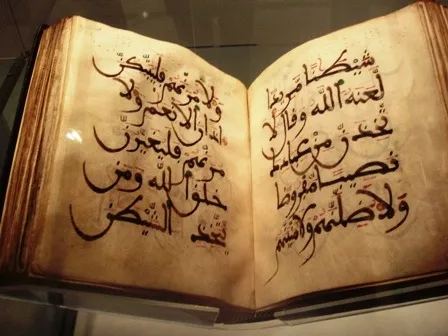
Written record: Scribes among the companions, most notably Zayd ibn Thabit, wrote down the revelations on whatever materials were available: parchment, palm leaves, flat stones, and bone.
After the Prophet’s (peace be upon him) death, the caliph Abu Bakr, concerned by the loss of reciters in the Battle of Yamama, ordered these written fragments compiled into a single manuscript under Zayd ibn Thabit’s supervision. Later, the caliph Uthman ibn Affan oversaw the production of standardised copies of this manuscript, which were distributed to major Muslim cities to ensure uniformity, as the Muslim community was expanding rapidly across different regions. This Uthmanic text is essentially identical to the Quran read by Muslims today, a continuity Muslims regard as strong evidence of the text’s careful, faithful preservation.
For Muslims, the question “who wrote the Quran?” rests on a premise that doesn’t quite fit the belief itself: the Quran was not written in the way a book is written, but revealed, recited, memorised, and transcribed under divine guidance. Muhammad (peace be upon him) is the messenger, not the author; the companions are its careful preservers, not its editors; and the Uthmanic codex is a testament to the community’s dedication to safeguarding the text exactly as it was received. This is why Muslims refer to the Quran as Kalam Allah, the Speech of God.
👉🏽 Click HERE to get your copy!