European companies count the costs and gains of extreme heat
Unlock the Editor’s Digest for free
Roula Khalaf, Editor of the FT, selects her favourite stories in this weekly newsletter.
The number of European companies flagging the impact of extreme weather on their businesses has jumped as a series of severe heatwaves boosts demand for some products but interrupts other business activities.
Terms related to extreme heat, drought and wildfires were mentioned on a record share of earnings calls in recent weeks — one in 10 — for European companies with more than $1bn in market value, according to data from AlphaSense.
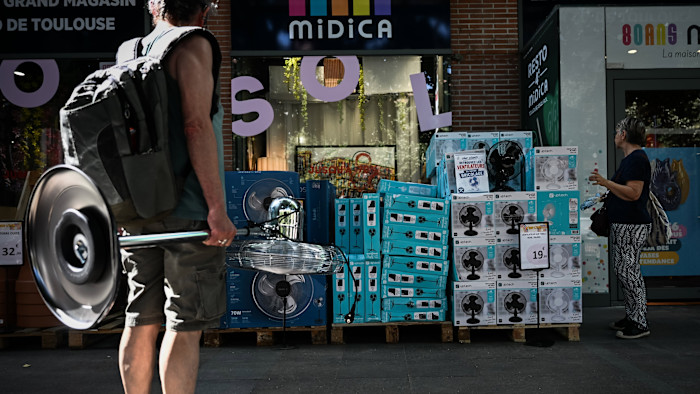
Several manufacturers said the heatwaves had increased demand for their products, including not only pools, air conditioning and sun cream but also groundwater pumps and electricity generators.
The finance director of appliance maker Groupe SEB said it had sold 30 per cent more fans in Europe in June compared with the previous year.
June was the biggest-ever month for sun protection sales in the history of the German multinational skin and personal care company Beiersdorf, its chief executive told the FT.
The chief sustainability officer at Fluidra, a Spanish pool manufacturer, said its products were “a climate refuge . . . that’s a long-term opportunity for the company.”
The executives at Swedish-headquartered Beijer Ref, which supplies refrigeration and air conditioning, noted that its biggest increase in demand was coming from newer markets in central Europe, the UK and France.
Several companies also said they had already made or anticipated a shift in their businesses to adapt to hotter summers, either with new products or new working practices, as a recognition of climate change.
Roisin Currie, chief executive of food chain Greggs — which last summer issued a profit warning as high temperatures in the UK hit sales — said its new line of iced drinks had helped it weather a second scorching year.
The chief of Dutch engineering group Koninklijke Heijmans said it could not rule out its policy of cold-weather leave for workers being replaced by a hot-weather one, as 35C temperatures forced crews to down tools.
Sophie Boissard, boss of nursing home provider Clariane, said it would “prioritise and accelerate” €10mn of investment into air conditioning, especially in northern Europe, saying it had seen a 15 per cent increase in short stays as families sought to drop off relatives in heat-safe places.
Companies were more divided on whether the sweltering conditions on the continent this summer were the start of a “new normal” or an aberration.
The boss of German pump manufacturer KSB said it experienced a “surge” of orders from farmers needing to extract deeper groundwater during a drought. “I fear this hot summer will not be [a] one-off . . . [but] probably a new era,” Stephan Timmermann told analysts this month.

Benoit Bazin, chief of Compagnie de Saint-Gobain, which makes building materials, said “climate adaptation is an urgent need”, pointing to widespread disruption of schooling in France during the heatwave.
UK energy supplier Drax said it would be increasingly challenging to get cooling water for its nuclear plants in summer. “It’s probably something we should have, and will be, expecting to be the new reality,” said chief executive Will Gardiner.
“2026, to me, is a tipping point,” Catherine MacGregor, the boss of French utility company Engie, said in July. “[The] climate . . . is becoming less predictable, more extreme.”

Some companies, however, said the hot weather was an unusual event that required no change to their business model.
Daniel Ervér, chief of clothing brand H&M, said the heatwave had boosted interest in its summer collections but warned that over time weather-related effects on sales tended to be “neutral”.
Stephen Heapy, chief executive of budget airline Jet2, said: “I’m sure the hot weather will pass, certainly in the UK, and we’ll get back to our normal summer, which is a lot cooler.”
Ryanair boss Michael O’Leary said: “As someone who put his wife and children on flights to Portugal yesterday, despite a prolonged heatwave here in Ireland, the Europeans are all still going to the beaches of Portugal, Spain, Italy, Greece, et cetera. I don’t see that changing . . . [L]ook, one summer is not going to make any huge difference.”